
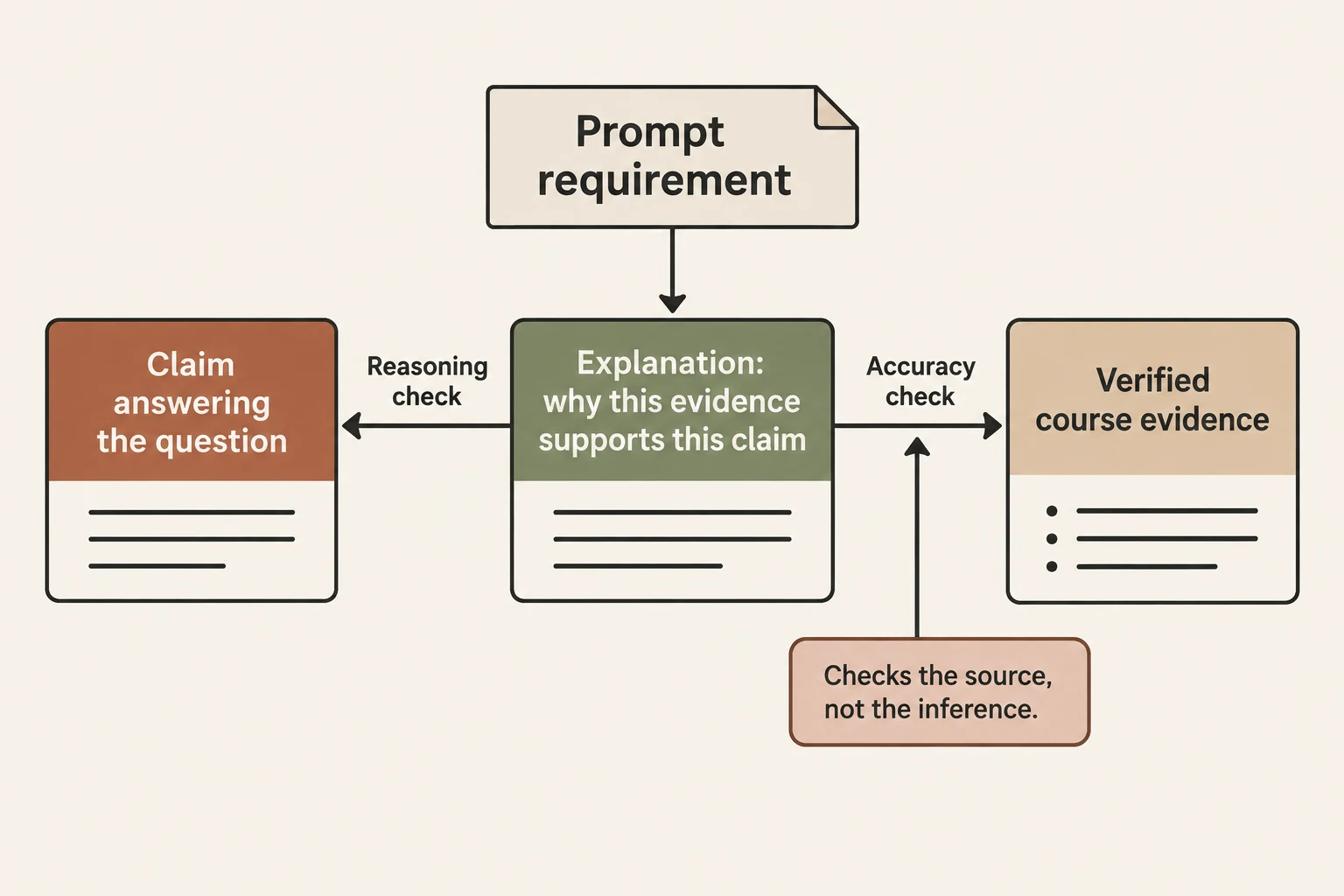
First pick a prompt from your course and write out as little as possible while revealing what you are bad at. Check your knowledge, how you answered the prompt and your reasoning. Write out a timed answer to see if everything works together. You will not be able to know what your score is on a test but at least know what you need to work on.
1. Extract the prompt’s required thinking
Pick a prompt from your course. Make sure to know what your answer needs to do and not just know what the question is about. You can use any of the review questions your professor may give you or previous prompts. If you decide to make your own question based on your learning objectives and notes. Know that the question may not represent the level of the test. You can practice reasoning with your made up question but it may not be reflective of the test.[3]
Reword the question into something that can be measured. Example "Which is better explained" becomes "Using information from your course explain why you think one is better than the other. State why you believe your conclusion." You may need to summarize both to explain your conclusion. But your practicing should be reflecting what is being asked on the question and not what it is about.[1]
Take that sentence and look at your rubric/ learning objectives and what your professor told you. Make sure to note what you know for sure and what you don't know. "Give an example from your course" is a must if it's on your rubric. "Give 3 examples" is something you assume. Take notes from your professor that may help but do not assume it's needed for every assignment. Command words will give you hints on what to include but figure out what your professor wants when they say "evaluate".
Don't try to fit every answer into an essay. You can argue a thesis with historical information and there may be many right answers. Law usually consists of identifying problems and laws that apply. Then applying those laws to a situation. By only practicing writing a thesis you are not practicing all of these skills. Know what type of answer your professor expects.[4][6]
You want to know what you need to do to answer the question. What you know to do and what questions you still have that could impact your studying. Do I need to know certain authors or quotes. How much do I need to know from my course. Do I need to evaluate or mention what someone else thought. Don't waste your time studying things that won't help you on this test.
2. Write the output your weakness requires
Decide to write out your thesis, outline, paragraph or full answer. Depending on what you were struggling with previously. Universities recommend outlining with your thesis and examples as well as writing full answers. The following table can help you decide what to do but it's not a proven method or what you need to do every study session.[2][3]
| Practice output | Use it when | Inspect | What remains untested |
|---|---|---|---|
| Thesis or direct answer | You explain the topic but avoid answering the question. | Does it answer the exact question, with a defensible qualification? | Whether you can substantiate it or finish on time. |
| Evidence-bearing outline | You omit required parts or cannot decide what belongs where. | Each section’s claim, specific evidence, and intended contribution. | Whether the written reasoning will actually connect those parts. |
| Evidence-linked paragraph | You list facts or quotations without explaining their significance. | The inference connecting evidence to the paragraph’s claim. | Whole-answer coverage, balance, and completion. |
| Full timed response | Fragments work, but the complete answer is unfinished or disjointed. | Coverage, connected reasoning, and completion under exam rules. | Performance on other prompts or the instructor’s likely grade. |
Make your outline more helpful than just writing what your paragraph is about. Instead of writing "resources" write something you want to say about resources. What example from your course you could use and what it will show. If all you know is that it's about resources then you don't have enough to support your answer. Write out why your example will prove your conclusion in a paragraph.
Study with your allowed materials during your test. Writing out a paragraph with open notes will allow you to see if you can construct an argument. Once you have that figured out write out your full answer in the amount of time you will have on your test. This includes time to plan and revise your answer. Just because you can answer parts of the question does not mean you can answer all of it.
3. Check claims and revise one defect
Save your original answer and go through your materials. Make sure your answer is correct by looking up anything you stated as fact. Definitions, quotes, what someone said or thinks. If it's not correct cross it off. Go over your writing and compare it to the question. Your writing may be correct but you didn't answer the question, you missed part of it or didn't explain why you think that.[2]
Go over relevance, logic, answering all parts of the question and organization. See if each paragraph addresses a part of your question. Underline what sentence shows why your example proves your point. Be able to point to what you wrote that answers each part of your question. You may have mentioned it but did you actually address it. Read your thesis and what each paragraph says. Are you building an answer or do you have different conclusions that aren't explained?
Inspect the reasoning, not just the facts
Example made up all facts made up. Prompt states does Team A win because of leadership or resources? Given facts Team A has a greater supply of resources and has a new leader. Practice response states “Because team A had greater supply of resources it was more likely due to resources.” Fact is related to question but goes beyond the given fact.
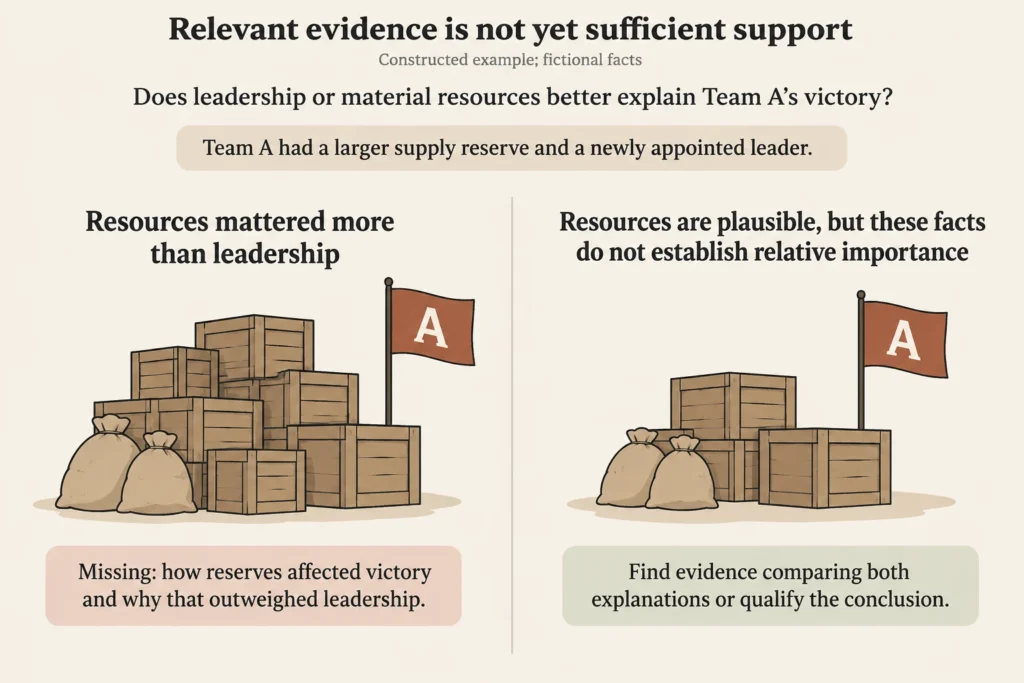
We need to know how having greater supply of resources helped them win. Why it helped them win more than the new leader. We could have a fact that says they did not run out of supplies and could have said that was what helped them win. To say it helped them win more than their leader we would need to analyze the new leaders impact as well. By adding facts about supply we would not be able to reach that conclusion.
Using only the given facts we can only repair our statement to. “I think resources helped Team A win. However we do not have enough information to conclude it was more influential than the leader.” This shows us what facts we would need to prove our claim. When practicing go back to your material and find facts that can help you answer the question. Revise your response if needed. If you are unable to determine which factor was more helpful state that we don't have enough information to know which was more beneficial.
Separate missing knowledge from writing difficulty
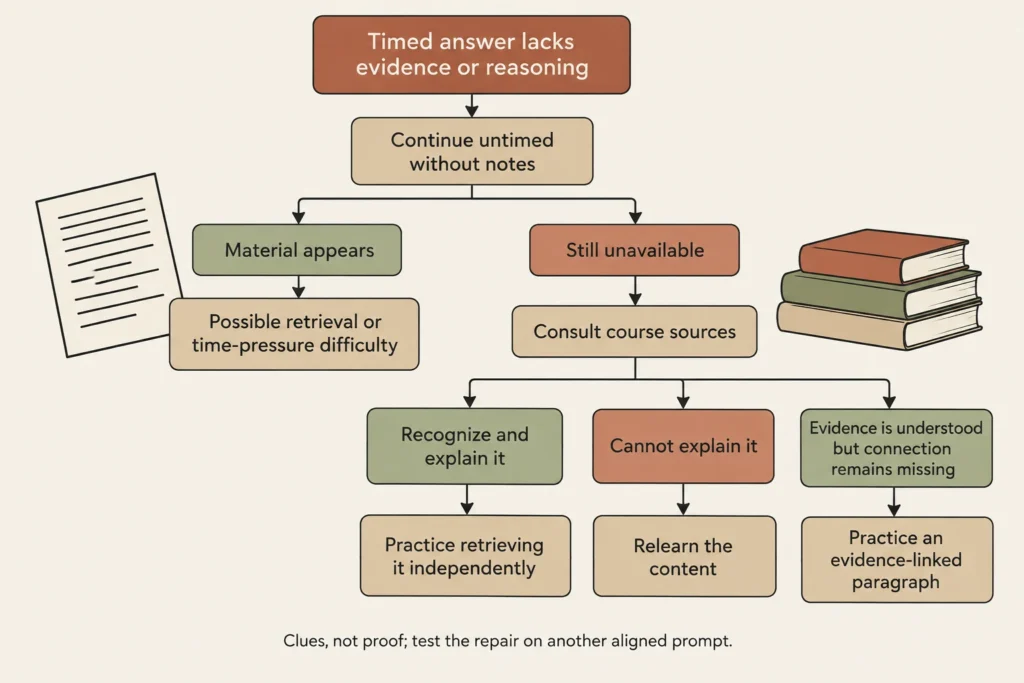
When you complete the prompt without any time and no information or thoughts were produced. Try doing it again with more time but still no notes. If you are able to retrieve this information when given more time than you probably need to study more or you have trouble under time pressure. If you still cannot retrieve this information use your notes. You will want to identify if its something you can remember just can't recall when it's being asked. Or if you don't know the information at all. These are general hints on what you might need to work on.
If you can find evidence to back your claim. But can't figure out how to apply that to your response. Practice writing paragraphs using evidence to back your claims. If you can outline the prompt without time and when you do it with time you aren't including all aspects of your response. Try writing out a small paragraph with evidence before you start. Find one major error keep your fixed paragraph and try on another prompt similar to the one you had trouble with. You may be able to improve your original answer by having more time and familiarizing yourself with the prompt.
Self grading should be used to find what you need to fix. Not tell you what percentage you will get on your exam. There is research about self assessment and using it to better your responses. It doesn't show that self grading can be used to predict grades. There are some things you can evaluate about your work that will help you know if your correct or not.[5]
Ask your instructor if you feel like your analysis may not be in depth enough. Give them the prompt and your paragraph “This is what I think will answer the question. Do you feel that I am analyzing the question enough for my exam or should I be finding other factors.” Maybe your not sure if your using your sources correctly. Ask if just citing the authors name and restating what they said will suffice or if I need to directly quote them. Whatever they tell you will allow you to change something in your practice responses.
Sources and references
- Carnegie Mellon University, Eberly Center: Why should assessments, learning objectives, and instructional strategies be aligned?
- Purdue University, OWL: Writing Essays for Exams
- Trent University, Academic Skills: Studying for Essay Exams
- University of Iowa, Department of History: Taking Exams
- Frontiers in Education; Heidi L. Andrade, University at Albany: A Critical Review of Research on Student Self-Assessment (2019-08-27)
- Georgetown University Law Center, Writing Center: Tips for Writing a Law School Exam