

Independently attempt a problem if it would help you learn something new and relevant, and possibly change your approach. If not, see if course staff is available. They can help you find your next move, and in the process determine if there are relevant unknowns you could test yourself. However, it’s best not to waste time trying random things in the hopes of figuring out what to do. In most cases, the answer to the uncertainty could have been learned with course staff's help.
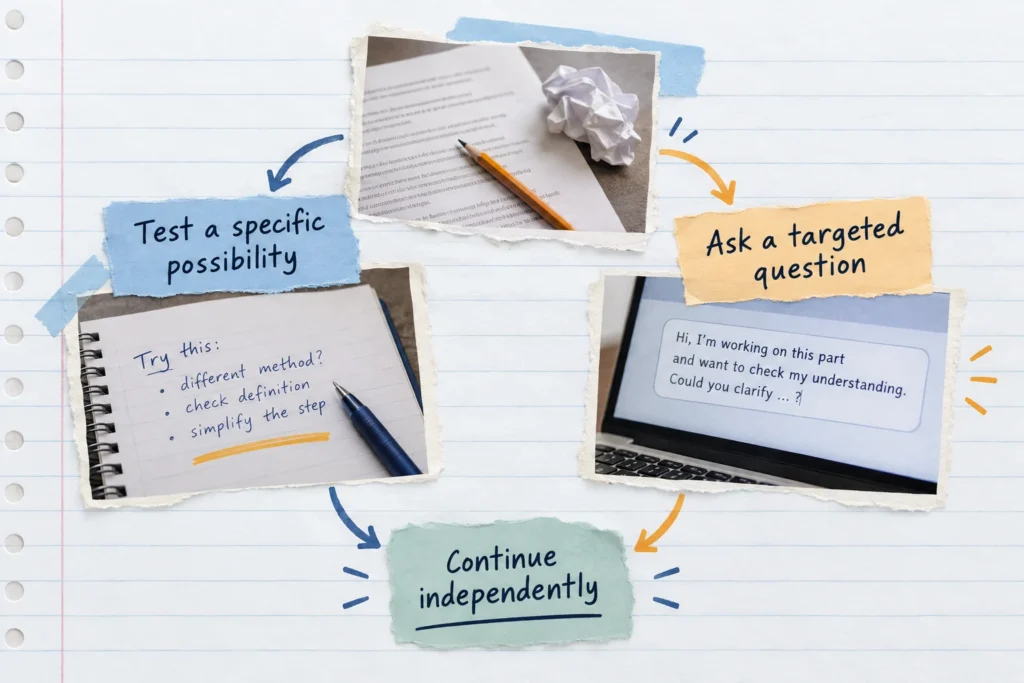
Give the next attempt a question to answer
A useful retry changes something relevant, not just your level of concentration. In a hypothetical programming assignment, “Maybe my loop skips the final item; I’ll trace it on a two-item input” tests a suspected cause. If the final item is processed correctly, you can look elsewhere. Running the same failing program again without a change or a new observation tells you much less.
Picture me, in an imagined example, staring at an essay prompt that says “use three sources.” My draft has three scholarly articles, but the rubric mentions primary evidence. I’m irritated enough to start searching for replacements, then stop. Another search won’t tell me whether primary sources are required. I send that question to course staff and keep drafting the section whose requirements are clear.
That’s the distinction I care about: can your own work resolve the uncertainty? Stanford’s CS103 office-hours guidance encourages explaining attempted approaches, but also allows asking how to proceed when you have no idea what to try. You don’t need a polished diagnosis before you’re allowed through the door.
The guidance for Stanford tells us about deadline-adjacent queues. Your access to your course may vary. It is a good idea to send your question and continue working on the part of the assignment that doesn’t require the part you’re stuck on. There’s no rule that says you can’t ask for help and try to work out the problem yourself. It may be best to ask for help when you don’t displace an important, time-restricted opportunity to do so.
Ask someone who can resolve this particular obstacle
| What’s blocking you? | Who to approach | What to ask for |
|---|---|---|
| An unclear requirement, rubric, or permitted method | Instructor or designated course staff | An authoritative clarification; a tutor’s guess cannot settle the requirement. |
| A course-specific concept or reasoning step | TA or instructor through the course’s help channel | Help locating the first unsupported step and a hint about what to consider. |
| A known skill gap, such as rearranging an equation | An authorized tutor | An explanation and practice on the skill, rather than completion of assessed work. |
| A concept you want to discuss aloud | A peer, only if that discussion is permitted | A conceptual exchange within the assignment’s collaboration limits, not a completed answer. |
Before you enlist the help of a tutor or peer, you should see if your professor allows students to discuss, view, or receive help for the part of the assignment you’re stuck on. If you are unclear on what the professor is allowing, ask the professor before you ask your classmates. UC Davis states that they are not allowing students to work with their peers, but they can get help from a TA. Princeton says their students can’t get help with their schoolwork from people who aren’t employed by Princeton, not for academic requirements.
Tutoring is just one way you can get help. You should do research to find out what is allowed for you to receive help at your college. You should know those rules before you turn to tutoring.
Bring the stopping point, then take the work back
Bring the prompt, your attempt, and the point where your reasoning stops. The University of Washington’s CLUE guidance says tutors will ask you about your approach and provide hints and leading questions. A clear and direct request provides a helpful starting point for that conversation:
If you’re not able to give as much detail as that, then say something like, “I'm able to follow the example, but I don't know how to take a starting approach here," and show what you've tried. Research defines help as the distinction between guidance that helps an individual complete a task independently versus helping an individual to solve the task. Providing that type of help is a better goal, rather than a moral judgment or a grade guarantee. A 2021 review of the literature concluded there was little to no evidence of the university achievement gap.
After your helper has provided their steps to you, attempt to do the block step you previously couldn't do, and explain why you think that step is correct, and continue. If you get stuck again, bring that exact same step. I'd take independent return of that step and the pause it provides over the reassurance of an explanation that seems clear. That suggests progress is being made, even if that progress and the entirety of the example doesn't prove mastery.
Sources and references
- Sustainability; researchers at Universitat Rovira i Virgili: Help-Seeking in an Academic Context: A Systematic Review (2021-04-16)
- Stanford University: CS103 Guide to Office Hours
- University of Washington Academic Support Programs: CLUE Tutoring
- University of California, Davis Student Conduct and Integrity: Collaboration: When You Can and When You Can’t Work with Others
- Princeton University Scholarly Integrity: Tutoring