

Yes, but the useful boundary isn’t how often you open an AI tool, because what matters is whether the tool improves what you can later retrieve, explain, solve, or write without it. If a polished response clears up tonight’s confusion but leaves you unable to make the same mental move tomorrow, the convenience was expensive.
I’ve caught myself reading a smooth explanation, thinking “yes, obviously,” and discovering once the tab was closed that I couldn’t reproduce the reasoning, a gap that’s easy to miss because recognition feels pleasantly like understanding. Here, “dependent” simply means relying on AI in ways that weaken your unaided performance, not a medical or psychological diagnosis.
Retrieval attempts matter for durable learning even when they feel slower than reading a ready-made answer, and emerging AI research is more mixed than either enthusiasts or critics sometimes admit. One 2025 randomized study of Brazilian undergraduates studying AI and machine-learning content found lower delayed performance after unrestricted ChatGPT-assisted study, while another experiment with college students learning cardiovascular content found stronger transfer with feedback designed to prompt reflection than with comparison feedback, which doesn’t settle every use case but gives me a practical reason to avoid unrestricted answer delivery during initial learning.
Use the support-or-substitution test before you prompt
Course rules control the decision because an educationally reasonable use can still be prohibited for a particular assignment, so check the current syllabus, assignment sheet, rubric, and disclosure requirements rather than assuming that silence means permission.
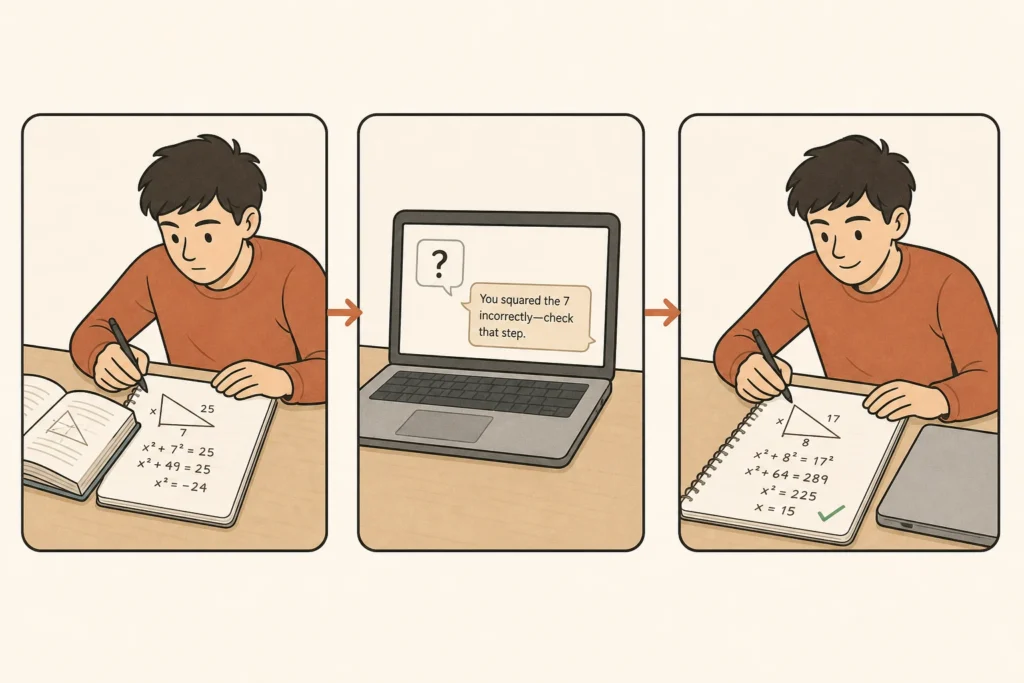
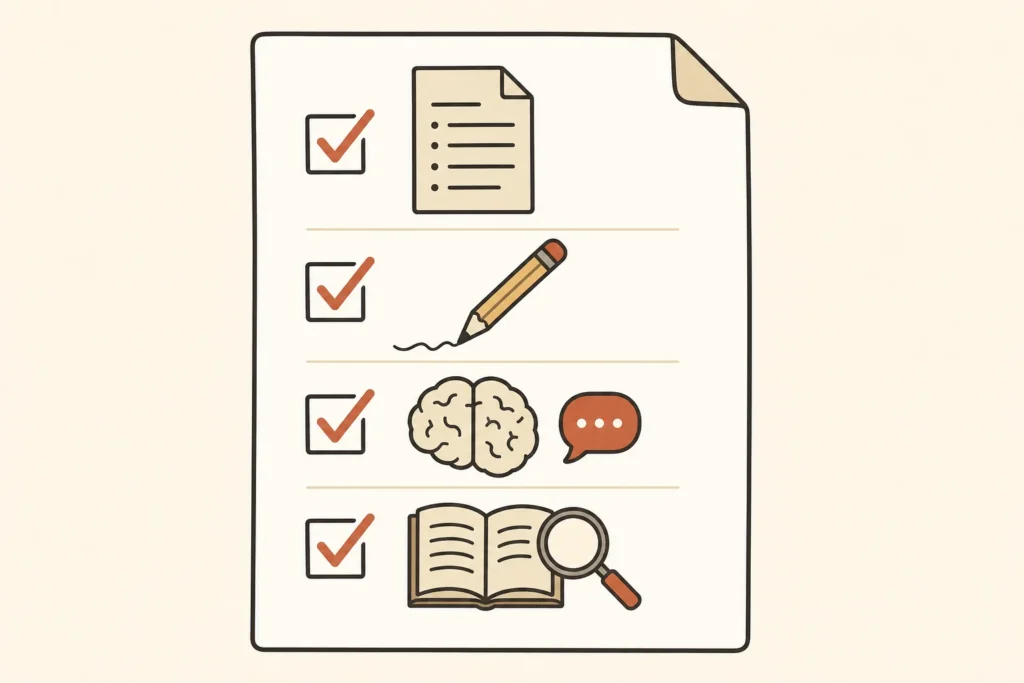
If the policy doesn’t expressly permit your intended use on assessed work, treat AI-generated content and feedback as unavailable for that task. An effective study technique isn’t automatically an allowed assessment technique, and for independent practice the dividing line is effort: prompting, questioning, checking, and explaining once you’ve tried can support learning, while supplying a complete version often substitutes for it.
Helpful AI use leaves the important thinking with you
The same feature can support learning in one sequence and bypass it in another. I don’t love how AI summaries can make a skipped reading look oddly well organized, because a neat set of bullet points is not evidence that you can evaluate the original argument.
| Study task | Use AI as support | AI becomes substitution when it… |
|---|---|---|
| Explanation | State your understanding first, then ask what is missing | Provides the explanation before you try |
| Problems or coding | Diagnoses your first wrong step or gives a comparable problem | Completes the solution before an attempt |
| Reading | Compares your summary with the original material | Becomes your only exposure to the source |
| Writing | Questions your outline or identifies an unclear passage | Produces prose, arguments, or citations you submit as your own |
| Practice | Quizzes you one item at a time, then explains errors | Reveals answers immediately or supplies an unchecked answer key |
Check generated questions and flashcards against your lectures, textbook, or instructor materials for terminology, scope, difficulty, worked steps, and answer keys, then remove anything outside the course. Accessibility accommodations and instructor-approved scaffolds may permit more substantial assistance, but the support should still preserve the learning objective you’ll ultimately need to demonstrate.
Use a verify-first study loop
I get frustrated by advice to “double-check later,” because verification works better as part of the study session, while the AI response can still be kept separate from your notes and submission.
- Preserve your attempt. Retrieve the idea, outline the response, or begin the problem using only the materials allowed for that task, then mark the precise sentence, step, or concept causing trouble.
- Get bounded help. Request one diagnostic question, an explanation of your error, a hint, or a comparable practice problem rather than a finished answer. For example: “Ask me one question that will help me find the wrong assumption, but don’t solve the problem.”
- Verify the output. Check factual claims and worked steps against course materials, and open every cited source to confirm that it exists and actually supports the claim. A plausible title and functioning link are not enough.
- Retry without AI. Close the chat, redo the task, explain the idea aloud, or solve a comparable problem, then record what still breaks down so the next session begins with a specific gap rather than another broad request for help.
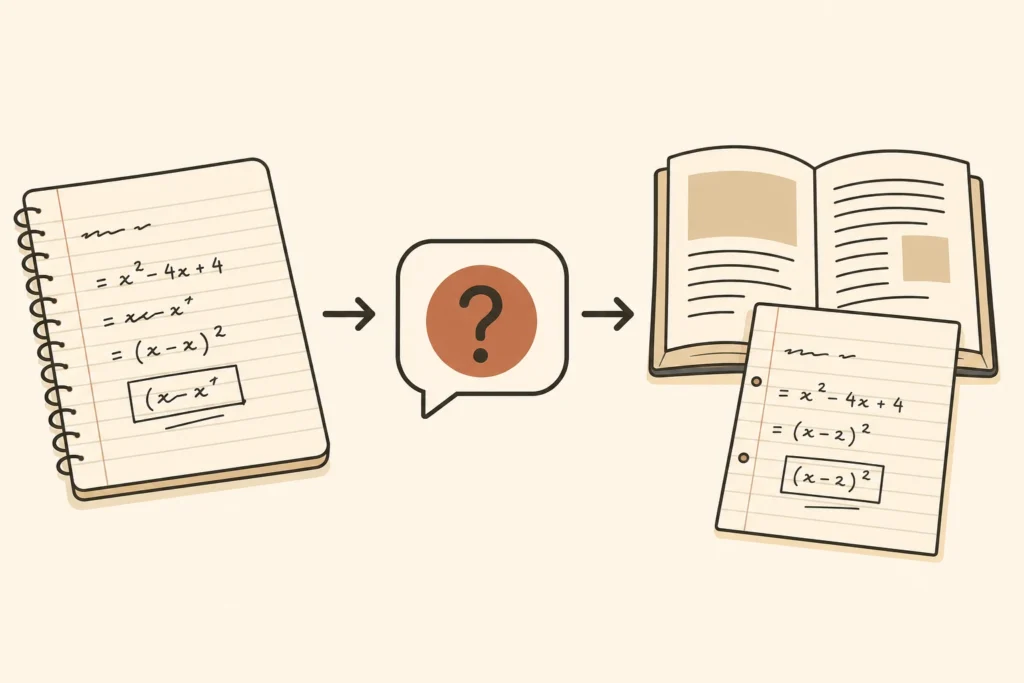
On a Tuesday evening, this could mean attempting two physics problems, asking AI to identify the wrong assumption in one, checking that explanation against class notes, and solving a third similar problem with the chat closed. That third problem, not the polish of the AI explanation, is the useful evidence.
Protect the skills you’ll need when AI is unavailable
Reserve some study time for unaided retrieval and practice, especially before closed-book exams, timed tasks, oral explanations, and foundational problem sets. If an answer seems obvious while the chat is visible but disappears when you close it, you have recognition, not dependable recall, so the next block should be retrieval or targeted practice without AI.
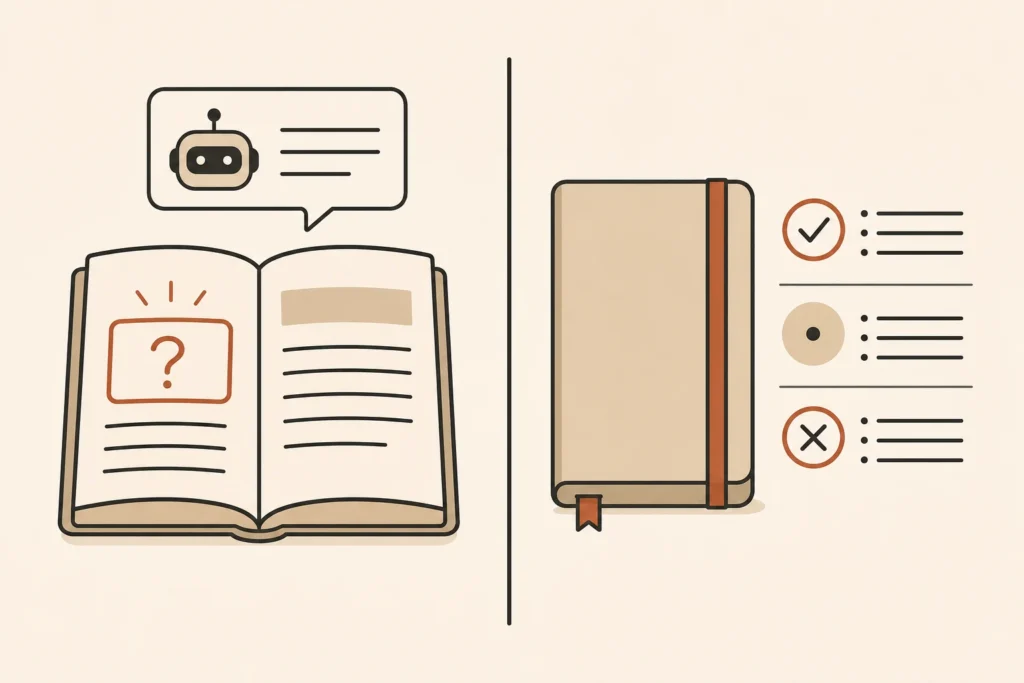
A failed unaided retry isn’t a judgment about your discipline, it simply shows which material belongs in one of three small lists: “can do alone,” “can do with one hint,” and “cannot yet do.” Practice the first category without assistance, use AI for feedback on the middle category only once you’ve attempted it, and revisit course explanations or simpler prerequisite work for the third, because AI is helping only when each prompt makes you less dependent on another answer.
Sources and references
- Cornell University: Cornell Center for Teaching Innovation, “AI & Academic Integrity”
- Northwestern University: Northwestern University Information Technology, “AI Study Buddy” (2024)
- Science: Karpicke and Roediger, “The Critical Importance of Retrieval for Learning” (2008-02-15)
- Social Sciences & Humanities Open: Barcaui, “ChatGPT as a Cognitive Crutch: Evidence from a Randomized Controlled Trial on Knowledge Retention” (2025)
- npj Science of Learning: Yin et al., “Effects of Different AI-Driven Chatbot Feedback on Learning Outcomes and Brain Activity” (2025-04-15)