
How Can I Practice for an Exam When My Course Gives Me No Practice Questions?
>
You can finish the readings, review every slide, and still have no honest answer to the question that matters: Could I do what the exam asks without the material in front of me? When a course provides no practice questions, rereading becomes an easy fallback because there is nothing obvious to attempt.
Build practice from the clearest evidence the course gives you. Learning objectives, assignment instructions, rubrics, repeated homework formats, and reasoning modeled in class reveal whether you are expected to recall, explain, analyze, or apply. They cannot reveal the exact exam, but they can give you a credible form of rehearsal.
Start with the strongest signals
Give the most weight to materials that show what students must produce: objectives with verbs such as “compare” or “justify,” grading criteria, assignment prompts, and tasks the instructor repeatedly demonstrates. Worked examples and homework show the choices you may need to make. Chapter headings, bold terms, and long slide decks identify content, but they often say little about how that content will be tested.
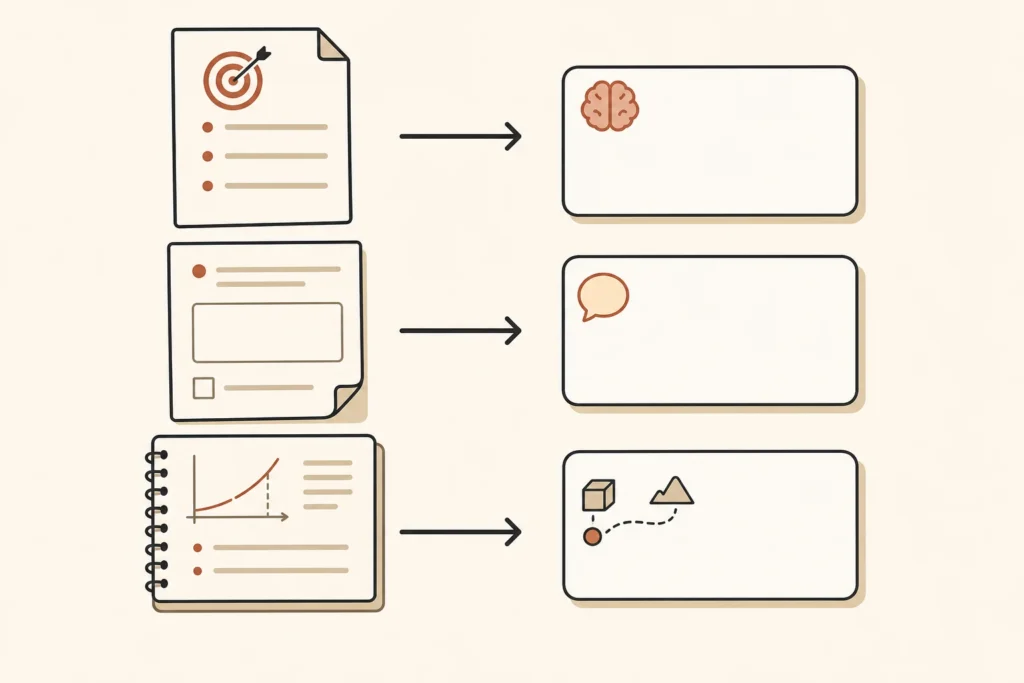
I once spent an evening at a kitchen table turning bold slide terms into index cards, then noticed that the assignment rubric kept asking for comparisons and justified conclusions. Half the cards went back into the drawer, and the next session became short comparison prompts instead.
Match the self-test to the course action
The same notes can produce very different practice. Choose the prompt shape from the work your course has demonstrated.
| Course demand | Prompt to make | How to check it |
|---|---|---|
| Recall | Define, label, list, or reconstruct from memory without choices or hints. | Compare with the course definition, diagram, or required components. |
| Explanation | Explain why, how, or what would change if one condition changed. | Check whether each causal link appears and uses course concepts accurately. |
| Analysis | Interpret a source, compare cases, or defend a claim using evidence. | Use the rubric, model response, or prior feedback to check claim, evidence, and reasoning. |
| Calculation or application | Choose a method for an altered problem or apply a concept to a new scenario. | Check the method choice, work, result, and interpretation separately. |
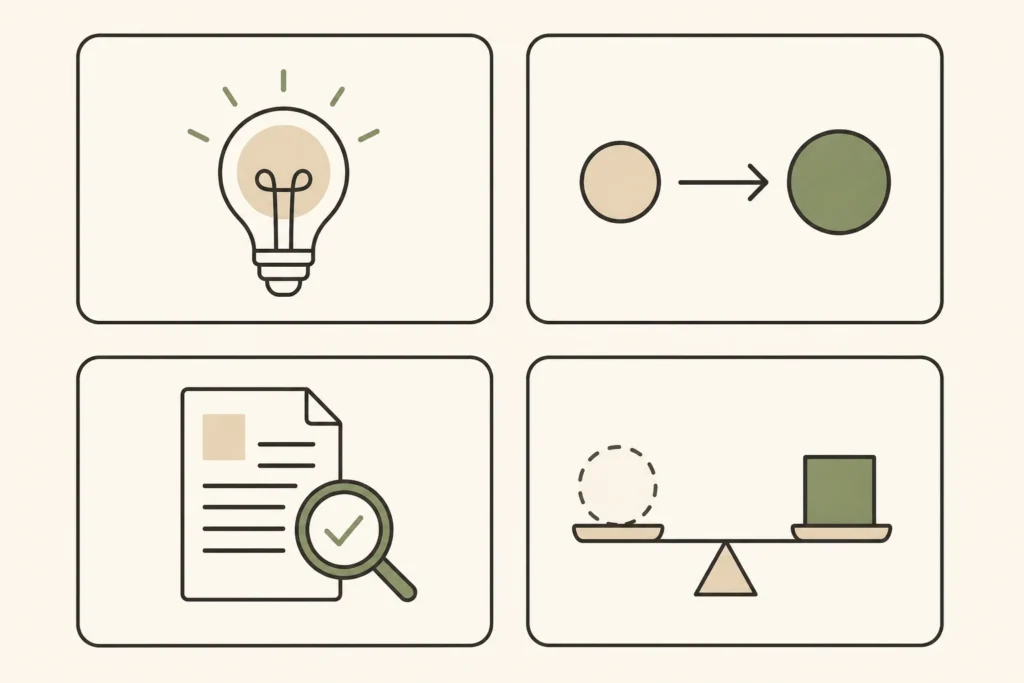
Retrieving an answer before looking at the material can improve later retention and transfer compared with repeated study alone. That does not make every homemade question useful. A definition card is poor preparation when the course repeatedly asks you to interpret evidence or select a method.
Change the decisions in homework
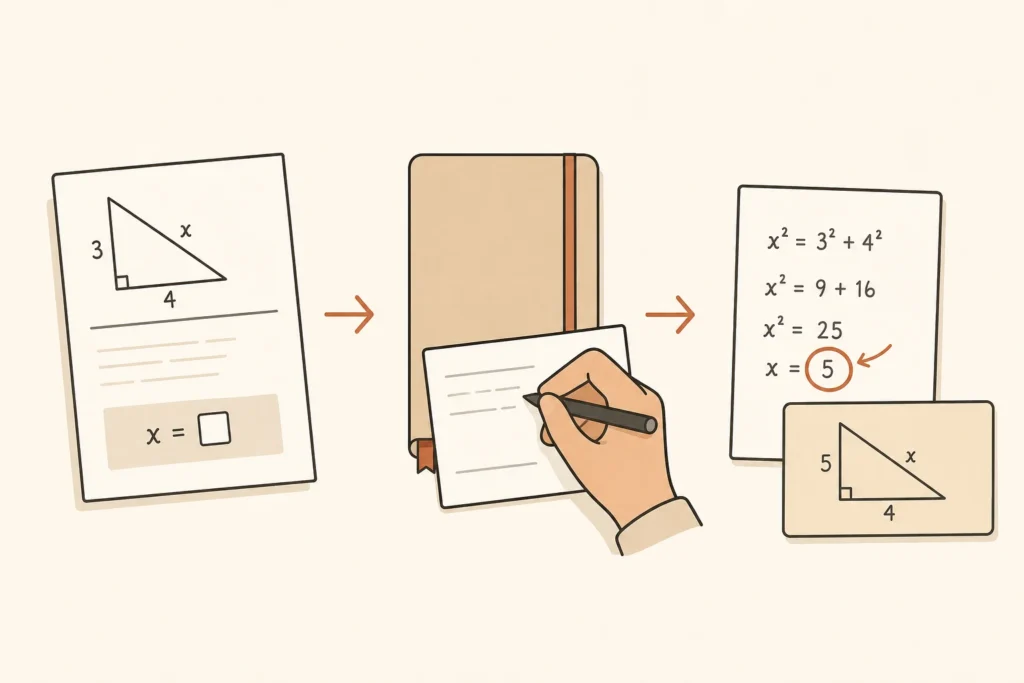
Do not copy a homework question and preserve every clue that made the original manageable. Change a condition, remove the method label, combine it with an earlier topic, or ask what would make a different method appropriate. With a worked example, cover the solution and attempt the first consequential choice before reading further. Then solve a nearby variation from the beginning. Difficulty should come from making relevant decisions, not from obscure wording or arithmetic clutter.
A messy set of course clues
Suppose a biology lecture on population growth contains 42 slides, several memorable wolf photographs, and a dozen bold terms. The objective says, “Compare exponential and logistic growth and explain the effect of resource limits.” Homework asks students to choose an equation and interpret a graph, while the lab rubric rewards claims supported by patterns in the data. One earlier quiz was mostly definitions, so the exam’s weighting remains unclear.
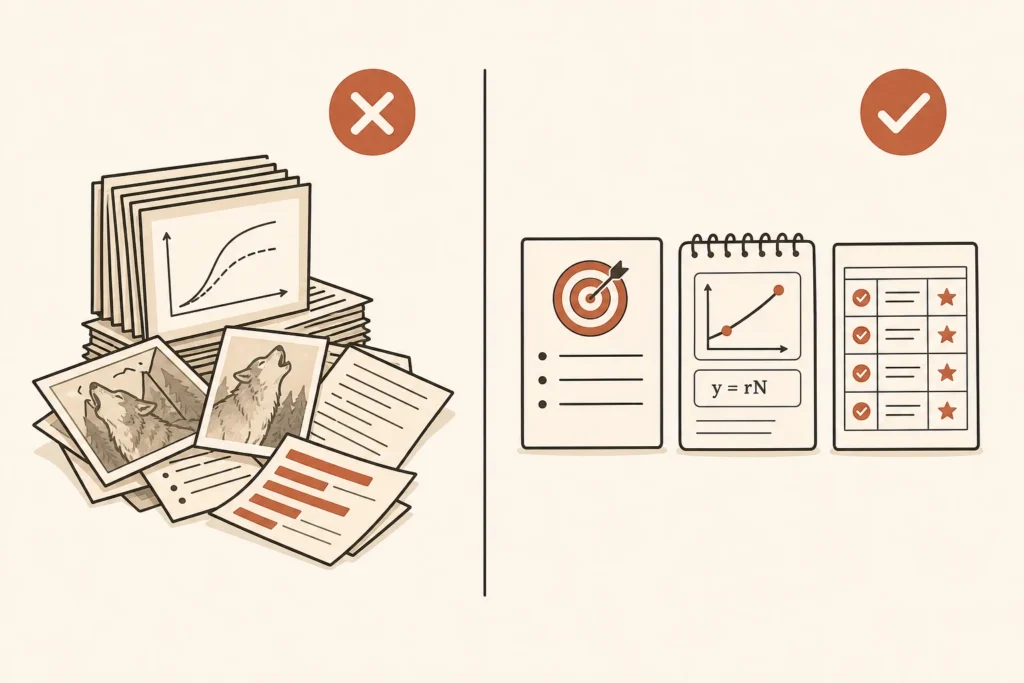
The photographs are distracting evidence; the objective, homework choices, and rubric matter more. A reasonable three-question set would ask the student to sketch both growth patterns from memory, explain what changes as a population approaches carrying capacity, and choose a model for an altered scenario before calculating and interpreting the result. Definitions still appear, but they do not consume the whole session merely because the quiz favored them.
During the closed-note attempt, the student remembers both formulas but chooses exponential growth even though the scenario says food is becoming limited. Checking the homework and worked example reveals a method-choice problem, so the next prompt uses a different species and again withholds the model name. This time, the student must justify the model before calculating. If the written explanation still seems debatable, the rubric can check its parts, but confidence alone cannot settle its quality.
Let the miss change the next attempt
Check only after committing to an answer. A wrong fact calls for a focused retrieval prompt later. A missing explanatory link calls for another “why” or “what changes if” question. A wrong method choice needs a new problem where the method is unnamed. An open response that you cannot judge needs a rubric, prior feedback, or outside calibration. Checking and feedback are part of useful practice; otherwise, a self-test can rehearse the same error with increasing confidence.
Office hours can clarify the expected performance without asking the instructor to reveal the test. Bring one prompt and ask, “I made a question that requires me to choose a model, calculate, and interpret the result. Is that close to the level of reasoning we should be able to show, or am I emphasizing calculation more than explanation?” The response can adjust your practice even when no sample question is available.
Your next study session
Take one recent lecture and one related assignment. Choose a course verb, find one task the instructor has already required, and write three prompts: one short retrieval check, one explanation or interpretation, and one altered version of the assignment task. Attempt them with the expected resources closed, check them against course material, and use the clearest miss to write one question for the following session. That is enough for a credible first practice set; it does not need to resemble an unofficial full-length exam.
Sources and references
- PubMed / U.S. National Library of Medicine record for Journal of Experimental Psychology: Learning, Memory, and Cognition: Butler, “Repeated testing produces superior transfer of learning relative to repeated studying” (2010-09)
- Carnegie Mellon University Eberly Center: Why should assessments, learning objectives, and instructional strategies be aligned?
- Princeton University McGraw Center for Teaching and Learning: Preparing for Exams
- Oregon State University Academic Success Center: Better Ways to Study
- PubMed / U.S. National Library of Medicine record for Journal of Professional Nursing: Testing enhances learning: A review of the literature (2018-05)