
Your study group can get every answer right while you still struggle with the homework alone. Check its value by keeping your own first attempt, discussing the reasoning, and trying a fresh task independently. What you can do afterward matters more than how smoothly the meeting went.
1. 1. Start separately
**Choose a task that resembles your course assessments, and have everyone attempt it privately.** Pick something worth discussing: choosing a method, explaining a concept, defending an interpretation, or finding an error. Save each person's answer and reasoning before anyone shares.
Use material you're allowed to discuss. Permission to practice together may not extend to jointly completing graded assignments; check the course's collaboration rules and clarify any uncertainty about the particular task.[3]
Consider a hypothetical algebra student whose group finishes worksheets easily, but who gets stuck alone. On 2(x + 3) = 14, their private attempt becomes 2x + 3 = 14, giving x = 5.5. That page exposes a specific problem: distributing the multiplier.
2. 2. Compare the reasoning
**Give each person a turn explaining a consequential step.** Watch for answers announced before others attempt, agreement without explanation, or the same person choosing every method. These are participation problems you can change, not personality verdicts. Check disputed reasoning against course materials.
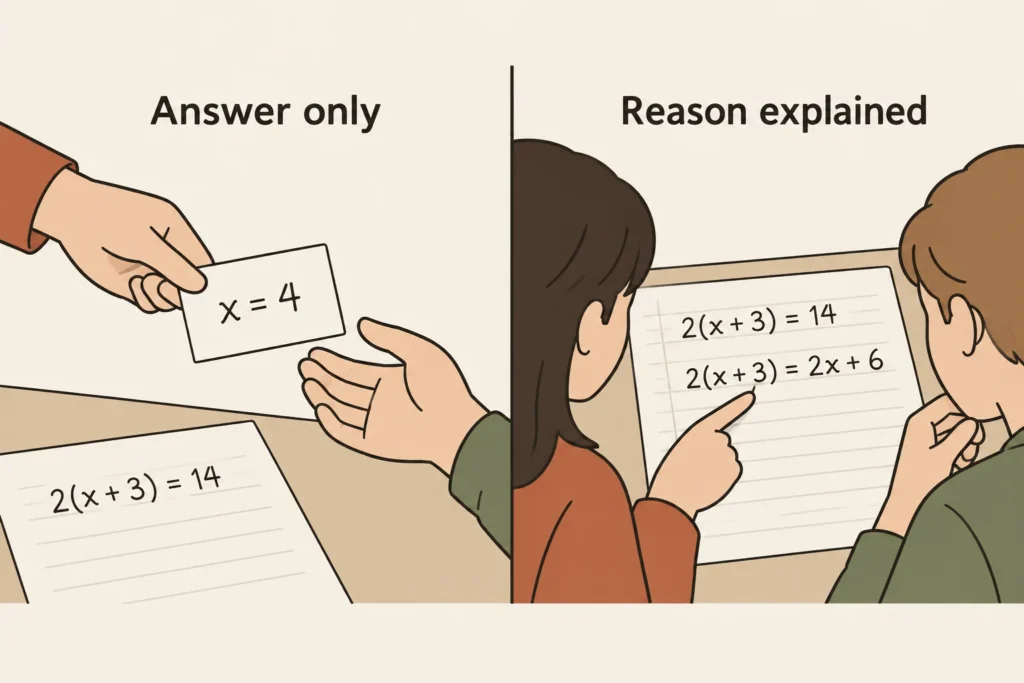
In the hypothetical group, a confident classmate announces x = 4 and everyone nods. The answer is correct, but the student's mistake remains unexplained. Change the turn: ask that student to explain the distribution while a peer checks it. With feedback, they write 2(x + 3) = 2x + 6 and explain why both terms receive the multiplier. That's useful discussion, though still assisted work.
3. 3. Try a fresh task alone
**Attempt a different task with the same underlying demand, without classmates' help.** Put away the group's solution and use only resources your assessment permits. Repeating the original answer checks too little; choosing a much harder problem makes the comparison misleading.
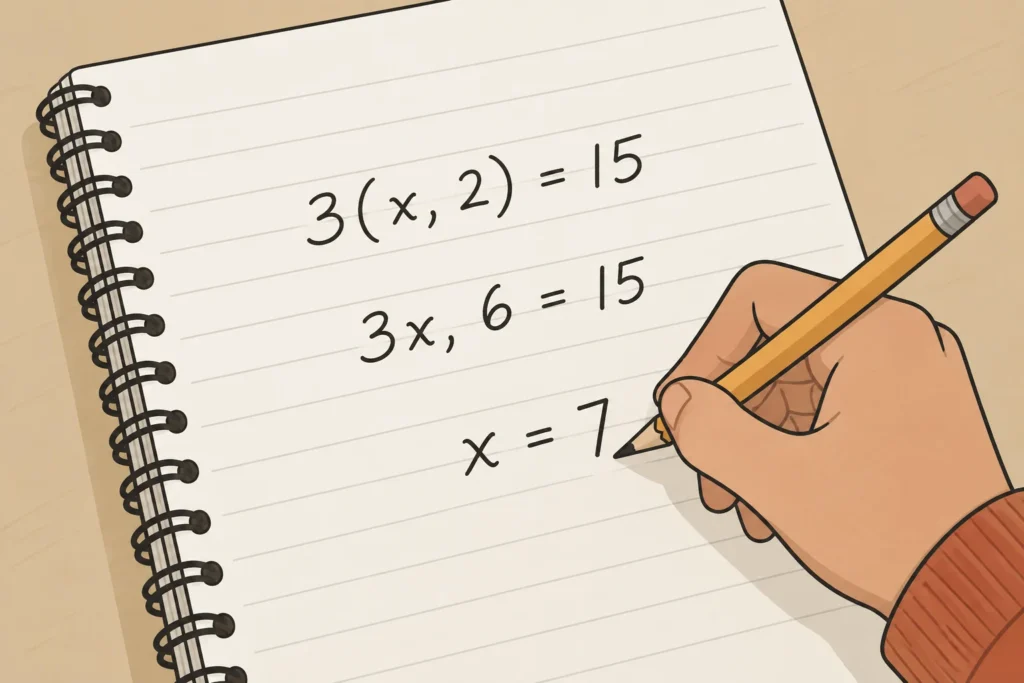
Our hypothetical student tries 3(x, 2) = 15, writes 3x, 6 = 15, and gets x = 7. Now there's independent evidence of correct distribution, including a subtraction term, not just recognition of the group's answer.
In an undergraduate genetics course, students improved on similar conceptual questions answered individually after peer discussion. That supports checking a fresh question. Classroom results don't guarantee an informal group's effectiveness, and your before-and-after check cannot isolate the group's contribution.[1]
4. 4. Check later, then adjust
**Check again later before judging what stuck.** Try another comparable task the next day, or before your next meeting, without first reviewing the solution. Immediate success is useful feedback, but practice performance can overstate longer-term retention.[2]
Suppose the student next attempts 4(x + 2) = 20 and again fails to multiply the second term. The explanation turn produced an immediate improvement that hasn't held up yet. Keep that turn, but add individual practice between meetings rather than declaring the entire group useless.
A missing prerequisite calls for preparation before discussion. Repeated independent success favors keeping the format. If several comparable tasks still go poorly after everyone gets explanation turns, move that practice to solo sessions and bring specific questions to the group. You can keep the social support while being honest about which work needs separate time.
Sources and references
- Science / American Association for the Advancement of Science; university-hosted article copy: Smith et al., Why Peer Discussion Improves Student Performance on In-Class Concept Questions (2009-01-02)
- Perspectives on Psychological Science; UCLA Bjork Learning and Forgetting Lab: Soderstrom and Bjork, Learning Versus Performance: An Integrative Review (2015-03)
- Oregon State University Academic Success Center: Successful Study Groups