
Consider withdrawing when the grade you need is no longer possible, or when earning it would require a level of performance and available time you can’t reasonably expect before the term ends. But make that judgment with the syllabus and your school’s rules in front of you.
Find the real cutoff
Look up the exact deadline and submission process in your registrar’s current calendar. Check whether you’re still in a drop period or would receive a withdrawal notation, and whether an instructor’s or advisor’s approval is required. Schools differ on these details. I once wrote “deal with it Sunday” beside a deadline without checking the hour. It was a tidy plan for missing the cutoff.
If the deadline is close, don’t wait for another exam to settle your feelings. You can gather the numbers and ask questions now without committing to a choice. And don’t assume an email asking for advice counts as an official withdrawal.
Run the grade forecast
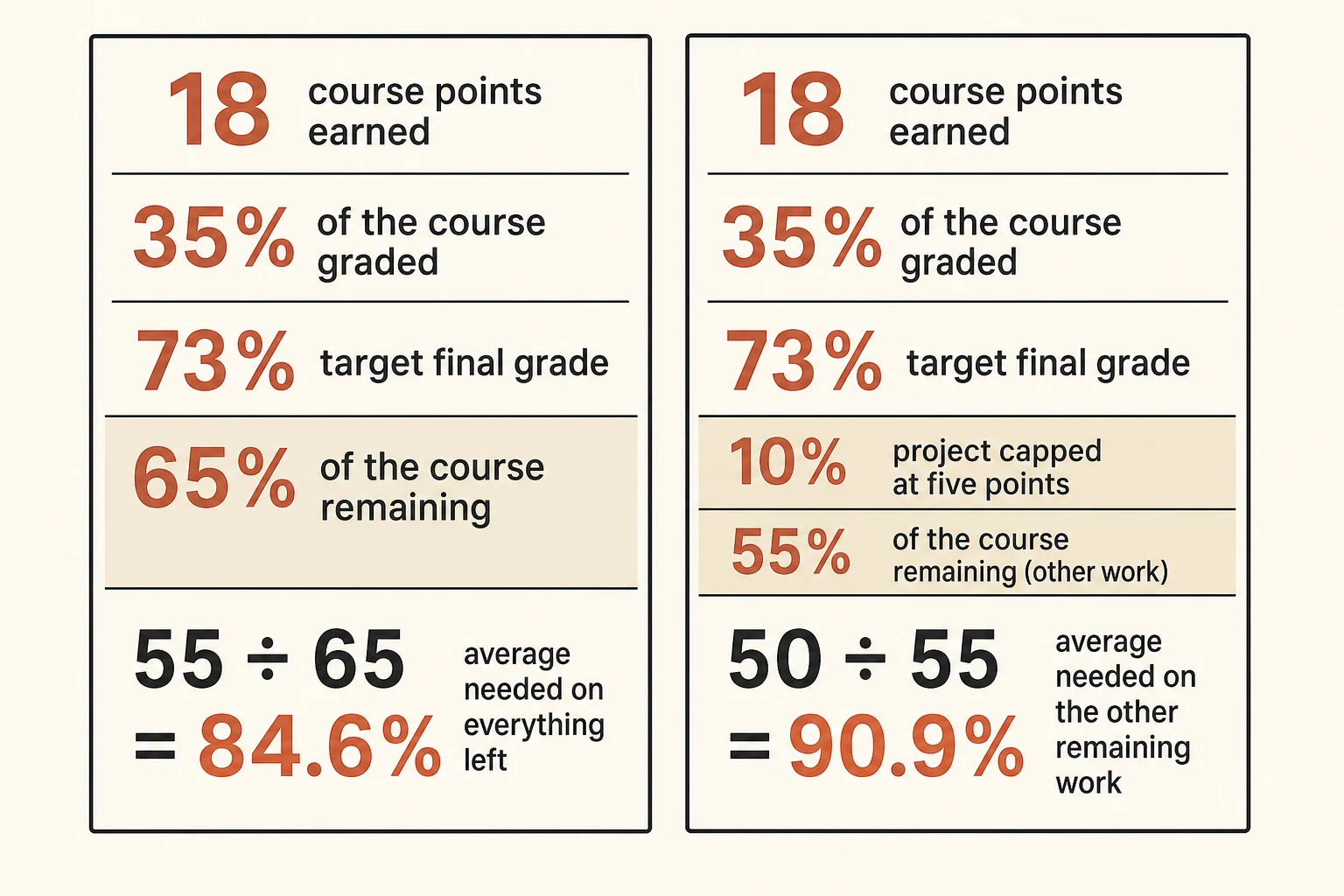
Find the grade you actually need: passing may be different from meeting a prerequisite or program requirement. Then use the syllabus weights, not just the percentage displayed in your gradebook. Subtract the course points you’ve earned from the points needed for your target grade. Divide that gap by the percentage of the course still available. The result is the average you need on the remaining work.
Say 35% of a course has been graded and you’ve earned 18 course points out of those 35. You need a 73% final grade for your intended requirement. With 65% still available, you need 55 more points: 55 ÷ 65, or about an 84.6% average on everything left. That might be reachable. Now check a detail the headline calculation misses: suppose a project worth 10% of the course is already late, and the syllabus caps late work at half credit. Even if you earn all five available points on that project, you’d need 50 points from the other 55% of the course, about a 90.9% average. A single grading rule has changed the decision substantially.
Check for dropped scores, replacement exams, assignment caps, and work the gradebook hasn’t recorded yet. Ask the instructor about any rule you can’t interpret. Then compare the required average with your results on similar work, not with the score you could imagine earning after an unusually perfect month.
Can the conditions behind the grade change?
A required 85% means something different if you’ve been getting 82% on comparable exams and recently found a fixable error than if you’ve been getting 60%, have missed required labs, and can’t attend the remaining ones. In the first case, staying might have a specific plan: practice the question type you keep missing, get feedback, and check the next result.
Ask what would have to change before the next major assessment. If it’s an unchanged work schedule, a continuing health problem, or time taken from two other courses, put those constraints into the forecast too. Don’t quietly assign yourself a free Saturday that doesn’t exist.
Check what each choice costs
Staying keeps the chance to earn the grade, but it also commits hours that may have to come from other classes. Withdrawing may free those hours, while changing your transcript, enrollment level, bill, aid, or path through a prerequisite. None of those effects should be guessed from another student’s experience. Check your program’s required grade and retake schedule as well: withdrawing from a fall prerequisite offered again next fall is a different choice from taking it next term.
Ask whether a grading-basis change is still available and whether it would meet your requirement. It may change how a grade is recorded without reducing the work you must do. If an abrupt circumstance interrupted the course, ask about formal support or an incomplete, if applicable; don’t assume either is automatically available. Withdrawing from one course while continuing the others is also different from leaving the entire term under federal aid rules, though a one-course change can still affect your aid or enrollment status. Your financial-aid office needs to check your particular package.
Bring a fact sheet, not an apology
An advisor can answer a much better question than “Should I give up?” if you bring these details:
- Course, credit hours, exact withdrawal deadline, and the official process you found.
- Grade needed for your requirement; points earned, work remaining, and required average under the syllabus rules.
- Recent results on comparable work, missed or capped assignments, and the specific constraint behind them.
- Credits you’d have after withdrawing; scholarships or aid you receive; the next course this one unlocks; and when you could retake it.
- Questions still unresolved: transcript treatment, aid and billing, program progression, and whether another grading option or formal support is available.
If the cutoff is imminent, send that summary to advising and ask the financial-aid office about your enrollment change today. Confirm the official submission steps separately. You’re trying to make the decision while the choices still exist.
Sources and references
- Stanford University Academic Advising: Stanford Academic Advising, Should I Withdraw from This Course?
- University of Connecticut Academic Center for Exploratory Students: Course Withdrawal Guide
- U.S. Department of Education, Federal Student Aid: General Requirements for Withdrawals and the Return of Title IV Funds
- University of California San Diego Academic Advising: Drops and Withdrawals
- BigFuture by College Board: When should I seek help on campus?