

Multiple-choice review gets overcomplicated at a familiar moment: you narrow a practice question to two answers, choose one, and immediately understand the key’s explanation. After seeing it, you can explain the concept. Before checking, you could not defend why one option beat the other. That missing distinction is what you need to study.
Write down what the stem requires, identify the exact claim on which the finalists differ, and test each claim against the relevant rule, condition, or evidence. Once you check the answer, classify why your reasoning failed and write one altered question that tests the same distinction again.
Why two answers can both look right
Both options may contain accurate course language. One might be true under different conditions, broader than the evidence allows, missing an exception, or answering a nearby question. In well-designed items, plausible distractors may reflect common misconceptions or typical errors; a single-best-answer question can also include an option that is partly correct but weaker than another. That makes the tempting answer useful evidence about your reasoning, although it does not guarantee that every question is well written.[1]
Read the demand in the stem
Before comparing options, determine whether the stem asks what “must be true,” is “most likely,” is “best supported,” or should happen “first.” These demands are different. Also confirm whether the exam uses one best answer or allows multiple selections. For a single-answer item, responsible design calls for one defensible best response, even when other options contain some truth; it should not depend on trick wording.[1][2]
A close call about sleep and grades
Suppose an introductory psychology question describes a survey of 800 students. Students reporting at least seven hours of sleep also had higher GPAs, even after researchers controlled for employment hours. The stem asks which conclusion is best supported. Your finalists are “Increasing sleep causes higher grades” and “Sleep duration was associated with GPA in this study.”
The large sample and statistical control are impressive-looking details, but they do not settle the choice. The course rule says that an observational survey can establish an association without showing that assigned changes in sleep caused changes in grades. Controlling for employment addresses one possible alternative explanation; it does not convert the survey into an experiment. The association answer matches what the study can actually support.
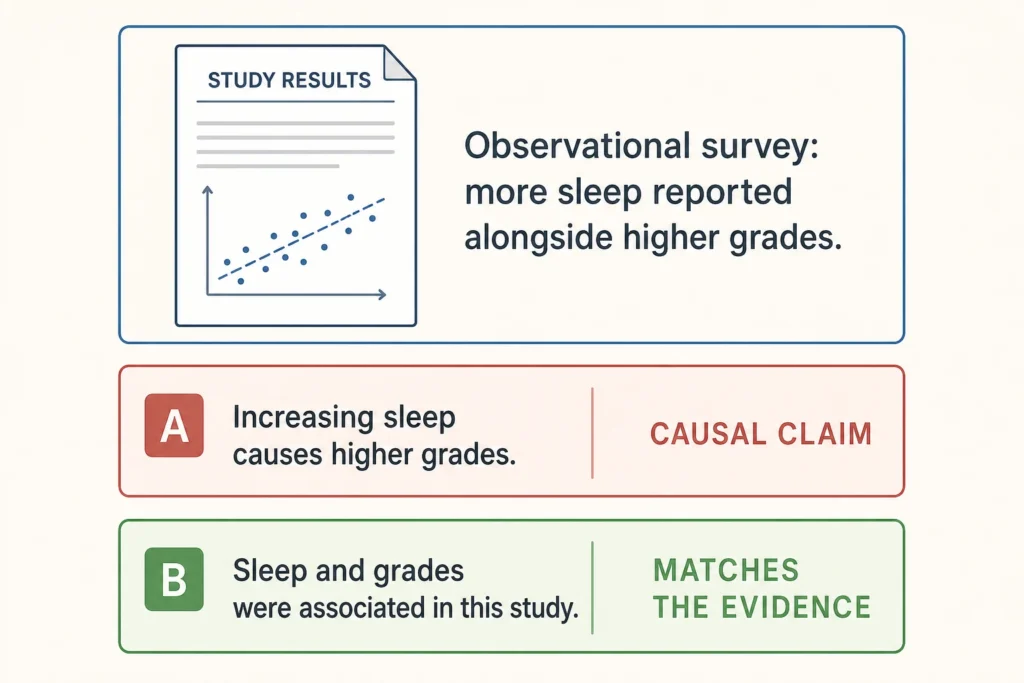
Now suppose a released practice set says that sleep “predicts” GPA. That word may describe a statistical relationship in the course, or it may be used loosely enough to sound causal. Check how the instructor uses it in lectures and released answers. If the course materials do not resolve the meaning, the wording needs clarification; memorizing “predicts” as a magic signal would make the next question harder, not easier.
Review while your reasoning is still visible
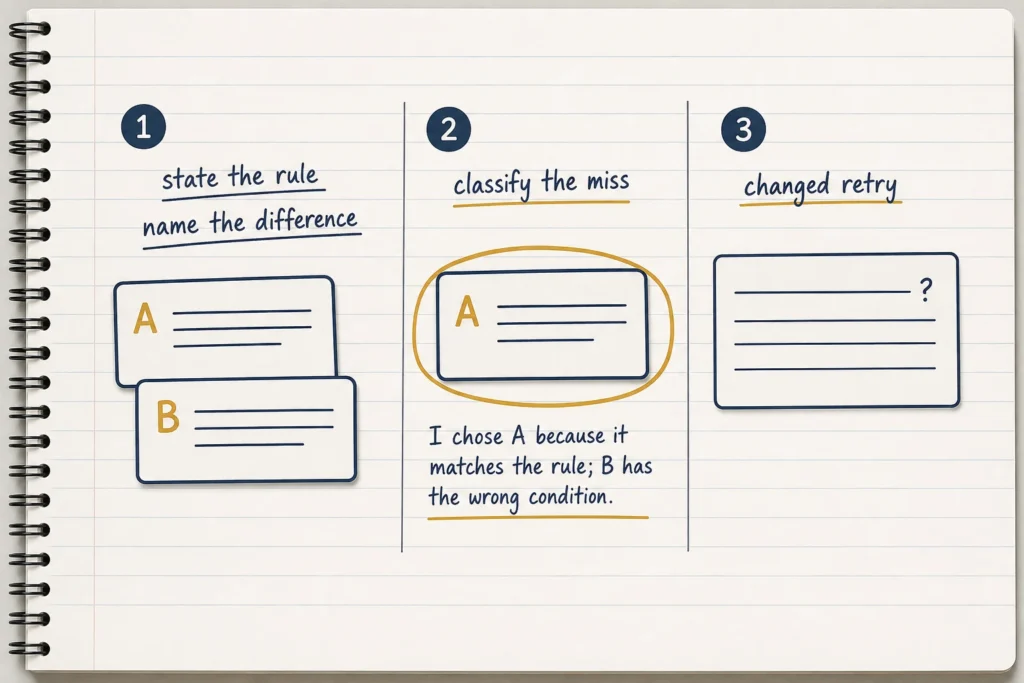
- Commit before checking. Record your chosen option and one sentence explaining the rule, condition, or evidence that supports it.
- Compare the finalists. State their exact difference: scope, category, cause, condition, exception, sequence, or strength of evidence.
- Classify the miss. Decide whether you lacked the content, blurred a category boundary, overlooked a qualifier, exceeded the evidence, or misapplied a rule.
- Finish by writing one changed retry without the original choices. Alter the scenario while preserving the distinction you need to practice.
Use answer explanations comparatively. Ask why the keyed option works and why your tempting alternative fails under this stem. In a 2020 study involving 64 medical students, option-level and concept-focused feedback led to better transfer than simple right-or-wrong feedback. The population and subject were limited, but the practical lesson is useful: the explanation should help you decide a changed question, not merely recognize the old key.[4]
What should you practice next?
Let the kind of close call determine the follow-up. If you could not state the governing concept, review that small section and explain it with the material closed. If you confused neighboring categories, create two short cases and identify which feature moves each case into its category. For a missed qualifier, rewrite the stem by changing “can,” “must,” “most likely,” or “except.” For an evidence error, change the research design and ask what conclusion the new design permits. For an application error, keep the rule and replace the scenario.
Attempt the altered prompt later without the original options in view. A systematic review of applied classroom research found retrieval-practice benefits across subjects, education levels, delays, and final-test formats. Here, retrieval matters because you must produce the distinction before familiar answer wording supplies it.[3]
Sometimes the item is unclear
If two options remain defensible after you apply the course rule and check the relevant source, record the stem, both choices, and your reason. Ask a precise question: “The lecture defines X this way, so option C also seems to satisfy the condition. What distinction makes B better?” Clear single-answer items are supposed to support one best response rather than reward guesswork. This is a reason to seek targeted clarification, though not every difficult choice is an ambiguous item.[1][2]
During an exam, make the best-supported choice you can, mark the question, and return if the format allows. During study, take three recent close calls and run the full review on them. If you repeatedly miss qualifiers, practice altered stems. If you cannot state the governing rule, review the relevant material before attempting another set.
Sources and references
- Australian Curriculum, Assessment and Reporting Authority: Multiple-choice questions
- McGraw Center for Teaching and Learning, Princeton University: Assessing Learning
- Educational Psychology Review; indexed by ERIC: Retrieval Practice Consistently Benefits Student Learning: A Systematic Review of Applied Research in Schools and Classrooms (2021-12)
- Perspectives on Medical Education: Beyond right or wrong: More effective feedback for formative multiple-choice tests (2020-10)