
Study plans usually fail for a simple reason: they are written for a fictional version of the student, not the actual one. The plan assumes unlimited focus, perfect energy at 8 p.m., no commute, no interruptions, and a willingness to begin every session just because the calendar says so. A workable daily plan does something much less glamorous. It protects a few important study blocks, defines exactly what happens inside them, leaves room for real life, and makes starting easier than avoiding the task.
Why most study plans fall apart by midweek
Cornell’s Learning Strategies Center recommends planning balanced activities, scheduling specific subjects rather than vague blocks labeled only “study,” studying at regular times and places, and doubling time estimates because students often underestimate how long work takes. Those points explain why many self-made plans collapse: they are too broad, too crowded, and too optimistic before the day even begins. (lsc.cornell.edu)
- The plan is built around mood instead of fixed cues, so every session becomes a fresh negotiation.
- Tasks are named by subject, not by action. “Study biology” is easier to avoid than “self-quiz on cell respiration and correct missed cards.” (lsc.cornell.edu)
- Every course gets equal time even when one assignment is due tomorrow and another can wait.
- The default method is passive review. Reviews of learning techniques have rated practice testing and distributed practice as high-utility approaches, while repeated rereading is much less dependable. (psychologicalscience.org)
- Sleep is treated as optional. CDC guidance says teens ages 13 – 17 need 8 – 10 hours of sleep and adults ages 18 – 60 need 7 or more hours, so a plan that repeatedly steals from sleep is usually undermining the focus it is trying to create. (cdc.gov)
Use the Anchor-Block-Review method
A practical daily plan needs only three layers. Think of this as the Anchor-Block-Review method: an editorial framework for building a realistic day, not a formal academic system. It works because it starts with constraints, turns study into finishable units, and creates a small feedback loop so tomorrow’s plan is better than today’s.
- Anchors are the fixed parts of the day: classes, work shifts, commuting, practice, meals, appointments, and bedtime.
- Blocks are the actual study sessions placed around those anchors. Each block should have one clear job and one visible output.
- Review is the short end-of-day check that answers three questions: What got done? What slipped? What is the first task tomorrow?
Start with the day you really have, not the day you wish you had
Begin with fixed commitments: class, work, commuting, sports, family responsibilities, meals, and bedtime. Cornell explicitly recommends planning balanced activities rather than scheduling only study, and CDC sleep guidance is a useful floor, not a luxury add-on. If the calendar cannot hold school, life, and enough sleep in the same day, the answer is usually to reduce the study target for that day, not pretend the day is longer than it is. (lsc.cornell.edu)
A strong plan respects constraints before it optimizes ambition. Two honest study blocks are more useful than five imaginary ones.
Turn each course into tasks you can finish
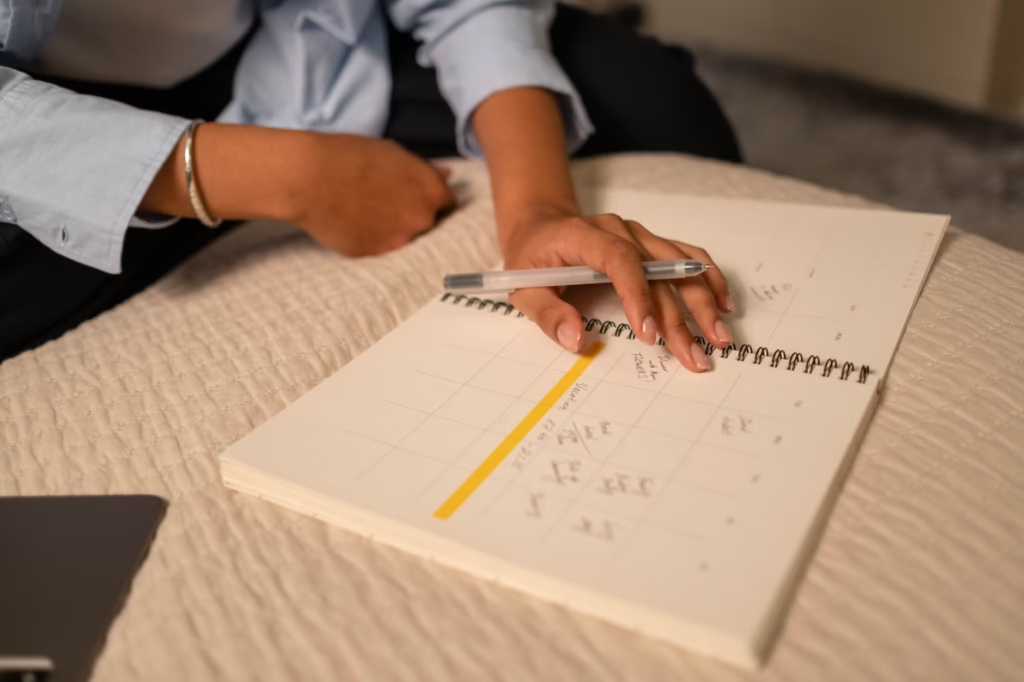
Next, translate each course into finishable tasks. Good study tasks leave evidence behind: a solved problem set, a page of recall questions, marked flashcards, an outline, a paragraph draft, or corrected mistakes from a quiz. Research summaries from the Institute of Education Sciences and the APS review of learning techniques both favor active approaches such as quizzing, retrieval practice, and spaced review over endless rereading. IES also recommends checking what you know after some delay, because material often feels familiar immediately after studying even when it is not durable yet. (ies.ed.gov)
| Task type | Useful block length | What the block should produce | Good stopping point |
|---|---|---|---|
| New lecture or textbook reading | 25 – 40 minutes | Read for structure, then write 3 – 5 recall questions or a short summary from memory | You can explain the main idea without looking |
| Problem-solving course | 40 – 60 minutes | Work problems without notes first, then check errors and redo misses | You finished a defined set and understand the mistake pattern |
| Memorization-heavy material | 20 – 30 minutes | Use flashcards, blank-page recall, or self-quizzing; mark only the misses for the next round | You completed one clean pass and tagged weak items |
| Writing or project work | 45 – 90 minutes | Draft one section, revise one issue, or gather sources for one subsection | You stop at a clear re-entry point with the next step written down |

This is why “study for three hours” is a weak plan. Different tasks create different kinds of fatigue. The right question is not how long someone can stay at the desk. It is what kind of mental work the block is meant to produce.
Choose priorities before you start filling open time
Once tasks are concrete, choose priorities before filling open time. A useful rule is one must-do block, one should-do block, and one small review block. The must-do block protects the assignment or exam with the nearest consequence. The should-do block keeps another course from quietly slipping. The review block keeps older material alive so the week does not become one long cycle of relearning. This keeps the day focused without demanding heroic willpower.
- Write down tomorrow’s anchors first: class, work, commute, meals, and bedtime.
- Choose one must-do task with a concrete end point.
- Choose one review task from older material so learning is spaced rather than saved for a last-minute cram. (ies.ed.gov)
- Place the hardest block where energy is most reliable, not where it would be convenient on an ideal day.
- Rename every session as a verb plus deliverable: “outline Chapter 4 essay” or “solve five stoichiometry problems,” not just “study chemistry.” (lsc.cornell.edu)
- Attach a start cue to each block: time, place, and first action.
- Add a 15 – 30 minute buffer or overflow slot, and double any time estimate that feels suspiciously optimistic. (lsc.cornell.edu)
- Decide what gets cut first if the day goes off track. Plans are easier to follow when triage is built in.
Make starting the block almost automatic
The hardest part of studying is often not the work itself but the five minutes before it. One of the most useful fixes is an if-then plan, also called an implementation intention: if situation X happens, then behavior Y follows. A National Cancer Institute summary of the research notes that implementation intentions improve goal attainment compared with goal intentions alone because they connect a cue to a specific response. In practice, that means replacing “I’ll study after dinner” with “If I finish dinner at 7:00 p.m., then I go to the library’s second floor, open my statistics notebook, and do problems 1 – 4 before checking my phone.” (cancercontrol.cancer.gov)
That sentence looks almost too detailed, but detail is the point. A usable plan removes small decisions at the moment when procrastination is strongest. It also creates a backup version: if the library is full, then the session starts at the kitchen table with noise-blocking headphones for 25 minutes. Following the original plan is ideal; following the backup plan still counts.
Leave more empty space than feels comfortable
Most daily schedules fail because they treat time as if it were perfectly divisible. Real days include walking, packing up, mental decompression after class, messages that actually matter, and tasks that run long. Cornell’s guidance to double time estimates is less about pessimism than about accuracy. It is also one reason back-to-back study blocks often collapse: the first task slips by 20 minutes, and the rest of the evening becomes catch-up. (lsc.cornell.edu)
- Leave at least one empty margin block on heavy days.
- Do not schedule every subject every day; most students do better rotating emphasis.
- Cap single-course sessions before concentration falls apart. Cornell advises limiting work on one course to roughly 1½ to 2 hours at a time before switching or taking a break. (lsc.cornell.edu)
- End difficult blocks with a written restart note so the next session begins faster.
A realistic example of a daily study plan
Consider a hypothetical college student with classes until midafternoon, a part-time shift twice a week, and a habit of losing the evening to low-value review. A workable Tuesday plan might look like this:
- 8:15 – 8:35 a.m.: history recall warm-up. Write five questions from yesterday’s lecture and answer them from memory.
- 1:10 – 1:50 p.m.: chemistry review right after class. Rework the example problem and mark the step that caused confusion. Studying soon after lecture can be especially efficient while the material is still fresh. (lsc.cornell.edu)
- 4:30 – 5:15 p.m.: algebra must-do block. Solve six assigned problems without notes, then correct only the misses.
- 7:00 – 7:25 p.m.: Spanish flashcards. Review missed words only.
- 7:30 – 7:40 p.m.: plan tomorrow, pack materials, and write the first task for the morning.
This plan works because it is small enough to survive. It uses a short review block, a higher-effort problem-solving block, and a next-day reset. It does not pretend every course deserves equal time every day, and it leaves evidence behind after every session.
How to tell whether the plan is working after one week
After a week, do not ask only whether the calendar was followed. Ask whether the plan produced learning. IES recommends delayed checks of understanding rather than judging immediately after a study session, when familiarity can be misleading. A quick self-quiz the next day is a better test than the feeling that the notes looked familiar last night. (ies.ed.gov)
- Start rate: If at least most planned blocks begin within about 10 minutes of the target time, the schedule is probably realistic. If not, reduce block count or improve start cues.
- Carryover: If unfinished work keeps moving forward for three straight days, the daily load is too large or the tasks are too vague.
- Retention: If next-day self-testing exposes major gaps, convert more blocks from rereading to recall practice or problem work. (psychologicalscience.org)
- Energy: If the plan only works by cutting sleep, it is not a functioning plan. Rebuild it around the amount of sleep recommended for the relevant age group. (cdc.gov)
Common ways a good plan gets derailed
You keep skipping the first block
Usually the first block is too vague or too large. “Work on paper” creates resistance; “open document and draft the first paragraph” creates motion. Shrink the launch task until it feels almost silly. Momentum matters more than ambition in the first ten minutes.
Everything takes longer than planned
This is not always a discipline problem. It is often a planning problem. Break assignments into smaller units, stop scheduling back-to-back blocks, and assume setup and transition time are real. Cornell’s advice to double time estimates is a good corrective when a plan keeps breaking for the same reason. (lsc.cornell.edu)
You put in time but do not remember much
That usually means the plan is tracking hours better than it is tracking learning. Shift more time toward practice tests, retrieval, worked problems, and spaced review. Reviews of learning techniques and IES guidance both point in that direction, and IES specifically recommends checking knowledge after a delay rather than with the answers visible. (psychologicalscience.org)
The plan works only on low-stress days
Then the plan needs versions. Create a full day, a reduced day, and a minimum day. On a reduced day, keep the must-do block and the short review block. On a minimum day, keep only the smallest next step that protects continuity. Consistency is easier to rebuild than to restart from zero.
When the structure, not the effort, needs to change
Some schedules do not need better discipline; they need a different design. Finals week, lab-heavy courses, clinical rotations, shift work, caregiving, athletics, or formal accommodations may require fewer but more protected blocks, heavier weekend planning, or support from an academic coach, advisor, counselor, or disability services office. If chronic sleep problems, concentration problems, or severe anxiety are driving the issue, a study plan alone may not solve it.
The goal is a plan you can repeat
A good daily study plan should feel slightly modest on paper and surprisingly solid in real life. It should tell you where to begin, what counts as done, and what happens when the day goes sideways. Start with anchors. Build small, specific blocks. Review the day before bed. If the plan helps work happen on an ordinary Tuesday, it is probably strong enough to carry a demanding semester.

How many hours should a daily study plan include?
There is no universal number that fits every student, course load, or life situation. A better question is whether the plan protects the right work and produces visible outputs. On busy class days, two or three purposeful blocks are often more realistic than a long, crowded schedule.
Should every hour of the day be planned?
Usually no. A plan that leaves no white space breaks the first time something runs late. Most students benefit from a few fixed anchors, a few clear study blocks, and at least one buffer period.
Is it better to study every subject every day?
Usually not. A short review block can keep older material alive, but daily planning works better when one or two courses get clear priority instead of every subject receiving shallow attention.
What if an entire day is lost?
Do not try to copy all missed hours into tomorrow. Re-rank tasks, salvage the must-do item, and restart with the smallest next step. Catch-up plans fail when they try to repay every hour immediately.
Should the plan be digital or on paper?
Either can work. The better format is the one that gets checked, edited, and reused every day. Digital calendars are strong for time-blocking and reminders; paper is often faster for nightly planning and quick revisions.
References
- Cornell University Learning Strategies Center: Guidelines for Creating a Study Schedule – https://lsc.cornell.edu/how-to-study/studying-for-and-taking-exams/guidelines-for-creating-a-study-schedule/
- Cornell University Learning Strategies Center: Guidelines for Creating a Study Schedule (alternate page) – https://lsc.cornell.edu/guidelines-for-creating-a-study-schedule-2/
- Institute of Education Sciences: Organizing Instruction and Study to Improve Student Learning – https://ies.ed.gov/ncee/WWC/Docs/PracticeGuide/20072004.pdf
- CDC: About Sleep – https://www.cdc.gov/sleep/about/index.html
- Association for Psychological Science: Improving Students’ Learning With Effective Learning Techniques – https://www.psychologicalscience.org/publications/journals/pspi/learning-techniques.html
- National Cancer Institute: Implementation Intentions – https://cancercontrol.cancer.gov/sites/default/files/2020-06/goal_intent_attain.pdf