
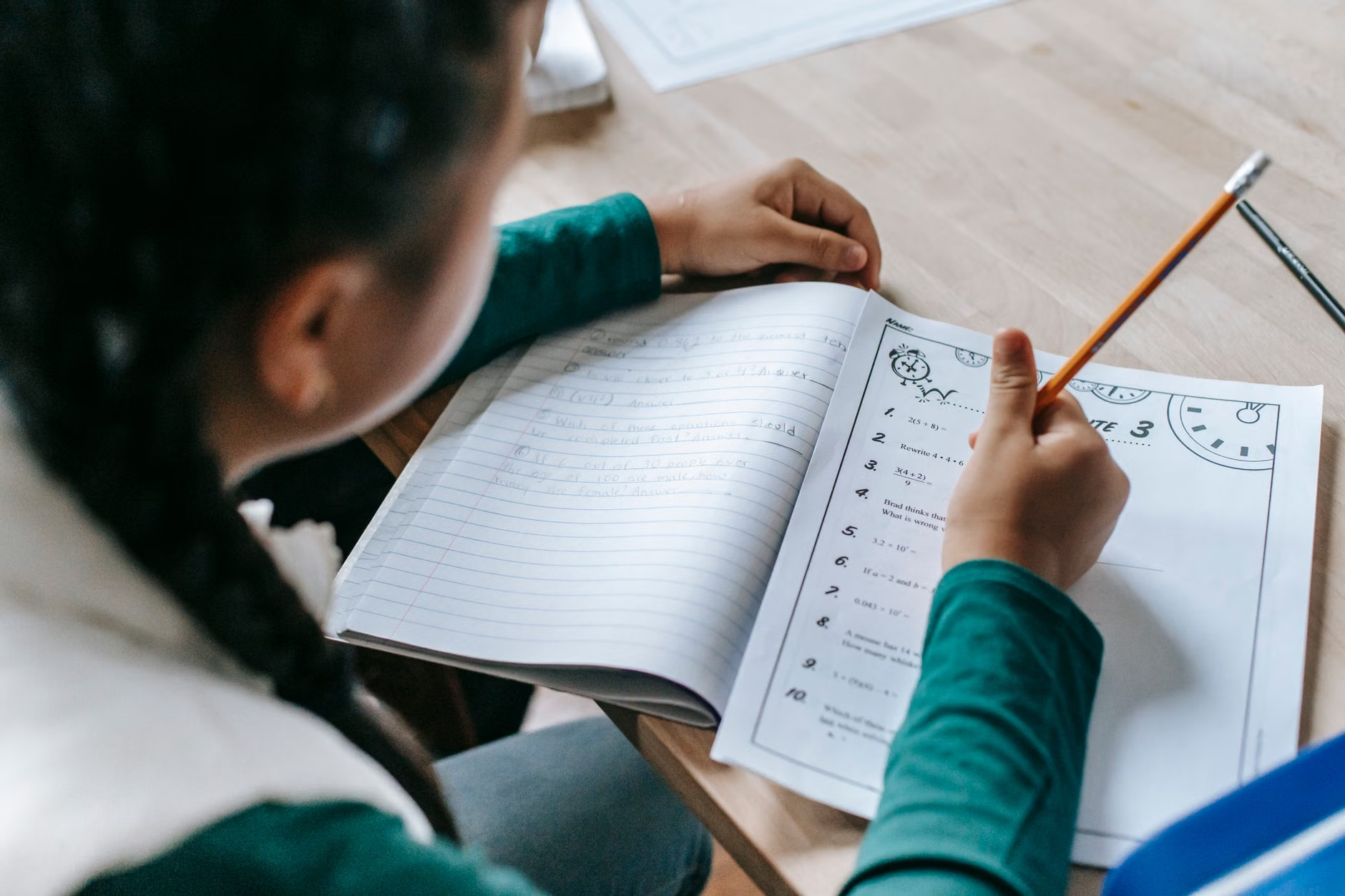
If the goal is to remember more in less time, the smartest move is not studying longer. It is choosing study methods that build durable memory instead of just creating the feeling of productivity. A major review of learning techniques found that practice testing and distributed practice, often called spaced practice, were especially useful across many learning conditions, while rereading and highlighting were much less reliable as main strategies. (psychologicalscience.org)
That does not mean notes, textbooks, or lectures are pointless. It means they should support memory-building, not replace it. Students who learn quickly are often the ones who spend less time staring at material and more time trying to pull information back out of memory.
Use active recall as the center of every study session
Active recall, also called retrieval practice, means trying to remember without looking first. That can be a self-quiz, a blank-sheet brain dump, a flashcard answer said out loud, or explaining a concept from memory before checking your notes. Research reviewed by Roediger and Karpicke found that taking memory tests can improve long-term retention more than additional study alone, and later reviews have continued to treat retrieval practice as one of the strongest tools students have. (pubmed.ncbi.nlm.nih.gov)
The practical mistake is making recall too easy. If a flashcard shows the answer after a quick glance, or a review sheet turns into passive scanning, the session slips back into recognition instead of real retrieval. A better rule is simple: try to answer fully before checking. If the answer is incomplete, mark the gap, correct it, and come back to it later.
There is one important nuance here. For brand-new material, a short first pass still matters. A chemistry chapter or history lecture usually needs an initial read or explanation before recall is possible. The mistake is turning that first pass into the whole session. Read to understand the structure, then close the material and retrieve.
Space your review and mix related topics
The second high-value method is spacing. Instead of one long session, study the same material in shorter rounds spread across time. Research on the spacing effect shows that memory improves when learning is distributed rather than massed into a single cram session, and Dunlosky’s review rated distributed practice as one of the most generally useful techniques. (pubmed.ncbi.nlm.nih.gov)
This is where the promise of “less time” becomes real. Spacing does require revisiting material, but it can cut wasted effort because each review exposes what is still weak. Instead of rereading an entire chapter for an hour, a student might spend ten focused minutes recalling the main ideas today, five minutes checking errors tomorrow, and another five minutes three days later. The total time can be lower because the review is targeted instead of repetitive.
A third method, especially useful once the basics are in place, is interleaving. That means mixing related topics or problem types instead of doing one type in a long block. Research on category learning and later reviews suggests that interleaving can improve the ability to tell similar ideas apart and apply the right method at the right time. (pubmed.ncbi.nlm.nih.gov)
It is not ideal for every moment. If a topic is completely unfamiliar, blocking a few examples first can help. Interleaving becomes more valuable when confusion between similar ideas is the problem: algebra formula choice, verb tenses in a new language, or distinguishing cell structures in biology. In other words, mix once there is something to compare.

A short study routine that actually improves memory
- Spend 3 to 5 minutes identifying the key questions. What would you need to answer on a quiz without notes?
- Study briefly for comprehension, then close the material and retrieve. Write, say, or sketch everything you can remember.
- Check your source and mark only the gaps or errors. Do not restart the whole chapter unless the foundation is missing.
- Create a short follow-up review for the next day and again a few days later. Keep those later sessions brief.
- End by mixing one or two related questions from older material so recall is not trapped in a single topic block.
A simple example: a student preparing for a psychology exam reads a section on memory for fifteen minutes, then spends ten minutes writing the main ideas from memory, checks what was missed, and schedules a five-minute self-quiz for the next evening. Two days later, that student mixes memory questions with perception and attention questions. That routine is less comfortable than rereading, but it is much closer to the kind of effort that exams require.
If a study method mainly creates familiarity, it can feel effective while producing weak recall later. If it forces you to remember, miss, correct, and return, it is usually doing more of the real work.
The best study methods are not fancy. For most learners, the highest-return combination is active recall first, spaced review next, and interleaving when topics are similar enough to be confused. Notes, summaries, and highlighting still have a place, but mainly as support tools. If the goal is remembering more in less time, the quickest upgrade is to spend less time looking at information and more time trying to bring it back. (psychologicalscience.org)
References
- Dunlosky et al., Improving Students’ Learning With Effective Learning Techniques (Association for Psychological Science) – https://www.psychologicalscience.org/journals/pspi/1529100612453266/
- Roediger and Karpicke, Test-Enhanced Learning: Taking Memory Tests Improves Long-Term Retention (PubMed) – https://pubmed.ncbi.nlm.nih.gov/16507066/
- Cepeda et al., Spacing Effects in Learning: A Temporal Ridgeline of Optimal Retention (PubMed) – https://pubmed.ncbi.nlm.nih.gov/19076480/
- Kornell and Bjork, Learning Concepts and Categories: Is Spacing the “Enemy of Induction”? (PubMed) – https://pubmed.ncbi.nlm.nih.gov/18578849/