
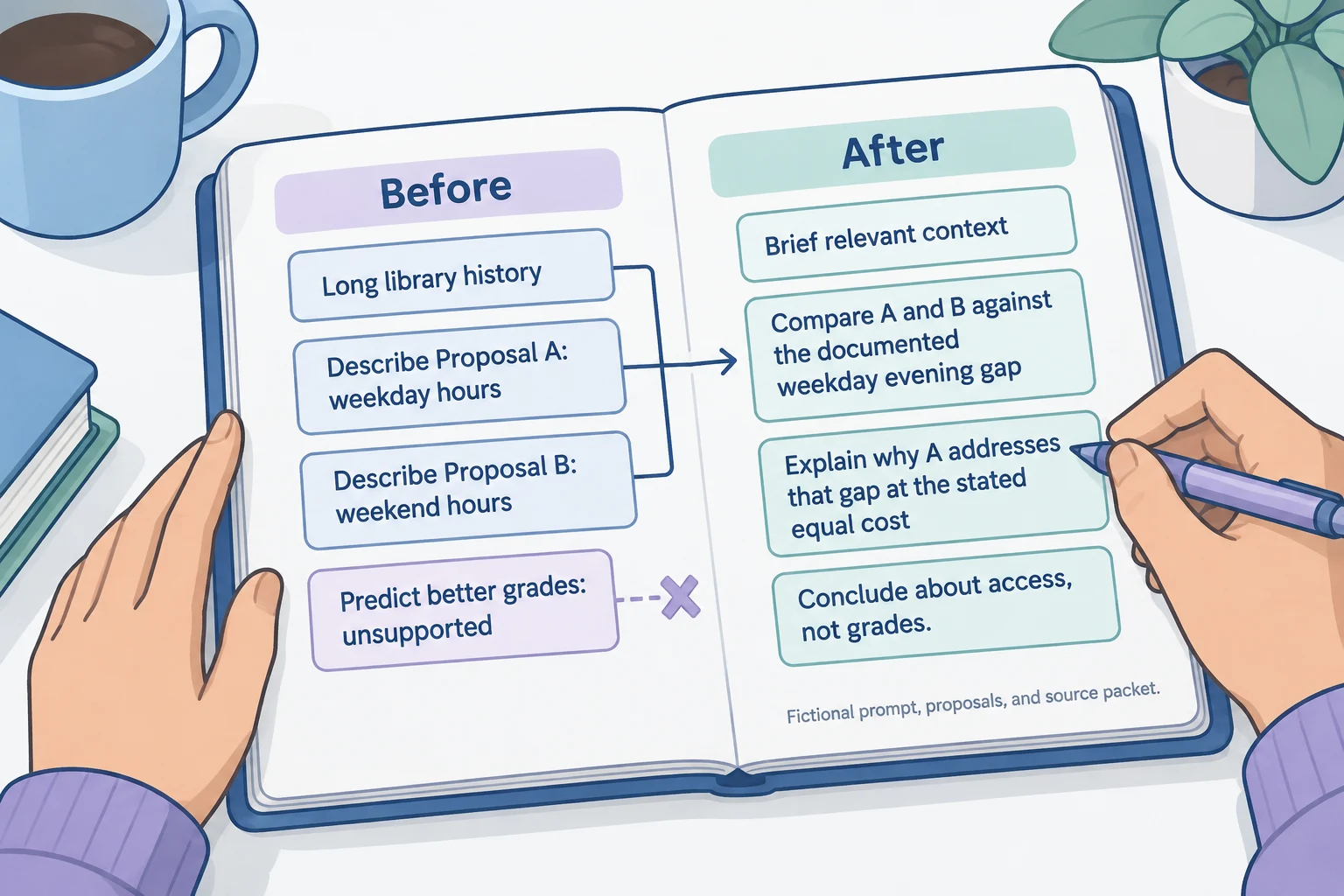
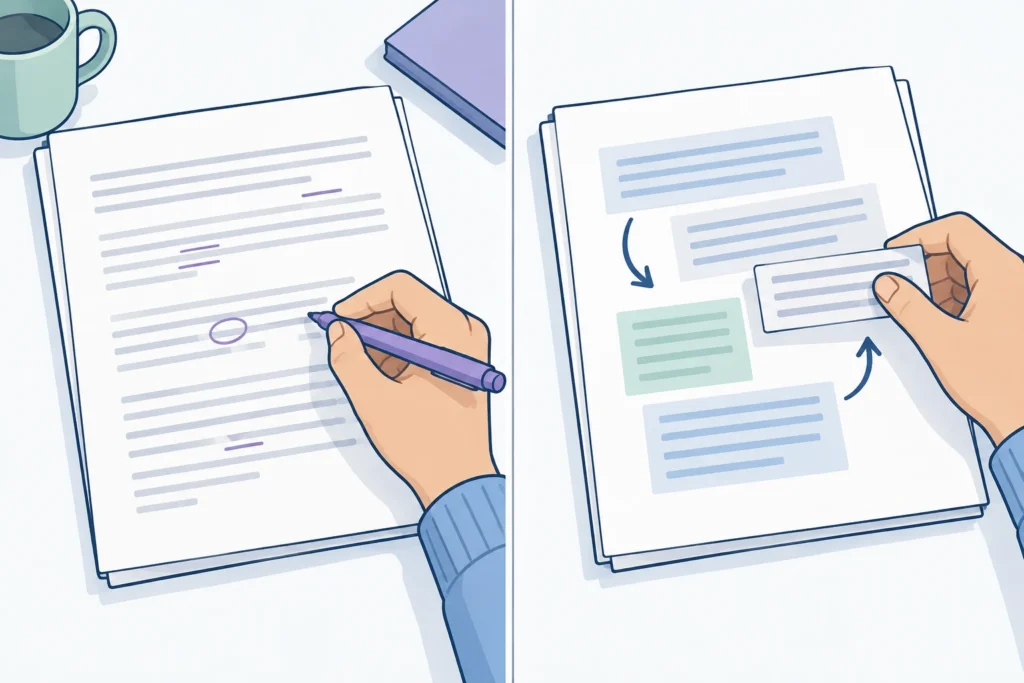
Final proofreading only begins when your draft responds to the assigned question, and when its sections build that response and contain the main claims. Often those parts will be stable rather than error-free. Don’t worry about grammar or spelling. Focus on changing what the paper does. Say there is an example or a claim or a section you need to remove. That needs to be fixed first. I don’t want you to waste your time during your last work hour fixing little things like spelling or grammar when you will probably just remove the sentence anyway.
Does the draft do what the prompt asks?
Once you have placed the main part of your answer (your thesis) next to the question, evaluate what part of the answer you need to locate next to the question, and make sure you aren’t copying what the prompt says verbatim. This isn’t always the case. A paper can be about two different policies, but not compare the policies' effects. Choose the part that performs the task, within the limits provided. If you can only identify the topic, better wording will not resolve this.
Apply what your rubric and your instructor said for “needs comparison” and “comparison is difficult to follow.” They differ. Say there is an ambiguous part of the task. If time permits, you can always ask for clarification: “Is the part of the task requiring comparison to state whether both of the proposals are assessed against the same access criterion?” You won’t necessarily need a long, reassuring answer to this. An answer to this question needs to change the next part of your paper.
Read the paper’s shape without its polished sentences
Construct a quick reverse outline: next to each paragraph, provide its point and function. Wisconsin’s Writing Center suggests reviewing both the content and the function of paragraphs to detect repetition and problems with organization. This part can feel awkward because you have to capture what’s actually on the page, not what you intended to write.[1]
Look over those notes only. Where is the information advanced? Where does it repeat? Where does it require the reader to understand something that is explained later? I don’t cut background because it isn’t analysis: keep anything that helps explain the analysis. Consider each section by its required function rather than try to fit it into a thesis-and-proof format.
One draft, two very different repairs
Imagine I’m revising a fictional library-hours paper with the submission clock open in another tab. I’ve spent several minutes untangling a convoluted sentence about “improving academic outcomes,” and I’m happy to have it finally sounding relatively clear. Then I reread the prompt: compare two proposals to improve access. My prediction for better grades is my conclusion. That little sinking feeling means the next thing I check is the comparison.
Here’s the source packet as constructed by the students: Student comments point to weekday access as a problem. Proposal A extends weekday hours; Proposal B extends weekend hours; the stated costs are equal. Nothing in the packet measures grades. The draft has a long history of the library, separate descriptions of A and B, and the conclusion, “Proposal A will improve grades.” A cleaner version of this claim is, “Extending weekday hours will improve grades.” Still unsupported, this claim has better rhythm.
The useful repair is to reduce the history, place the proposal elements in direct comparison, and clarify that A addresses the weekday gap and B does not. The conclusion is, “At the stated equal cost, Proposal A better addresses the weekday evening access problem identified in the comments.” This responds to the fictional assignment without predicting grades and without claiming that no one needs weekend access. The basic idea of the original draft is preserved. It shows visible changes and activity. However, the improvements are substantive and significant.
Distinguishing the weekday and weekend gaps has a research precedent, though not a prediction formula. Nancy Sommers’s 1980 qualitative study documented student revisions in which word choices were altered, but idea repetition was preserved. It doesn’t speak to the prevalence of that occurrence today, nor to your predicted grade. It speaks to the reason that appearance of editing and improvement aren’t always the same.[5]
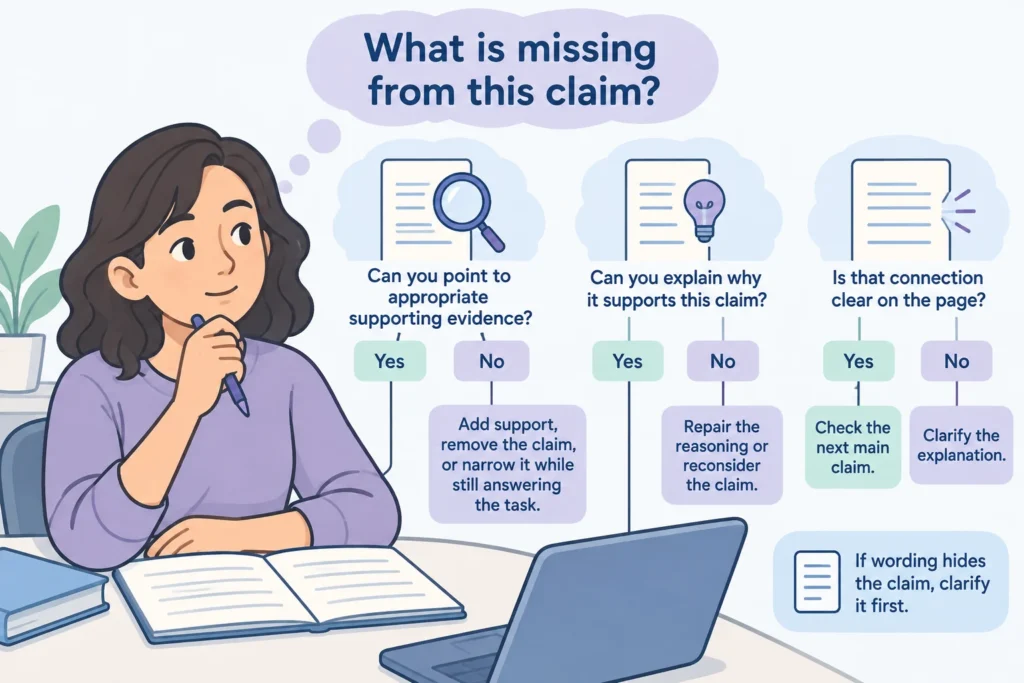
Is the support missing, or just hard to see?
Locate evidence and clarify the relation with plain language for each claim. A citation may be reassuring on a page, but that does not address the connection. UNC’s Writing Center touches on both points. What qualifies as good evidence and how it is explained depends on field of study, not a universal source count or paragraph formula.[4]
- No support: You may remove the claim and/or evidence, and/or justify why the claim is not supported and/or state the claim more narrowly (and satisfy the assignment with the narrower claim, if possible).
- Misplaced claim: You may change the evidence or claim. Claims about the ease of access to courses don’t necessarily mean improved grades.
- Evidence may be clear, but you may need to add more analysis to conclude properly. One paragraph needs analysis.
- Good connection but awkward wording. You don’t have to explain the entire argument to make the connection.
You don’t have to leave an unreadable sentence untouched until every structural problem is solved. Purdue’s guidance gives priority to purpose, focus, organization, and development while allowing earlier attention to language that obstructs meaning. If rewriting a sentence lets you see what it actually claims, that’s useful clarification. Save the final proofreading pass for remaining typos, punctuation errors, and formatting inconsistencies once the content is stable enough.[2]
Choose a repair you can finish, and recheck
Improving the sentence may require improvments elsewhere. UNC considers strategies to be large like changing emphasis and thesis. But think about consequences. Changing a thesis means changing three body paragraphs, the conclusion, and transitions. Adding or removing a paragraph may require just two changes to transitions. Judging improvement by the length of the first edit, especially if large, is misleading.[3]
With 90 minutes left, I’d protect the finishing time before promising myself a repair: 20 minutes for proofreading and citation checks, 15 for required components, file checks, and submission, plus 5 for trouble. That leaves 50 minutes, maybe 10 for diagnostics, and 40 for repair and reread. This is editorial heuristic; it’s probably not a tested optimum or grade predictor. Use your judgment. Don’t give all 90 minutes for writing and hope the upload itself takes care of time allocation.
Be careful when you set your stop repair time. A aim-for comparison may be feasible; rebuilding the paper and finding new sources may not. At stop time, reread claim and supporting passages, as well as conclusion, to verify they answer the same question, citations are in order and all required things are there.
There are two valid reasons to perform a final check: the argument is stable enough, or the remaining repair is not a fit. I'd rather state that second reason overstating that the defect has disappeared. You are protecting a final, whole, and complete submission, not saying your submission is flawless.
Go through your references and required components, open the final file to look over the formatting and check the contents, confirm the upload and submission receipt. An elegant introduction can wait; turning in a blank paper cannot.
Sources and references
- University of Wisconsin, Madison Writing Center: Creating a Reverse Outline
- Purdue University OWL: Higher Order Concerns (HOCs) and Lower Order Concerns (LOCs)
- University of North Carolina at Chapel Hill Writing Center: Revising Drafts
- University of North Carolina at Chapel Hill Writing Center: Evidence
- College Composition and Communication; copy hosted by Yale University: Nancy Sommers, Revision Strategies of Student Writers and Experienced Adult Writers (1980-12)