
The blank final page may be the least useful clue on an unfinished exam. It proves the time limit affected what you could show, but it does not reveal whether the missing minutes went to recalling facts, understanding prompts, choosing methods, carrying out the work, checking answers, or refusing to leave one stubborn question.
Assessment researchers distinguish these effects from subject knowledge itself: a time limit can produce unanswered items, guesses, and rushed responses that do not cleanly represent what a student knows. The useful target is therefore better allocation with sufficient accuracy, rather than maximum speed on every question.[1]
Run one checkpointed timed set before changing your whole study plan
Choose a 20- to 30-minute segment that resembles the exam: mixed problems, short essays, or multiple-choice questions drawn from instructor materials or permitted past exams. Use the expected resources and response medium. Mark checkpoints at one-quarter, one-half, and three-quarters of the available time. At each checkpoint, record your question number and a few words describing the delay, such as “couldn’t recall,” “reread stem,” “which method?” or “checking again.” When time ends, circle your stopping point and finish untimed in a different color.
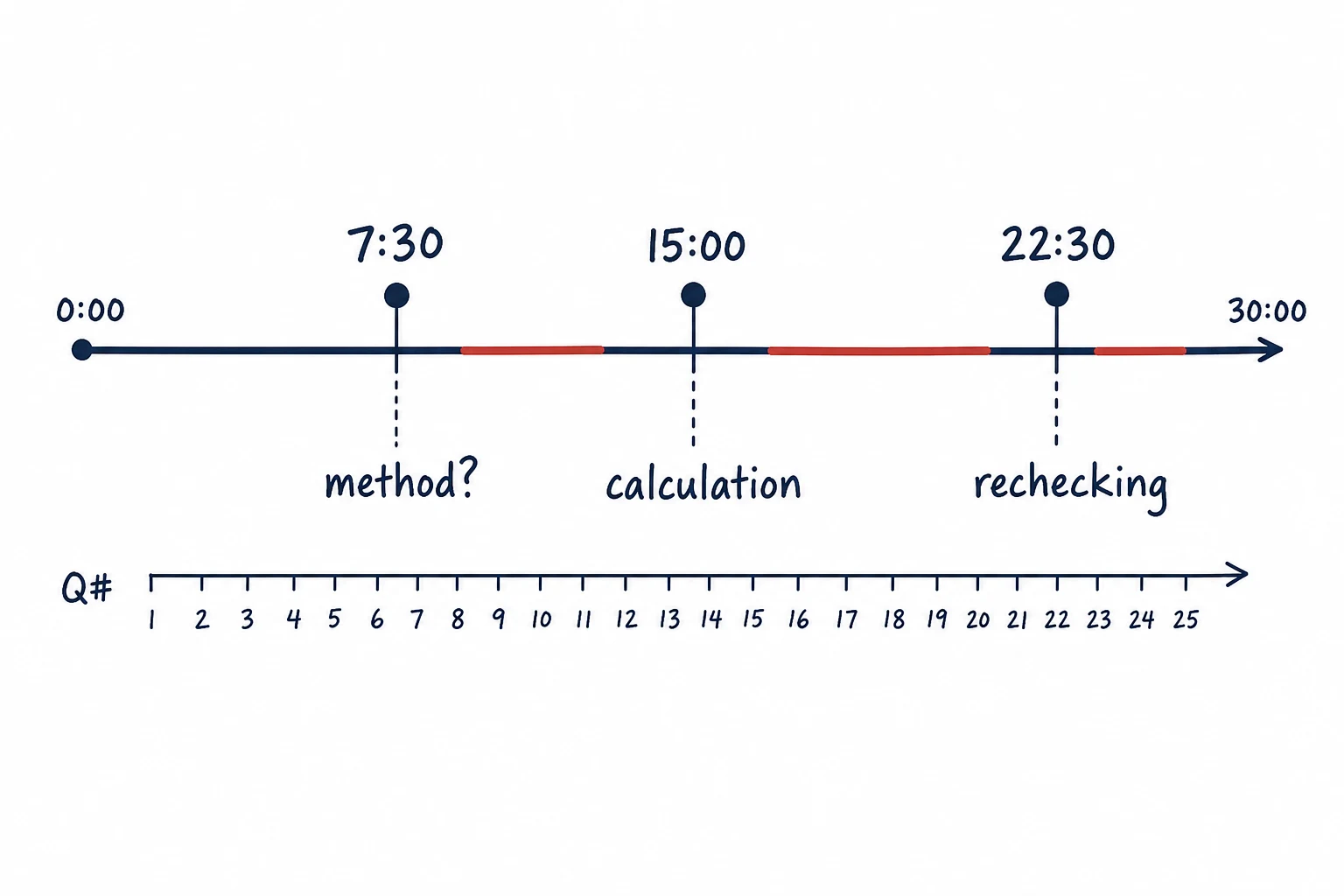
Consider a hypothetical student who expects calculation speed to be the problem. On a 30-minute set of six equally weighted calculus problems, they reach question 2 at 7:30, question 3 at 15:00, and are still on question 3 at 22:30. The notes show four minutes spent deciding which convergence test applied, three minutes doing the calculation, then five minutes rechecking because the answer looked odd. Time expires before question 5 begins. Untimed, questions 5 and 6 are completed correctly in nine minutes.
More arithmetic drills would miss the larger problem. The next practice should mix similar-looking prompts and require a method choice plus the first equation before full calculation. Checking also needs a boundary: one defined check for signs, units, or plausibility, followed by a move-on decision. The first guess, slow calculation, has become much weaker.
Let the location of the delay choose the repair
Read the timed trace from the first point where productive work stopped. A long pause before writing anything differs from slow work after a correct setup, and both differ from repeatedly revisiting a completed response. The first visible delay tells you more than the final blank page.
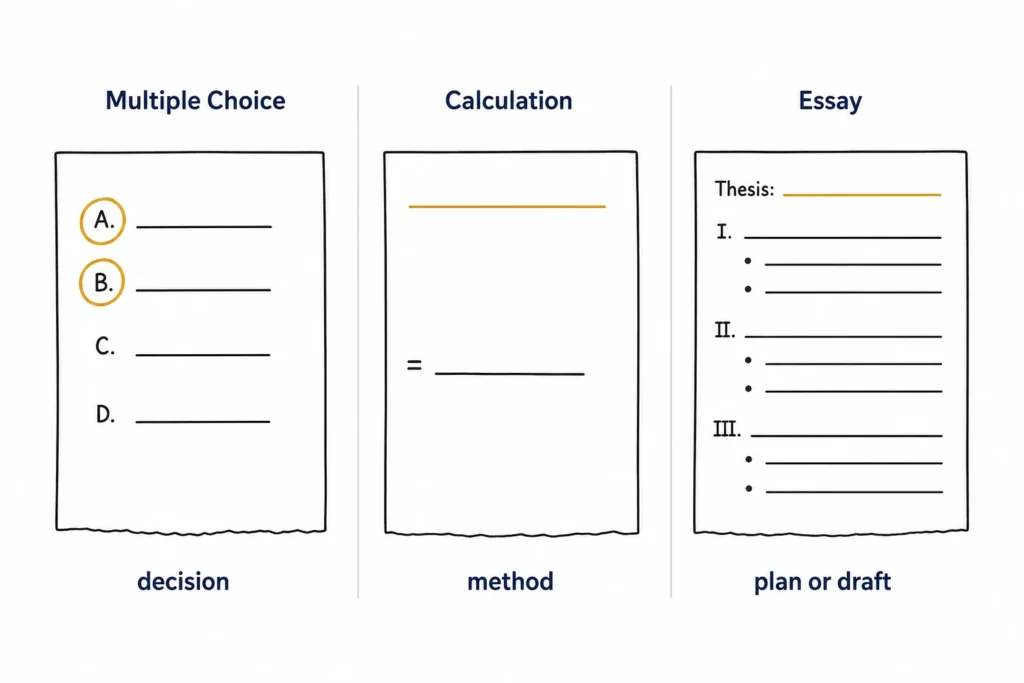
| Format | What the delay looks like | Practice change |
|---|---|---|
| Multiple choice | You understand the stem but repeatedly debate two plausible answers. | State the tested distinction before choosing. Give one reason the selected option fits and one reason the close alternative fails. |
| Calculation | The page stays blank before setup, or setup is quick but manipulation drags. | For a setup delay, classify mixed prompts and write only the first equation. For an execution delay, repeat a mastered process through to the answer. |
| Essay | Planning consumes much of the period, or the outline is ready but drafting remains slow. | Time a claim and brief outline separately from drafting. If drafting is the delay, practice one complete paragraph in the actual exam medium. |
This is why accurate untimed review does not automatically produce timely exam performance. A large research synthesis found that retrieval practice can support transfer, while also showing that transfer depends partly on how well the practice response matches the later task. If the exam requires selecting a method and producing a solution, recalling a formula by itself leaves important work unpracticed.[2]
For a handwritten essay exam, transcription can be a separate bottleneck. One undergraduate study found that handwriting fluency constrained performance in timed exam essays. That result is paper-specific and does not establish the cause for every student, but it is enough reason to test drafting speed separately when ideas and structure arrive on time but the prose does not.[3]
When should you skip?
Build the decision from your exam’s point values and your successful practice attempts. Observe how long a normal successful start takes; that becomes your opening budget. If it expires and you still cannot state what the question asks, choose a method, or write a defensible claim, mark the item and move on when the format permits. If you have a sound first move, continue until the item’s full planned budget. When that expires, write a short note showing the next intended step and leave it for the return pass.
This rule changes when navigation is locked, omitted work earns no partial credit, or the exam has unusual submission requirements. On multiple-choice exams, a provisional answer may make sense before flagging if wrong answers are not penalized. On calculation or essay exams, a legitimate formula, setup, claim, or outline may preserve some credit. Confirm those rules before relying on a return pass, and reserve a review margin only if the format actually allows one.[4]
Practice the missing action
A retrieval delay calls for short closed-note responses. An interpretation delay calls for paraphrasing prompts and identifying task words. Slow method choice needs mixed questions, because grouped practice tells you which method to use before you begin. Laborious execution needs repeated work on an already understood process. Overchecking needs one check chosen in advance, while getting stuck needs practice leaving at the planned boundary.
Keep untimed work for new or genuinely weak material. After two or three targeted sessions, repeat an equivalent checkpointed set. If you finish sooner only because errors rise sharply, the pacing rule is too aggressive. If the first move now arrives quickly but drafting or calculation still runs long, the diagnosis has changed; practice the new delay rather than defending the original label of “slow test taker.”
Check the exam conditions early
Before the next exam, verify the number and type of questions, point distribution, permitted materials, navigation settings, and submission procedure. Returned assessments and rubrics can also show whether you are losing time on low-value detail while leaving higher-value work untouched.
If timing problems persist across representative practice and exams, you may also want to ask your campus accessibility or disability-services office about its process. Running out of time does not establish eligibility for an accommodation. Procedures can vary by institution and course, including notification deadlines, testing locations, booking requirements, and conflict arrangements, so check your own campus information and contact the relevant office and course staff early.[4][5]
For the next study session, one representative timed set is enough. Record the checkpoints, finish the unanswered work untimed, and change the practice task that matches the largest documented delay. Then test that change on a second comparable set before adding more speed work.
Sources and references
- Educational Testing Service: ETS Research Report: Methods for Measuring Speededness: Chronology, Classification, and Ensuing Research and Development (2021)
- Psychological Bulletin / American Psychological Association: Transfer of Test-Enhanced Learning: Meta-Analytic Review and Synthesis (2018-07)
- Educational Psychology: The Slow Handwriting of Undergraduate Students Constrains Overall Performance in Exam Essays (2005-01)
- University of Washington Disability Resources for Students: Test Taking Strategies
- Cornell University Student Disability Services: Exam Accommodations