

When an essay prompt leaves you blank despite solid notes, the missing practice is often decision-making: identifying what the prompt requires, choosing a defensible answer, selecting evidence, and putting the reasoning in order.
You don’t need to predict and memorize a polished essay for every possible question. You need to rehearse retrieving relevant knowledge and shaping it into an answer that fits the prompt in front of you.
Find the Course Arguments Before You Try to Predict Questions
A week-by-week review preserves the course’s filing system, but an essay prompt may connect material taught months apart. I find chronological revision reassuring and oddly unhelpful here, because it can leave every fact in its original drawer when the exam asks you to combine them.
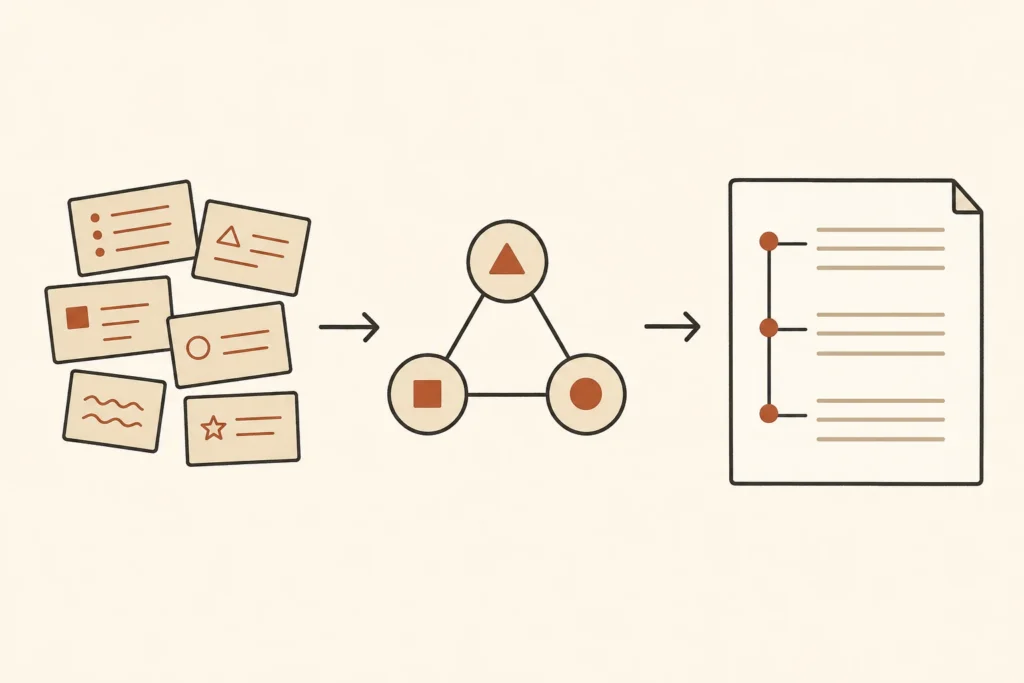
- Name three to six recurring debates, relationships, or causal questions, such as individual versus institutional power, continuity versus change, or two competing explanations for an outcome.
- Connect each theme to relevant units, texts, thinkers, cases, or events, even when they appeared in different parts of the course.
- Add one useful comparison or tension and two to four anchor examples that you could retrieve without rebuilding the entire unit.
Use the map to prioritize essay rehearsal, not to replace factual review. A definition, chronology, doctrinal element, passage, or case holding may still be an essential anchor even if it doesn’t fit a broad theme yet, but don’t give it prime essay-practice time until you can say what question or claim it could help answer. The examples that do have a job become the first entries in your evidence bank, and possible questions remain practice material rather than predictions.
Build Evidence Banks That Can Move With the Prompt
An evidence bank is not a grand fact inventory. Each entry should preserve enough context to retrieve the example and, more importantly, explain why you might choose it.
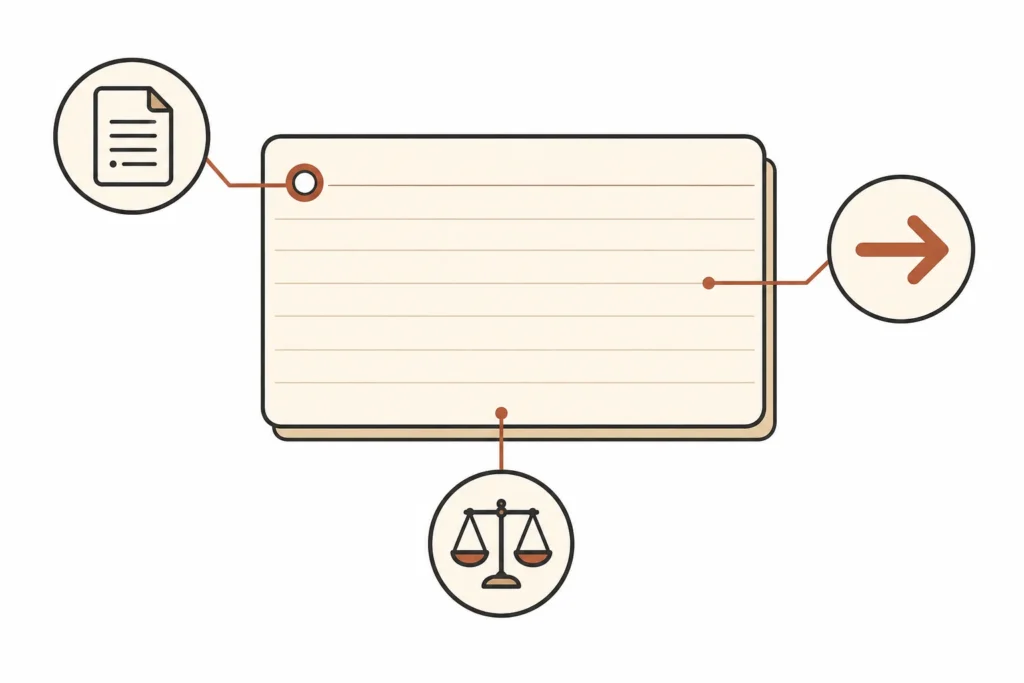
- The example, detail, quotation, case, event, or concept
- The course theme or debate it belongs to
- A claim or interpretation it could support
- A relevant contrast, limitation, or competing interpretation
I once caught myself copying names into a revision grid and feeling impressively prepared. Then I added a “What does this prove?” column, and several rows became embarrassingly empty, which was useful because the missing connection was finally visible.
A model essay fixes evidence inside one answer, while an evidence bank keeps its argumentative uses available for several answers. Models can still reveal expected depth or organization, but they become brittle when treated as scripts, and any quotation, citation, or outside-source expectations must match the course’s exam rules.
Treat Each Practice Prompt as a Set of Decisions
- The task verb, such as compare, evaluate, interpret, or analyze
- The subject, texts, cases, theories, or items being examined
- The time period, unit, source, or other limit on the answer
- The judgment or relationship your answer must establish
Comparison requires more than listing similarities and differences because you must explain their significance, evaluation needs criteria and a judgment, and analysis focuses on relationships rather than summary, although your course may define these terms more narrowly. A provisional one-sentence answer gives you something to test against the evidence, while changing the scope, comparison, or task verb in familiar practice questions keeps you from escaping into a rehearsed script.
Use Timed Outlines Until Writing, Not Planning, Is the Bottleneck
Not every practice session needs a complete essay. I dislike assigning full responses by default because they’re an expensive way to discover that the real problem happened in the first five minutes, when the claim and evidence were chosen.
| Choose a timed outline when | Choose a full timed response when |
|---|---|
| You misread the task or can’t state a provisional answer. | Your plan answers the prompt, but paragraphs drift away from it. |
| You list facts without deciding what they prove. | You select good evidence, but don’t explain its connection to the claim. |
| Your points feel interchangeable or poorly ordered. | Your reasoning is sound, but time expires before the answer is complete. |
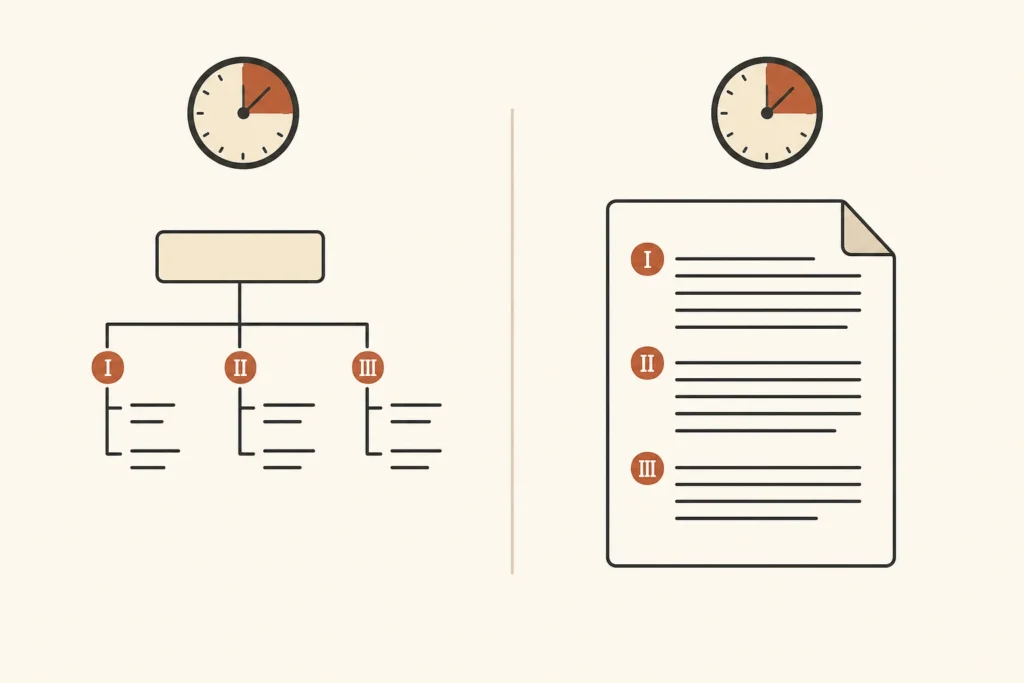
A timed outline is more than decorative headings, and it should contain a main answer, ordered paragraph claims, named evidence, and a brief note explaining how each item supports the answer. When that plan becomes dependable, full responses under the exam’s actual time and material rules can expose paragraph drift, thin explanation, and pacing trouble, so they create valuable feedback without needing to become the only tool in the box.
Let the Rubric and Old Feedback Choose the Next Drill
The most useful targets are one or two repeatedly weak, heavily weighted criteria from returned essays or the actual exam rubric, translated into visible checks rather than treated as a demand to repair everything at once, which usually produces a lot of concern and very little diagnostic clarity.
- “More analysis” becomes adding a sentence after each example that explains how it proves the paragraph claim.
- “Weak organization” becomes checking whether every planned paragraph advances the provisional answer in a distinct way.
- “Does not address the question” becomes marking the task, scope, and required judgment before outlining.

Scoring one timed outline or response against that criterion reveals what the next drill should address, and the rubric’s language and weighting outrank generic online essay advice because a structure that works in a history course may not satisfy a literature, law, or sociology examiner.
A Better Next Study Block Than “Review Everything”
Going blank becomes less mysterious when you repeatedly practice the first choices an unfamiliar prompt demands, so let the next-study rule be simple: if you can name facts but can’t say what they would prove for this question, practice an outline, not another reread.
Sources and references
- George Mason University Writing Center: Taking In-Class Essay Exams
- George Mason University Writing Center: Understanding Your Instructor’s Prompt
- George Mason University Writing Center: Outlining
- Cornell University Center for Teaching Innovation: Using rubrics
- Annual Reviews: Practicing Retrieval Facilitates Learning (2021-01-04)