

The blank page can be surprisingly rude, because a topic that looked obvious in your notes can suddenly produce three scattered words, half a formula, or an explanation that begins confidently and then wanders off looking for help. I once caught myself nodding through every heading in a set of notes, but when I closed the page, I couldn’t rebuild the argument in the right order, and that unpleasant little pause revealed the real distinction: recognition is knowing something when the material supplies it, while understanding has to remain usable after those cues disappear.
The page feels reassuring because it is still helping you
Recognition isn’t worthless. It helps you orient yourself, spot relevant terms, and follow an explanation, but it’s weak evidence of what you can produce independently because the wording, layout, highlighted phrases, and worked steps are all acting as cues.
This is why confidence measured while studying can run ahead of later performance, and experimental work has found that repeated study can increase confidence even when retrieval produces better retention after a delay. I find this especially annoying because rereading feels smooth and productive, while an honest attempt feels slower precisely because it is showing you the work your memory must do.
Highlighting and rereading can still help you locate and initially organize difficult material, but they shouldn’t be the final proof that you’re ready. Broad reviews of learning techniques have found stronger support for practice testing than for rereading or highlighting, so the last check needs to resemble the performance the course will actually require.
Replace “Do I know it?” with four observable checks
The following ladder is a practical diagnostic, not a formal scale and not a demand to reach the top for every topic. Start with the rung your assessment requires, because a vocabulary quiz may mainly test recall, while an essay, case, lab question, or unfamiliar calculation asks for explanation or application.
| Level | Small check | What the result tells you |
|---|---|---|
| Recognition | Identify the term, step, or answer while notes, labels, or choices are visible. | You can orient to the material, but readiness is still unproven. |
| Recall | Close everything and define, list, label, or write the key steps from a brief cue. | The basic information is available without the page. |
| Explanation | Explain how or why it works in plain language, or draw the relationship from memory. | You can connect the pieces rather than repeat their labels. |
| Application | Solve a changed problem, classify a short case, or justify which method fits. | You can select and use the idea beyond the familiar example. |
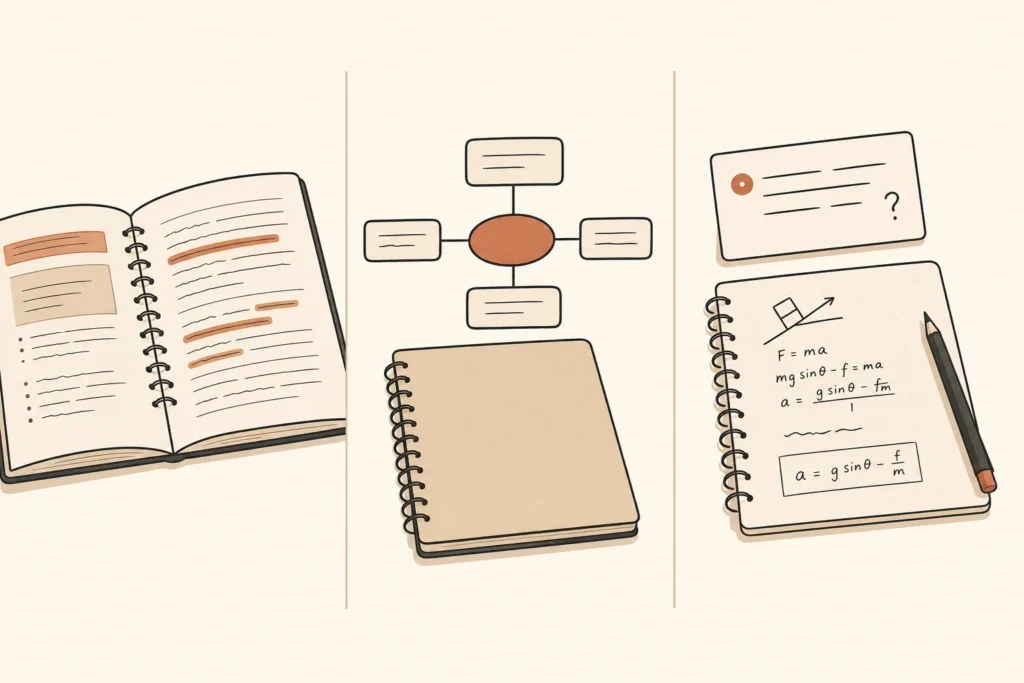
Multiple-choice questions can belong in this check when the exam uses them, but choices provide cues that a blank page does not. Before looking at the options, try to predict the answer or write one sentence explaining what the correct option must accomplish, then see whether your reasoning survives contact with the choices.
Run the smallest honest check before reopening your notes
You don’t need to turn an ordinary Tuesday evening into a full practice exam. One short response can reveal far more than another general review block, provided you attempt it before looking for help and check its accuracy afterward.
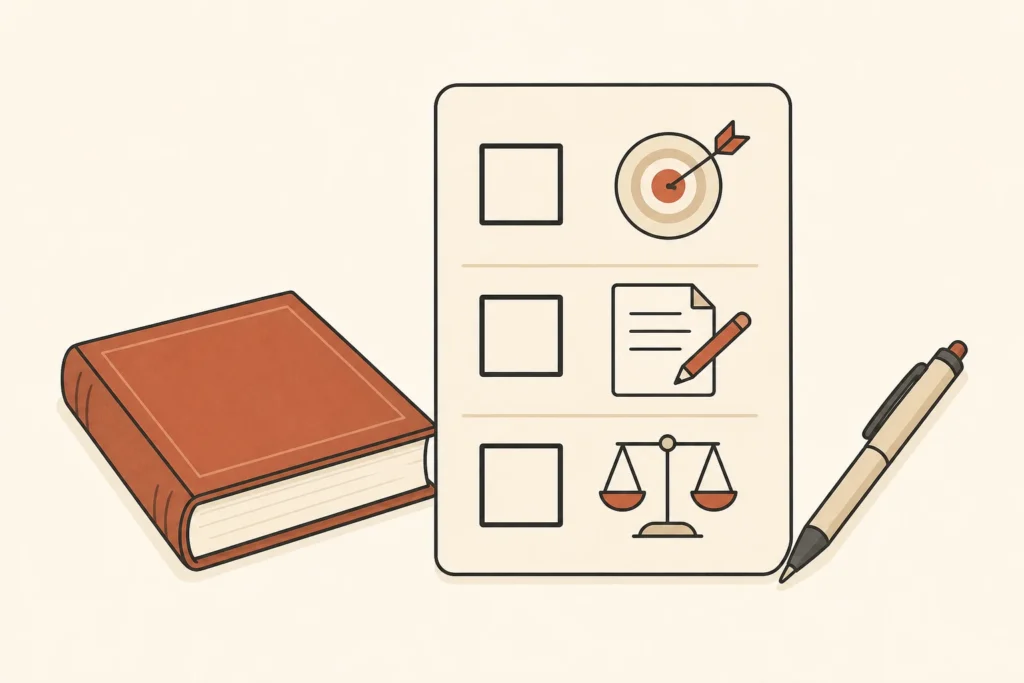
- Choose one concrete course demand, such as defining a term, explaining a process, selecting a formula, drawing a mechanism, or solving a changed problem.
- Hide the materials and produce one matching response. Use a blank page, a spoken explanation, a labeled sketch, or one fresh problem, whichever best resembles the real assessment.
- Compare your attempt with reliable course material only after finishing it, then mark what was missing, inaccurate, out of order, or recovered only after a hint.
- Name the gap as recognition, recall, explanation, or application, and put one matching repair plus one fresh check into tomorrow’s plan.
Checking matters because a fluent guess can feel secure until you compare it with the source, and a correct answer assembled through heavy hints still belongs in the “can do with support” category. I like this method because the struggle stays small: you’re collecting one useful piece of evidence, not staging a referendum on whether you’re good at the subject.
Let the kind of miss choose tomorrow’s task
A disappointing self-check becomes useful only when it changes what you do next. Treating every miss as a reason to reread the whole chapter is a very thorough way to avoid diagnosing the problem.
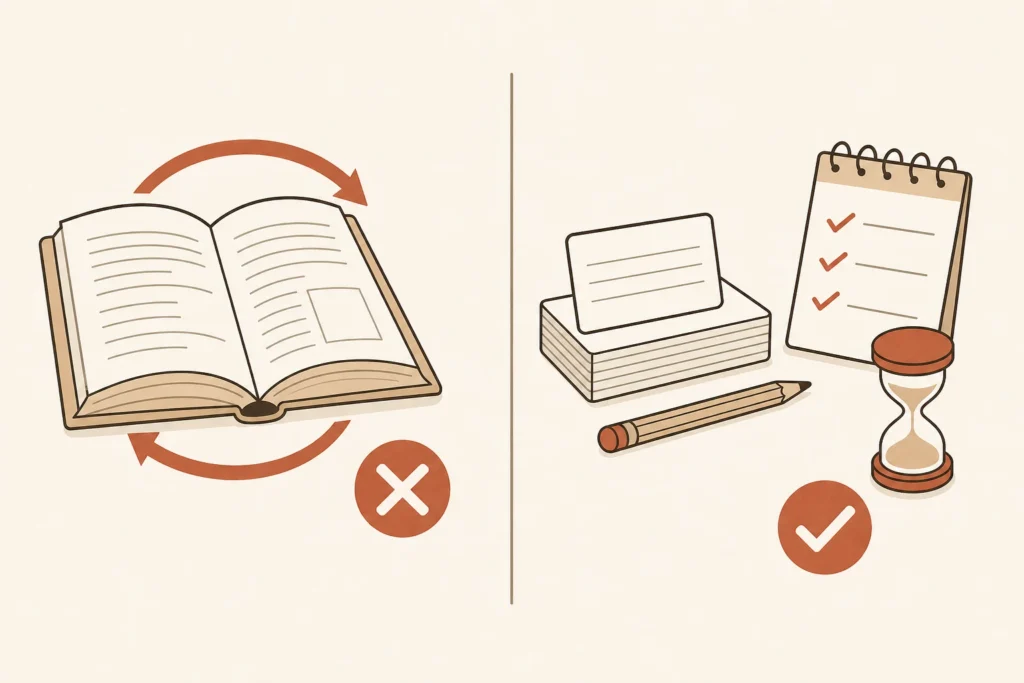
- Familiar only: The answer returns as soon as the page or worked example appears. Tomorrow, create a few brief retrieval prompts, answer them closed-note, check them, and revisit them later instead of rereading the section first.
- Recall gap: You cannot generate essential facts, terms, formulas, or steps. Narrow the target, retrieve from a short cue, check immediately, and retry after a delay before moving to harder application work.
- Explanation gap: You can name the pieces but cannot show their relationship, sequence, or cause. Rebuild one comparison, causal chain, or worked rationale in plain language, then explain it again without the source.
- Application gap: You can explain the standard example but choose the wrong method when the prompt changes. Work through two contrasting examples, identify the cue that changes the method, and compare the solution paths rather than merely rereading both answers.
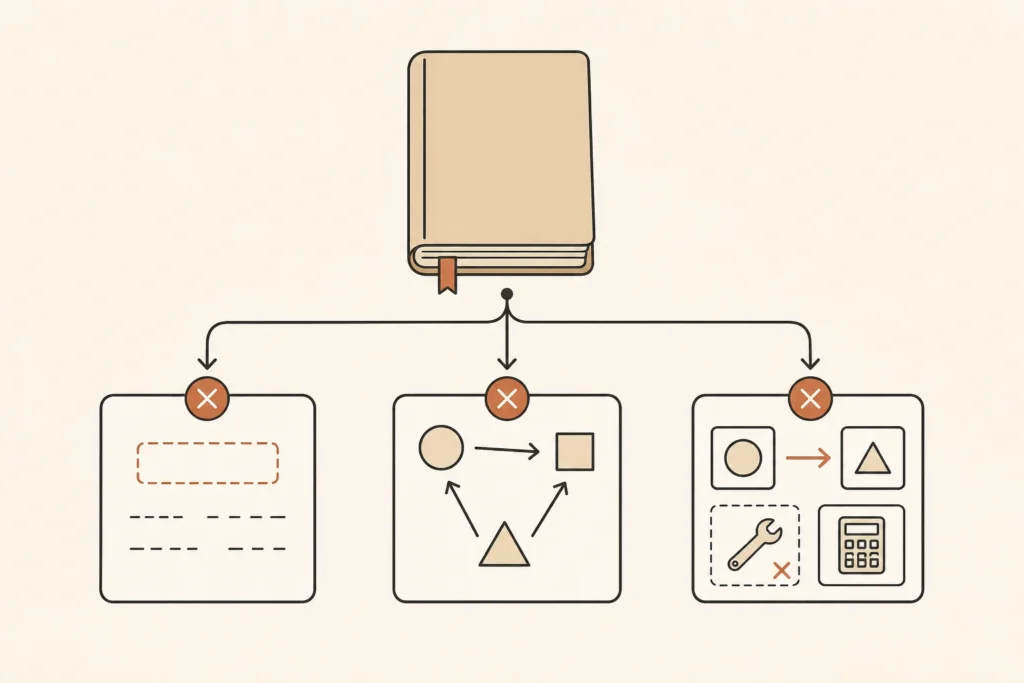
An application miss does not always mean the concept itself is missing. You may have misread the prompt, overlooked a prerequisite, or failed to notice the feature that distinguishes one method from another, so compare your method choice before deciding to relearn the entire topic.
One correct unaided answer is encouraging, but it does not prove the knowledge will remain available later or under a differently worded prompt. Put one fresh check into a later session, and let tomorrow’s plan contain the smallest repair that matches today’s miss, not another vague block labeled “review chapter.”
Sources and references
- Journal of Experimental Psychology: Learning, Memory, and Cognition: Koriat and Bjork 2005 on illusions of competence during study (2005-03)
- Psychological Science: Roediger and Karpicke 2006 on test-enhanced learning (2006-03)
- Journal of Experimental Psychology: Learning, Memory, and Cognition: Butler 2010 on repeated testing and transfer (2010-09)
- Association for Psychological Science: Dunlosky et al. 2013 review of learning techniques (2013-01-07)
- Cornell University Learning Strategies Center: Cornell Learning Strategies Center guidance on effective study strategies