

Avoid using speaking practice as a crutch for every free response. Try to record, in a single take, your best explanation to a given prompt. Compare this to doing the same explanation while a partner gives you follow-up questions. Look for inconsistencies, i.e. missing information, long pauses while you formulate an answer, logic that is presented in the wrong order, and an overall breakdown while doing a live exchange. Once you identify where you struggle, practice only that section and not the entire course again.
I would take those differences as clues as to what is wrong and not a diagnosis. Often times there are multiple issues at play, and while a few practice answers may give you a general idea of what your grade may be, you will not know for certain.
A correct opening can still leave you stranded
Imagine I’m practicing at my kitchen table, with a beautifully memorized explanation of why the median resists outliers. A partner asks for total income instead, and I start my median speech again. Halfway through, I realize I’m answering yesterday’s question. That’s an irritating snag, but it changes my next move: I need to practice choosing a statistic, not polishing the speech.
Consider five annual incomes: $30,000, $35,000, $40,000, $45,000, and $350,000. The first question is: “Which summary would you use to describe a typical person’s income here, and why?” One possible response is: “I would use the median, $40,000, because the mean is pulled up by the unusually high income, so the median describes the person in the middle of the group better.”
Now the follow-up: “Suppose you only have one summary statistic and the group size. Which statistic lets you recover total income?” The answer changes: “The mean. These incomes total $500,000, so their mean is $100,000. Multiplying that mean by five recovers the total. The median and group size wouldn’t generally let me do that.”
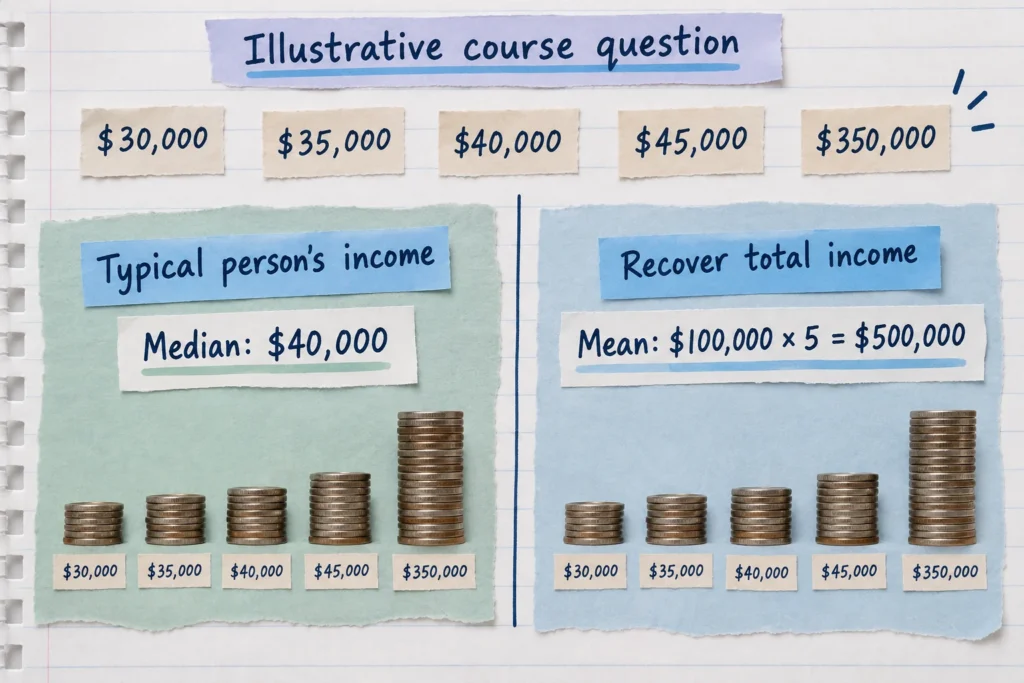
The first response was not incorrect. It answered a different question. I typically answer with a direct response, a reason, and an example of something that limits the answer, rather than with rigid sentences. That provides a better foundation to build upon when the rules of the game change. It may not always work; a proof, analysis, or language test may require different structures.
Compare what you can actually produce
You may wish to use a similar type of question in your course that assesses the same skills. Start with spoken responses (no notes), and then write (if that’s easier) to see how your students perform in different modes.
| Practice setting | What it can reveal | What can mislead you |
|---|---|---|
| Private, unaided spoken answer | Whether you can produce the content and reasoning without supplied cues. | No interruptions or listener; a familiar prompt may hide difficulty choosing an approach. |
| Single-take recording | Your actual answer order, omissions, and whether you ever reach the point. | Recording can itself create self-consciousness. Retakes can hide the initial breakdown. |
| Partner questioning | Listening, responding to changed conditions, and recovering after a follow-up. | Hints, friendly rescue, unusually hard questions, or hostile delivery can distort the task. |
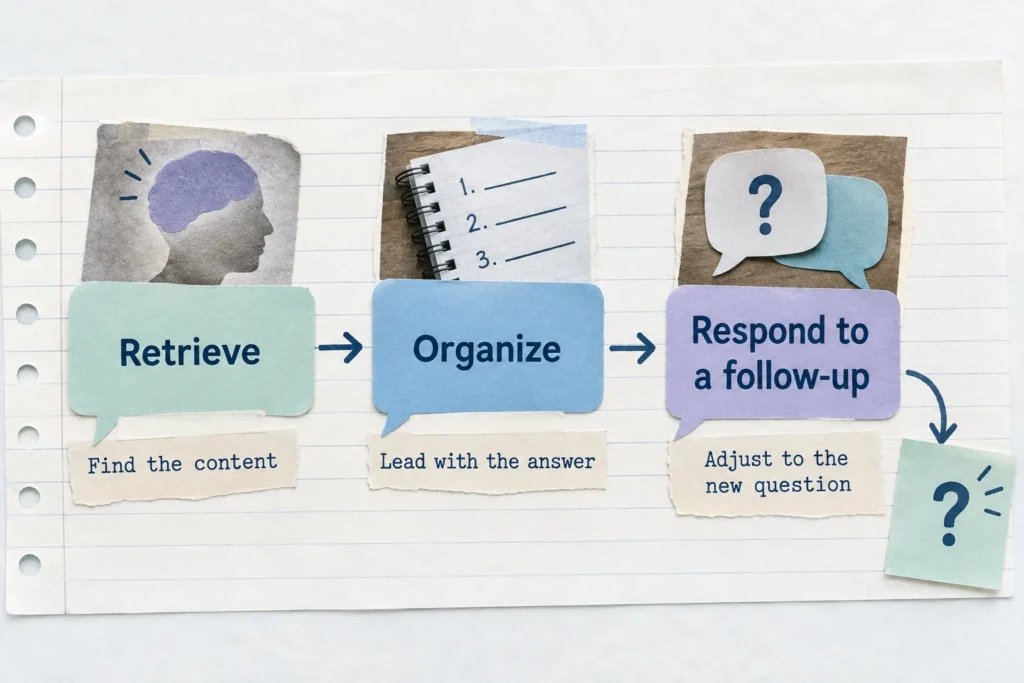
When the same question is asked repeatedly, answers to subsequent questions become easier to obtain. Using new prompts and looking for patterns across multiple sessions is a better approach. Factors such as fatigue and language demands can also affect test outcomes. This comparison is more of a practical approach to finding answers, rather than a validated self-test.
Give the recurring snag a narrower rehearsal
If incorrect explanations occur both privately and publicly, identify the specific content and self-test by attempting an explanation. Check the answer against course materials and correct the error. Revisit the explanation without the answer. This is the only way to identify the correction without being able to give the complete explanation.
If the correct response is long and takes a while to find, practice identifying the opening decision from different prompts. Verify the response before altering it to be within your course’s time constraints. Repeating a memorized opening may appear faster, but doesn’t help find a different answer.
Listen to one recording to see where the answer begins. Then, practice putting the answer first, justification second. In the income example, saying “I’d use the median” lets the listener know the explanation will be about the difference between the two incomes before the justification. Don’t lose time for each filler word. Hesitation does not mean missing reasoning.
If a student repeatedly gets the right answers but keeps revealing incorrect ones, then that student also provides a helpful practice by including listening and follow-ups. Ask the student to conceal hints while you attempt the problem. Afterwards, tell the student one or two things you should have included in your answer. The student must ask questions like the course expects; conducting an interrogation is not ok. If one student continues to disrupt the class, that is a good reason to ask for feedback or to seek support, but continuing to expand the content you review is not warranted.
The research supports some of this more directly than the rest. A systematic review found numerous classwide benefits to implementing retrieval practice. An oral-assessment review identified practice and feedback as positive contributors, but also mentioned other activities, including presentations, and a variety of study designs. My targeted rehearsal suggestions expand the evidence from the reviews to this case; the reviews do not address whether diagnosing freezing with anxiety and rehearsal are related.[1][2]
Don’t rehearse rules your course doesn’t use
Before you set a timer, check with your instructor to clarify how much time you can spend preparing the answer, the expected length of the answer, whether you can take notes, whether you can write the questions, how follow-up questions work, and what answers will earn you points. It is a good idea to ask permission to take a pause, repeat a question, write down keywords, or jot down a few things to assist you in your preparation. These permissions aren’t given at all exams, however.
For example, UC San Diego instructor Will Styler’s published policy permits written questions and doesn’t deduct points for nervousness or accent, but gives zero for a question if a substantive answer cannot begin after a full minute or a second asking. That is one instructor’s policy, not a recommended pause length for you. Your own criteria should shape rehearsal, rather than generic advice about eye contact or flawless delivery.
When another practice session isn’t the best next move
If you can’t judge whether an answer has enough reasoning, bring an instructor a specific prompt and a short answer outline, or a recording if they agree to review it. Ask: “Is the missing part my explanation, my application, or how I respond to the follow-up?” A partner may notice that you ramble without knowing what the course actually rewards.
For a disability-related barrier to access, contact your accessibility office as early as possible about your documentation, deadlines, and possible arrangements. Examples from your institution may help; for example, Boston University has informational consultations prior to intake, and in its process, you submit an application, documentation, and review. Your institution makes its own decisions about the processes and procedures for making formal requests; don’t assume a written alternative will be approved or wait until every last option is exhausted.
Worry is having an impact if it’s affecting your sleep or making you avoid going to class or to assessed situations. You may need to contact a counselor or healthcare professional. Freezing doesn’t mean you have an anxiety disorder.[1][3][7]
For a different type of question, try a different opening or follow-up. I’d rather hear an answer to the new question that is slightly unclear than a really well-articulated answer to the old question.
Sources and references
- Educational Psychology Review: Retrieval Practice Consistently Benefits Student Learning: a Systematic Review of Applied Research in Schools and Classrooms (2021-03-14)
- Assessment & Evaluation in Higher Education: Interventions and facilitators of oral assessment performance in higher education: a systematic review (2025-06-01)
- World Journal of Psychiatry: Oral but not written test anxiety is related to social anxiety (2016-09-22)
- University College London: Making oral assessments inclusive
- University of California San Diego, Will Styler: Will’s Oral Exam Procedures and Policies
- Boston University Disability & Access Services: Requesting Accommodations
- University of Massachusetts Amherst: Test Anxiety