
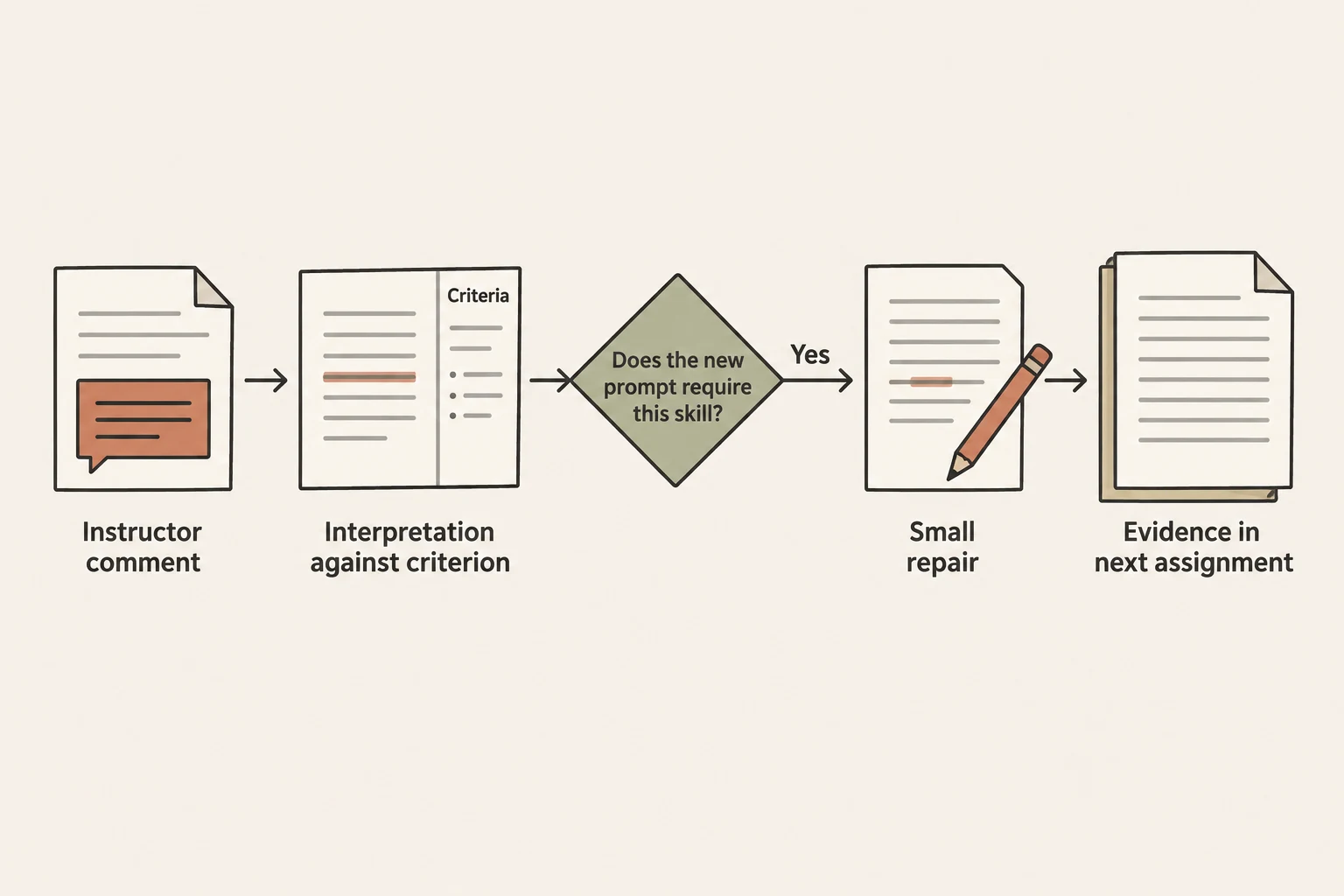
Select one or two prescriptive comments relevant to the following prompt, recognize the absent skill, practice it over a brief passage or logic problem, and review the next submission for that improvement. Feedback isn't a to-do list you slip forward intact: some comments point out deficits you can carry forward, others apply only to the finished work or its score.
1. Select feedback for the next task
Put the annotated assignment next to the following prompt and rubric. Distinguish between recurring skills (such as explaining why evidence supports a claim) and local requirements (such as explaining an assigned source). Distinguish grading questions as well: a challenged inference should be followed by justification of how the criterion was measured, not an assumed revision of your prose. Similarly, university writing-center consultations differentiate conversations about a grade from talk about how to do better next time.[3][4]
Choose a weakness that is on something important, repeated or brought to your attention by the instructor and is reasonable for you to fix. Ten punctuation errors don't trump one comment on an unsubstantiated assertion. On the other hand, a missing element that was required or a significant factual error might. Next to each comment jot down the criterion and location of the next assignment where it is needed: "Evidence and reasoning, support recommendation made in discussion section." If you can't recall where that is, ask yourself if the comment carries over.
Selecting one or two targets is a heuristic for managing your workload. It is not something that research has identified as optimal. Feedback-literacy research highlights the importance of interpreting information and putting it to use, and acknowledges that feedback targeted at a specific task can be harder to generalize; it doesn't show that this four-step process will lead to better grades.[1]
2. Clarify the missing writing or reasoning
Turn the comment into something you can see in the work. "More analysis" could mean break down evidence, weigh reasons against each other, or assess a limitation; adding sentences could fix none of these. Systematic review found ambiguous terms and lack of specificity were barriers to implementing feedback. If alternate understandings would result in dramatically different revisions, clear up beforehand to avoid sinking in.[2]
Post the direct quote ,the rubric you are referencing, and a suggested fix. Example: "You noted 'more analysis' on my paragraph where I summarized both authors. The rubric wants me to compare their reasonings. I believe I wrote their common conclusion but did not show how their reasons contrast. Would contrasting those reasons fulfill that, or is analysis missing as well?" It allows the teacher to see what you are reading from it.
Wait until you are able to articulate what is missing as well as what would show it. If your note doesn't match up with how you graded according to the rubric, note the conflict in your question rather than believing one of them is absolutely correct.
3. Rehearse the skill, then adapt it
Revise only a small portion of your old work, instead of redoing the entire assignment. Instead of saying "Both authors support the policy" in your constructed comparison example, say "A supports the policy because it expands access; B supports it because it reduces costs. They agree on a solution, but stand on different principles." Read the originals: only use an explicit relationship if it's earned.
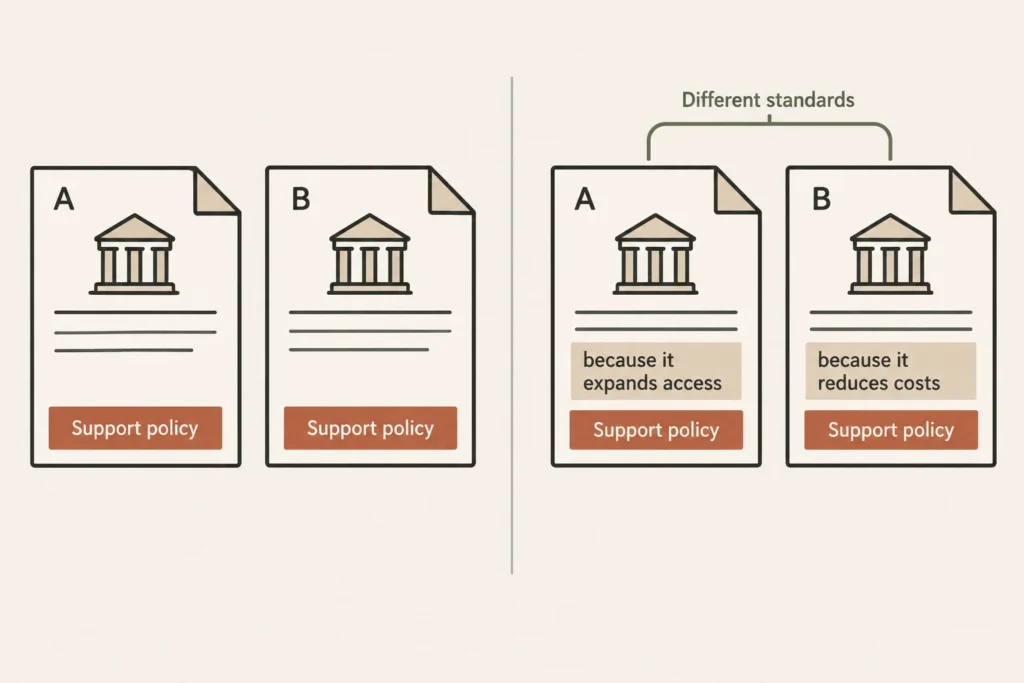
Now write the corresponding move in your current assignment. If its prompt asks you to explain rather than compare, don't stuff two perspectives into it. Port over the underlying habit, allow the linking of evidence and conclusion to be visible, not the old paragraph template. If you did it right, the new passage responds to the new prompt with reasons clearly articulated, not that it looks like the patched up passage.
When doing work that requires reasoning, practice supplying the omitted reasoning. If there's a comment that says "reason why you can do this step" next to dividing by a variable, come up with the requirement that allows you to do it and address the zero case if you can. On a future problem, provide the requirement wherever it's needed, not some canned reasoning for a step your new solution doesn't actually take.
4. Inspect the criterion before submission
Find the skill you want to target in your new draft. Find where you compare it to the actual criterion. Show someone else (a reader, tutor) your essay and say, “Hey, look at this paragraph. Where do I compare the authors’ reasons?” If they don’t see it and you didn’t draw attention to it first, the relationship is nonexistent or unclear. If they do see it, great. Make sure it’s correct; just because you can see it doesn’t mean it’s logically sound.
If feedback is received after beginning a draft, select edits that can be finished and double-checked prior to submission. An omitted rationale may be incorporated into another paragraph; an entirely new thesis may necessitate edits throughout. Do not automatically recommit. However, do not keep an essentially incorrect interpretation of the prompt just because you are close to done. Make note of larger outstanding skill goals on a future appropriate assignment.
When the evidence returns, compare comments about the focused criterion, not just the grade. Better connection to evidence can still earn low scores elsewhere. See the corrected previous passage above where I fixed one local spot. Successfully using it on your own in new writing is better evidence of transfer. If an old worry returns, check if the move was missing, incorrect, or not enough to meet the criterion before you tweak your practice goal.
Sources and references
- Assessment & Evaluation in Higher Education; University of Hong Kong repository: Carless and Boud, The development of student feedback literacy: enabling uptake of feedback (2018-05-03)
- Educational Psychologist; Aston University repository: Winstone, Nash, Parker, and Rowntree, Supporting Learners’ Agentic Engagement With Feedback (2016-09-08)
- University of North Carolina at Chapel Hill Writing Center: Getting Feedback
- Austin Peay State University Writing Center: Understanding Writing Feedback