
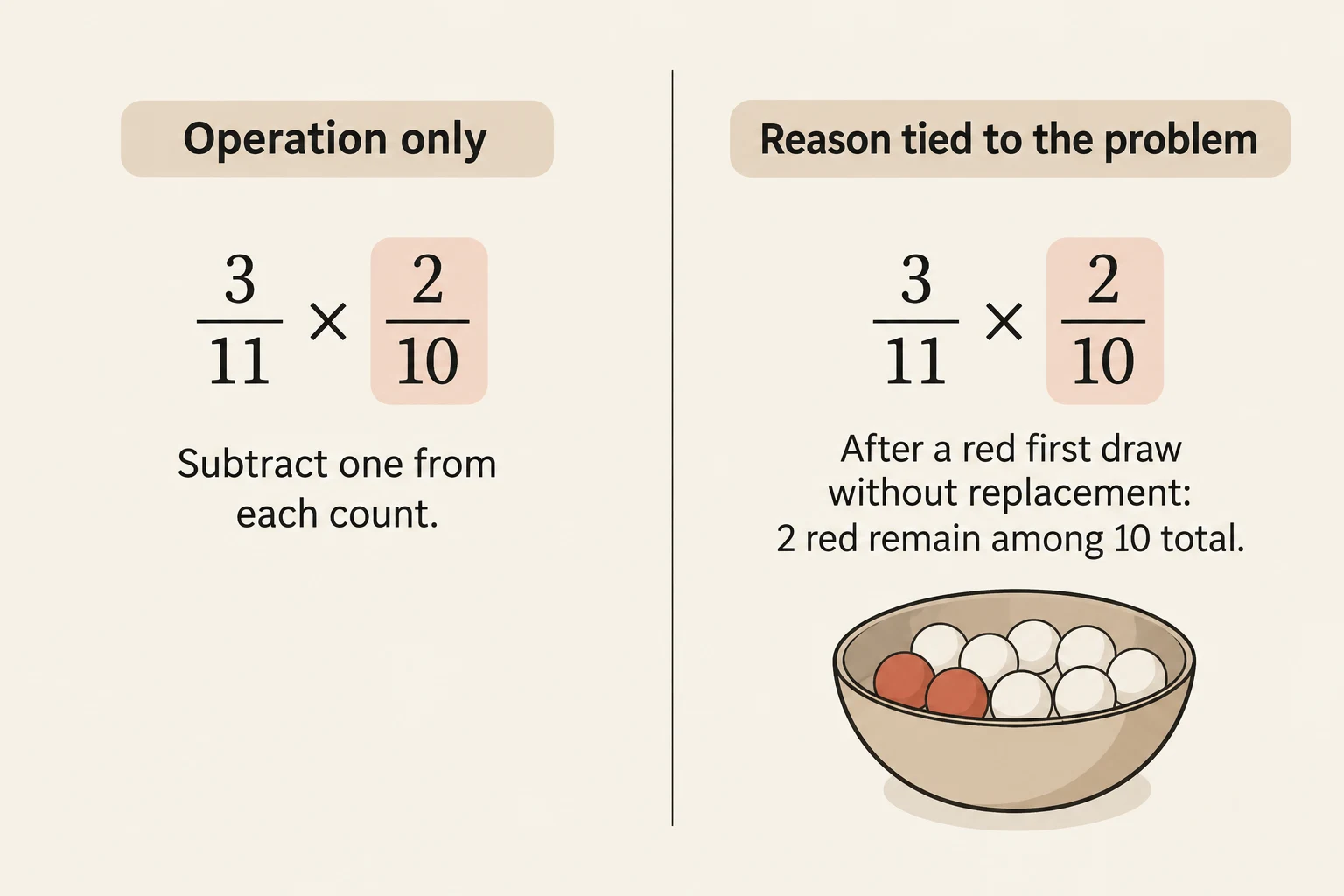
Practice setting up a solved problem so that you understand why the subsequent moves logically flow from the position. Then remove your crib and play through a puzzle that alters a piece of pertinent information. Playing through the printed board configuration tests pattern recognition. Creating the position and modifying it tests logical thinking skills. Refer back to the example while you are still learning a rule. Once you know it, stop looking at parts you can already setup correctly.
1. Explain the solution’s consequential decisions
Select EITHER a textbook OR instructor-provided solution of a problem you currently cannot explain or execute. Provide a complete worked out example when you would have insufficient cognitive load to search for your next step. If you have similar problems that are doable, try one on your own and use the example as a reference if you get stuck. Studies have demonstrated expertise reversal effect, where scaffolding that benefits novices can become superfluous with an increase in germane knowledge; it all depends on this problem, not your overall grade in the course.[3]
Here's another probability question: An urn holds three red marbles and eight blue marbles. Two marbles are drawn at random without replacement. Find the probability that both marbles are red. Assume that the marbles are equally likely to be drawn and that the urn is sufficiently mixed. Solution: P(both red) = (3/11)(2/10) = 6/110 = 3/55.[4]
Stop before multiplying and tell why you chose that method: You need to pick red first AND red second when you are trying to find "Both red." The rule is P(A and B) = P(A) × P(B given A). Multiplication allows you to find the probability of the first event AND the second event conditional on the first. Multiplication does not need the events to be independent because the second probability is dependent (conditional). Addition would find the probability of EITHER red drawn, not the two-event probability you want.[4]
Now, describe the evolving second factor. "Without replacement" means the first marble is not put back. For the branch where the first marble drawn was red, there are now two red marbles out of ten total marbles. Thus, P(second red | first red) = 2/10. The top and bottom both refer to the urn after a specific first event has occurred, rather than being a general rule of decreasing each number by one every time there are two draws.[4]
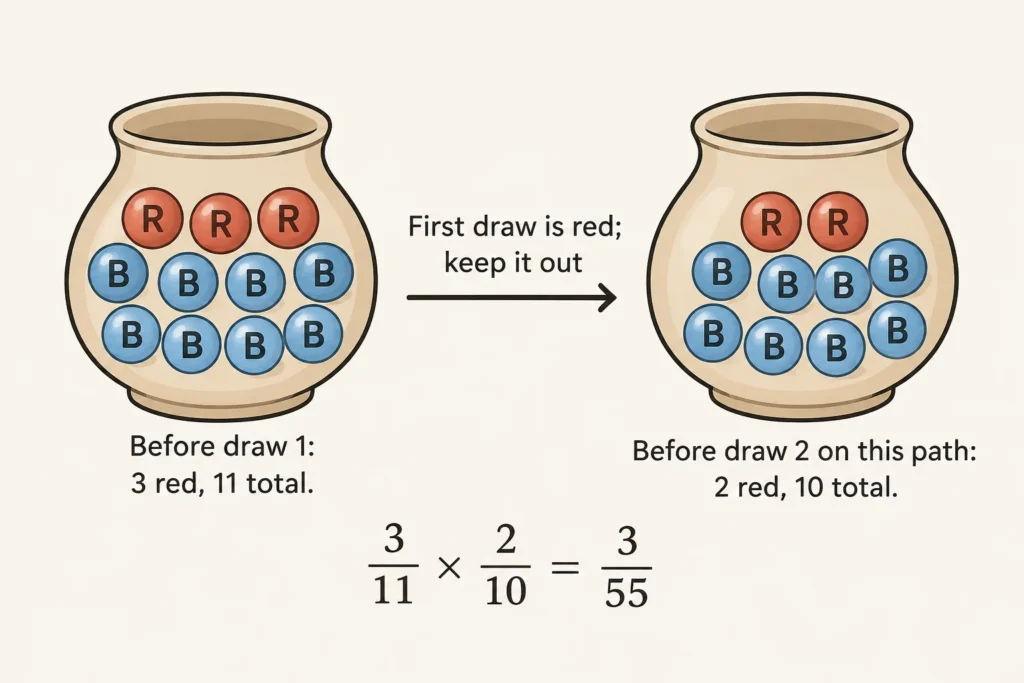
Provide short explanations next to these important steps. "Multiply the fractions." tells what to do. "Multiply the first-event probability by the conditional second-event probability because both events must occur." tells why. Blank the line below before you write your explanation so it can't give you the answer. You do not need to explain how to simplify fractions unless the simplification is the issue.
This teaches itself: producing connections or implications instead of restating visible text. One meta-analysis showed prompted self-explanation led to better learning overall, though it doesn't mean any plausible explanation is correct. If you can't explain why the conditional multiplication rule is valid, review that rule and its conditions from your course materials. The success signal is rationale that relates the problem's statement to the move without referencing the next printed line.[1]
2. Complete progressively less supplied work
Pose a similar question with a step of the solution provided. If the selecting process is still confusing, leave the first step visible and delete a subsequent meaningful step. Example: An urn contains four red marbles and six blue marbles. Draw twice without replacement. What is the probability of drawing two red marbles. Provide P(both red) = ( 4/10 )× _____. Complete the blank and describe the state of the urn it corresponds with then calculate.
The deleted factor is 3/9. so (4/10)*(3/9) = 2/15. Providing it completes the proof that you can alter the urn and apply the provided procedure. It doesn't prove that you would have chosen conditional multiplication on your own: the problem statement did that for you. Delete a step or manipulation that challenges thought, not random every other line or just the answer.
If there is a reasonable amount of work missing, try another similar problem without providing the equation. Before solving, say what event is asked for, which rule you will apply and what information tells you each factor. If you get stuck, name the unresolved branch and look at one cue or rule instead of flashing to the entire solution. Write down that prompt: An answer with a cue is progress towards a solution, but that is not solving it independently.
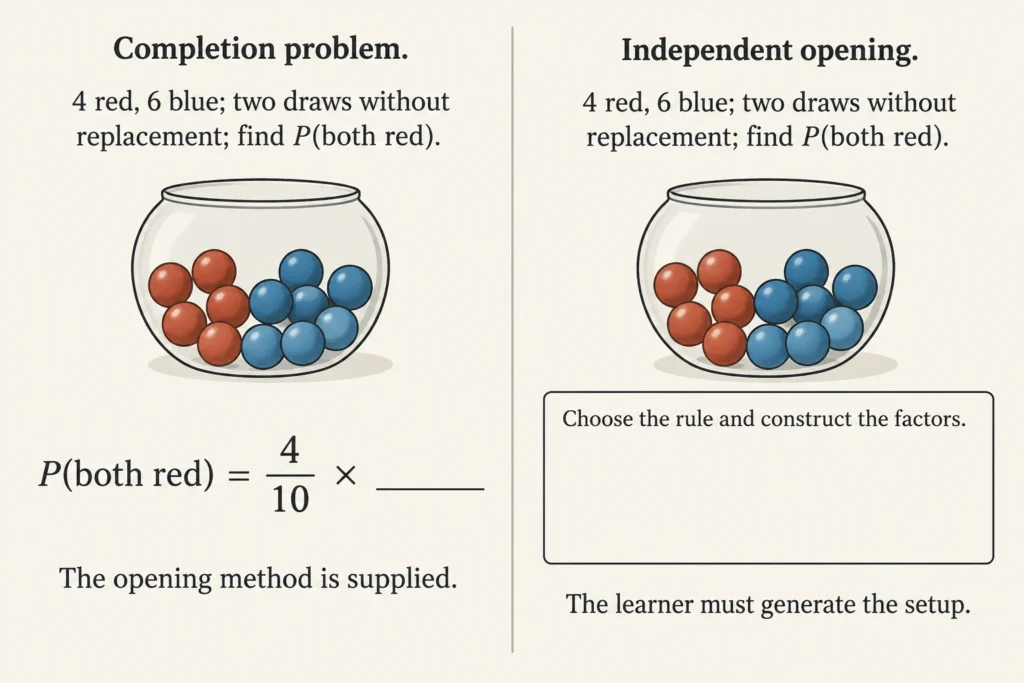
Keep worked solutions for problems you can't solve yet; take them away when you can solve and explain the work. You may need a worked out problem even for a harder problem if you don't know all the steps. On the other hand, you probably don't need to read the whole solution over and over again if you only stumble on one move. Let your performance dictate these decisions, not an arbitrary number of problems.[3]
The sequence above is an example of how one might edit using this strategy. It is not an empirically-proven recipe. There have been studies using probability problems which faded worked examples and prompted students to verbalize principles. However, those studies also provided feedback. We do not know from those studies that explanation without feedback is sufficient, or that this technique will ensure transfer to novel proofs or other mathematics. Compare each response to both the answer and the underlying principle before fading additional assistance.[2]
3. Solve a changed problem independently
Shelve the solution and alter an assumption that impacts inference, not just numerals. Return to the urn with three red marbles and eight blue marbles, but this time replace the first marble and shake up the urn before pulling the second marble. Determine the probability that both marbles are red. State if the first red marble impacts the likelihood of a red marble in the second draw before presenting your equation. Try solving the problem before viewing the solution below.
Sampling with replacement leaves us with three red marbles out of eleven before the second draw. The chance of drawing a red marble on the second draw is therefore still 3/11, so P(both red) = (3/11) × (3/11) = 9/121. The multiplication rule holds, but the conditional second factor no longer gets smaller. An answer needs to explain what changed and what didn't. Copying the original 2/10 maintains the sequence but disregards the new condition.[4]
Save your work. Find the earliest point where you made a move without support from scratch. If you inserted the draw prob's or weren't sure what to do about "both," go back to combining events and choosing your method. If you multiplied but kept 2/10, go back to how replacement affects the state for the second draw. In either scenario, more math drills would have you miss the logic issue.
If you got the product incorrect but your work and explanation were right, continue working the incorrect problem without starting the process over. If you failed to state the prerequisite rule even with a hint, read the explanation of that rule and practice using it; you do not get extra blanks for missing instruction. Being correct is not enough if your written explanation shows you guessed or used a rule in the incorrect situation.
An independently selected configuration, an accurate description of the new state, and a verified outcome warrant decreasing assistance on similar problems. One study variant offers anecdotal evidence of understanding, but not necessarily evidence of permanent proficiency or test preparedness. After some time, on another new course question, test to see if you can still produce the starter; if you can't, reinstate assistance at the point of failure instead of re-reading the whole solution.
Sources and references
- Educational Psychology Review / Springer Nature: Bisra et al., Inducing Self-Explanation: a Meta-Analysis (2018-03-29)
- Journal of Educational Psychology / American Psychological Association; full-text copy hosted by Mr Barton Maths: Atkinson, Renkl, and Merrill, Transitioning From Studying Examples to Solving Problems (2003)
- Educational Psychology Review / Springer; author-posted full-text copy: Kalyuga, Expertise Reversal Effect and Its Implications for Learner-Tailored Instruction (2007-09-13)
- OpenStax / Rice University: Introductory Statistics 2e, Section 3.5: Tree and Venn Diagrams