
Prioritize what to do next based on the cost of delay and whether the remaining work still fits before the deadline, not just the closest due date. It could be a short dependency or question that comes before scheduling the biggest block of time for a final that depends on it. If the required workload is more than your available time, trim optional scope or negotiate allowable slack; reprioritizing won't fill gaps that don't exist.
1. Check each assessment’s actual constraints
Click on the syllabus and assignment description. For each, note the due date, overall-course weighting, late-credit policy, expected elements, and pass criteria for the class. Differentiate between "loses some credit tomorrow" and "does not earn credit after tonight." Determine if the assignment can be dropped or is unlocked by completing a future assignment. An easy required lab might warrant shielding prior to a larger, elective activity.
Policies can vary within a course. One syllabus from Spring 20|26 at the University of Florida generally denied late logs and quizzes but gave some decreased project credit if you handed something in during a set window of late days. One course from Spring 20|26 at Cornell gave some slip days but did not offer any late credit beyond that. These are just examples from individual courses, not whole universities. Neither of these policies/rules will apply to your assignments.[4][5]
Compare percentages for your final courses, not raw point values. A 100-point homework assignment may count for less than a 20-point quiz in someone else's grading system. Percentages for your courses also need to be viewed holistically: a particular exam may have its own passing requirement or one class may be closer to your grade boundary than another. Clearly indicate questions you did not finish; an assumed extension request or guessed-at partial-credit policy does not constitute available capacity.
2. Compare remaining work with available hours
Try to estimate how much work is left to fulfill each requirement, independently from what would make the assignment better. For a paper, requirements may be: a defensible thesis, required evidence, all required sections, citations, and submission verification. Additional sources or another pass through APA might be optional. By "minimum acceptable submission" we mean a complete version of your paper that actually meets requirements and is done to a level you are willing to submit, not an incomplete draft that you are hoping will earn partial credit.
Separate research from waiting. Sending a data request can take minutes, but it might take days to get an answer. You need to wait until you have the data before you can analyze it. If uncertainty can affect whether something can be done, do a bounded first pass. Find the necessary sources. Run the analysis. Write one sample subsection. When you have sufficient information to revise your estimate, stop. Don't turn this inspection into an unknowingly scheduled completion task.
Draw from similar past tasks, but do not consider estimates set in stone. The planning-fallacy studies showed that anchoring in relevant past experience reduced optimistic prediction bias but did not aid overall predictive accuracy in that experiment. Rice's workload estimator does similarly break down reading difficulty and purpose, and qualifies its writing estimates as guesses. These articles justify breaking down tasks; neither gives you an exact number to multiply by pages for yourself.[1][2]
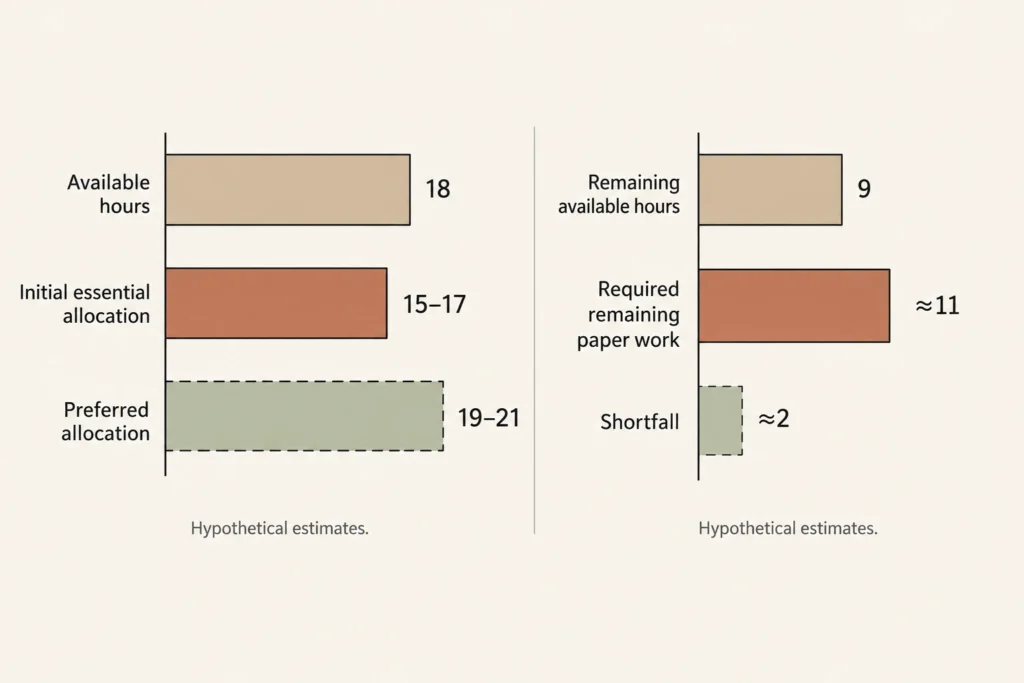
This week only has 18 hours left to work with. Keep in mind that these are planning estimates; they are not necessarily how long you should study something. This student made sure they can fit the quiz and exam studying before their self-imposed cutoff.
| Assessment | Consequence and constraint | Remaining effort |
|---|---|---|
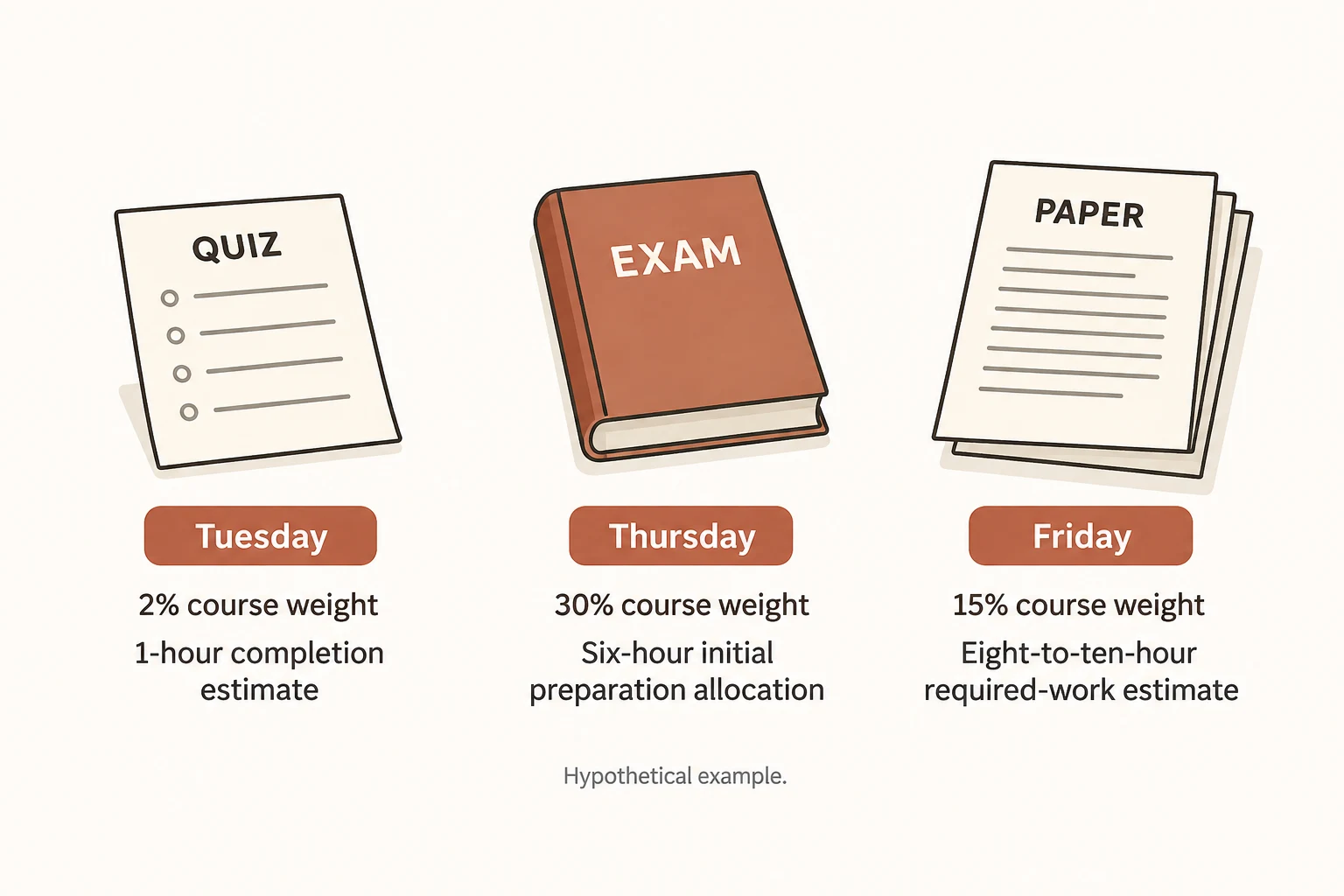
| Quiz due Tuesday | 2% of course grade; no late credit | About 1 hour to complete and submit |
| Exam Thursday | 30% of course grade; fresh practice shows a recurring method-selection gap | 6-hour initial allocation for targeted preparation and checks |
| Paper due Friday | 15% of course grade; required analysis must precede the argument; no confirmed extension | 8-10 hours to meet the brief, plus 4 hours of preferred refinement |
The soft estimate is 15-17 hours; the optimistic estimate is 19-21 hours. Subtract out the four hours of optional assignment polishing before you schedule for the week. The leftover 1-3 hours are slack for unknowns, not evidence that everything will fit into the schedule. Also verify the previous deadlines independently: 18 hours before Friday lunch won't save a test if you don't have enough hours before Thursday night.
3. Protect consequential work and unblock dependencies
Move the first short task out of the block. Send me questions regarding clarification of the analysis now, rather than after the exam when there will be too little time to respond. Assign the remaining block to studying for the exam if pushing it back will risk the learning gap mentioned above. Block off the quiz's estimated time frame before Tuesday. Account for submission confirmations as well. The closest due date is safe if you don't get the majority of the week.
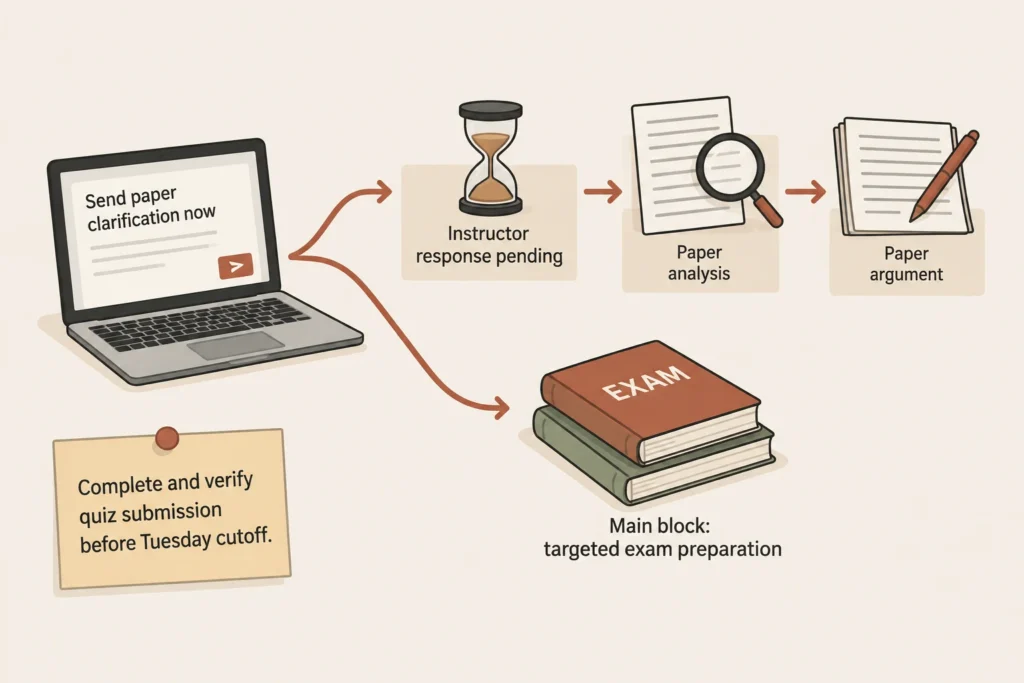
They're guidelines for editing, not a tested prioritization algorithm. They rely on variables also found in Bryn Mawr's student academic-support manual: significance, timeliness, dependencies, workload, available supplies, and scope for negotiation. The relevant question is what the next block maintains, frees, or reasonably enhances, not which item tops the list.[3]
Grade math tells you about risk levels, not expected gains. In our fictional scenario, improving your exam score by ten percentage points would be worth three percentage points towards that class total; improving your paper score by ten percentage points would be worth 1.5. However, you can't guarantee either increase with one more hour. Splitting total assessment value by your guessed hours at it misunderstands the trade-off; you're deciding between your remaining hours, not buying "the test's" worth of credit.
Assign some visible output to your selected block. On the test, fix your persistent method-problem selection mistake and verify it on new questions you are confident meet course objectives. For the paper, finish the remaining analysis necessary to complete your argument. If you are getting satisfactory results practicing for the test already, that may merit less of your time than leaving a required section of your paper incomplete. Formatting your paper should not take away from studying if there are serious mistakes you will make on the exam.
4. Revise scope from observed progress
Reset your timer when an outcome assumption becomes measurable: once the paper's prerequisite research is done, once you complete the first exam question you directly studied for, or once you reach some other measurable milestone. Log how much was accomplished versus what's left, instead of just how long it took. One off-testing prerequisite doesn't set the pace for every subsequent segment. Find out what changed where before generalizing.
Imagine that the student now reports having spent one hour on the quiz, six hours on exam preparation, and two hours on the paper. That leaves nine hours. Revising his time estimates for the paper, he realizes that the required work will take another 11 hours, not six to eight hours. Now the shortage is roughly two hours. And he's already taken "polish less" off the table.
First determine whether the scope creep is actually due to a misconception about what was required. Pose a binary question like, "Do we need to include both analyses, or is one analysis that is fully justified enough to meet this requirement?" If you really do need to do both, negotiate an officially sanctioned extension, unused slip day, or instructor-supported method for overcoming the technical hurdle. Specify what you have done, what you still need to do, and what specific substitution you are requesting. Don't claim that existing deadlines from other classes should be considered extenuating circumstances: the referenced Cornell course noted that other courses did not provide valid reasons for extra leniency.[4]
Prior to approval, keep the current cutoff. If there's still a deficit, weigh the actual penalties for on-time submission of a reduced scope deliverable against late allowance. Eliminating a component may mean you can't turn in the assignment; turning it in late may mean you lose all points or receive a lesser deduction. Decide based on the actual rule and expected rubric loss. Should cutting corners still result in losing points, show that loss instead of maintaining an improbable distribution or pulling hours from another guaranteed assignment without adjusting its penalty.
Sources and references
- Rice University Center for Teaching Excellence: Course Workload Estimator
- Journal of Personality and Social Psychology; Buehler, Griffin, and Ross: Exploring the Planning Fallacy: Why People Underestimate Their Task Completion Times (1994-09)
- Bryn Mawr College Academic Support: Priority Setting
- Cornell University: Late Work & Deadline Extensions, INFO 4340/5440, Spring 2026 (2026-01-19)
- University of Florida Department of Psychology: DEP 3053 H576, Spring 2026 Syllabus