
Why Do I Get Practice Questions Right by Topic but Miss Them on Mixed Exams?
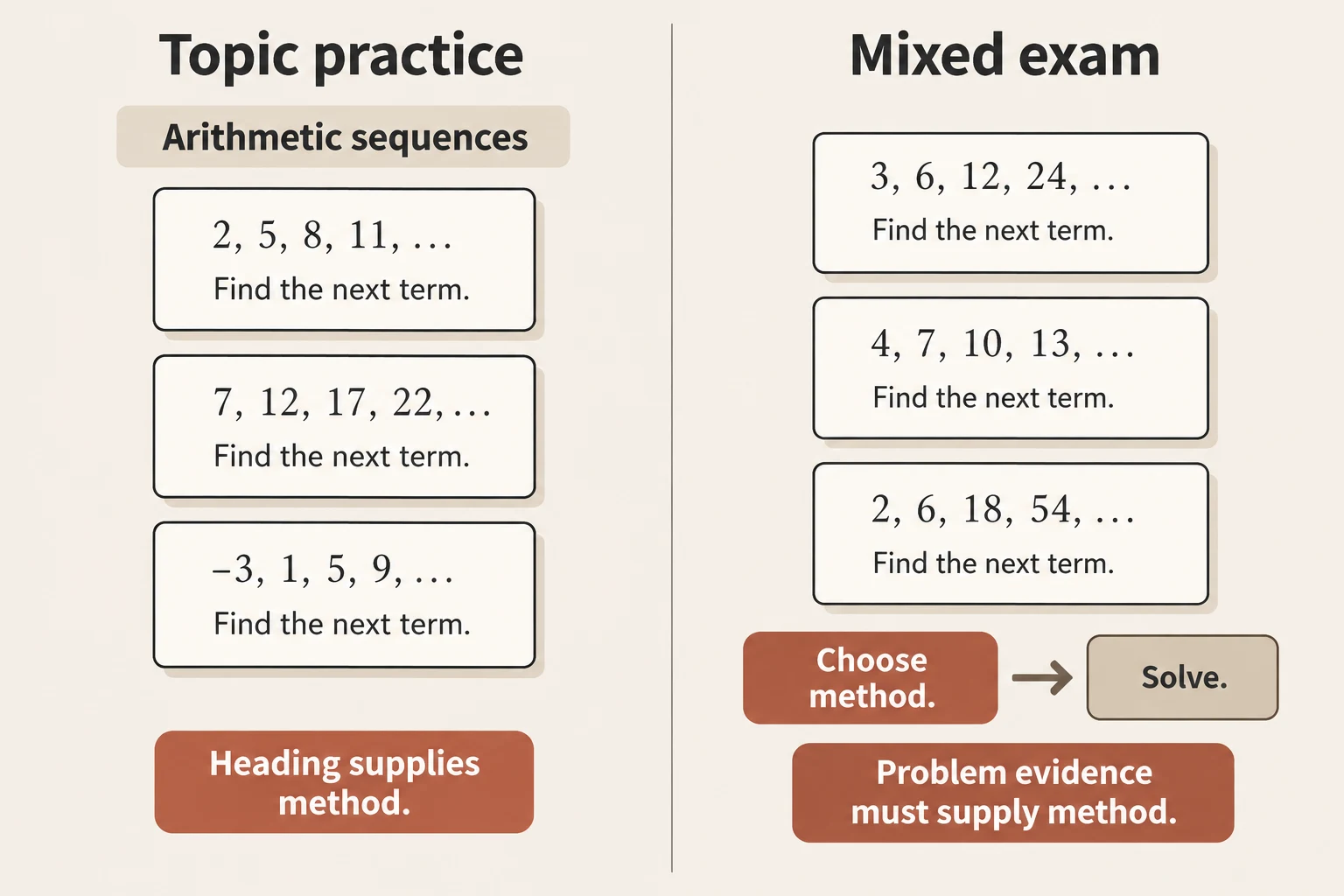
>Section-specific practice allows you to know the method before you see the problem: the title and previous questions tell you what to use. A mixed exam eliminates that signal. You may know how to perform each method but not consistently select between them. Determine whether your first mistake is picking the method, remembering it, or executing it before you repeat more problems you are familiar with.[1]
Same starting numbers, different relationships
Imagine two algebra questions looking for the sixth term. A starts: 3, 6, 9, 12. B starts: 3, 6, 12, 24. Suppose the class instructs you to look for an arithmetic or geometric pattern. They both start with 3 and 6, so that commonality doesn’t tell you which to use. The discriminating factor is comparing terms.
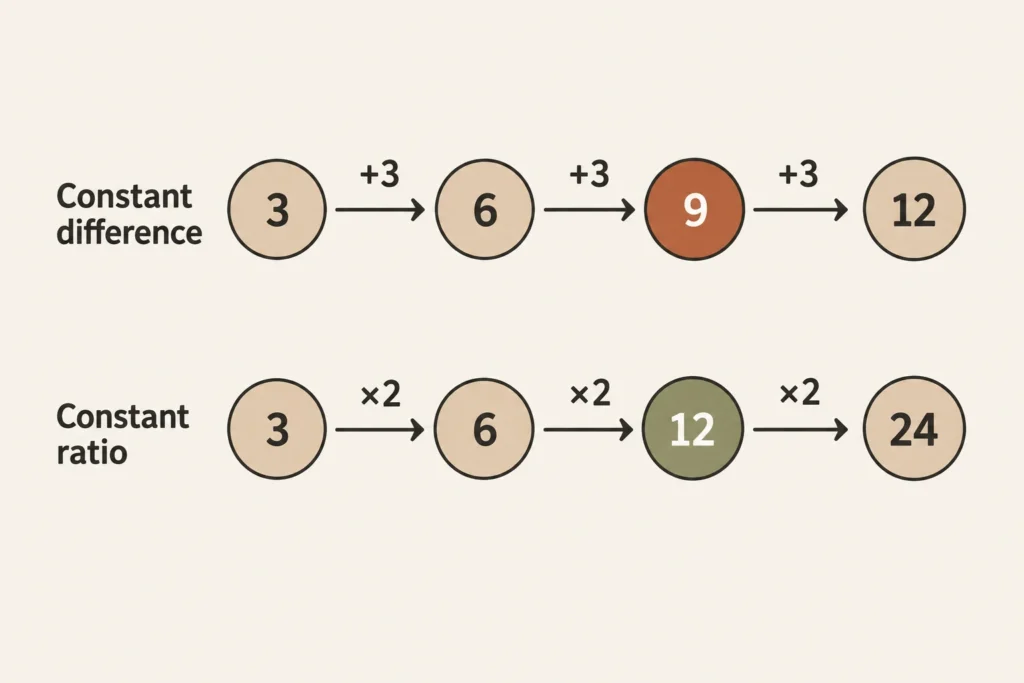
A has a common difference of 3: Use the formula a_n = a_1 + (n, 1)d , which gives a_6 = 3 + 5 × 3 = 18. B has a common ratio of 2: Use the formula a_n = a_1r^(n, 1) , which gives a_6 = 3 × 2^5 = 96. If there were a heading above these two that said “Arithmetic Sequences”, it would inform the solver’s choice for problem A. Without that hint, figuring out that the differences don’t match the ratios would be part of the problem. These solutions also depend on what pattern families have been taught; listing only finitely many terms does not uniquely specify a continuation.[4]
Locate the first unsupported decision
Let’s say you got 18 for your answer to B. That doesn’t prove you got it right. Keep your work isolated from hints. If you wrote “difference = 3” based on the first two terms, then another hint is that 6 to 12 has an increase of 6 not 3. The relationship you chose does not match with what is given. The math could be right, while your choice is incorrect.
Now let’s consider what occurs when selection is reinforced. On a similar blank problem asking you to enter the sixth term of 5, 15, 45, 135, type only “use a geometric-sequence rule,” without providing the formula or answer. If you spontaneously respond with 5 × 3^5 = 1,215, then selection should be examined. If you know the common ratio but don’t remember the formula, memory can also be at fault. If your formula and substitution are accurate but you don’t get the right answer, then implementation may need fixing.
| Observed failure | Likely practice need | What to check next |
|---|---|---|
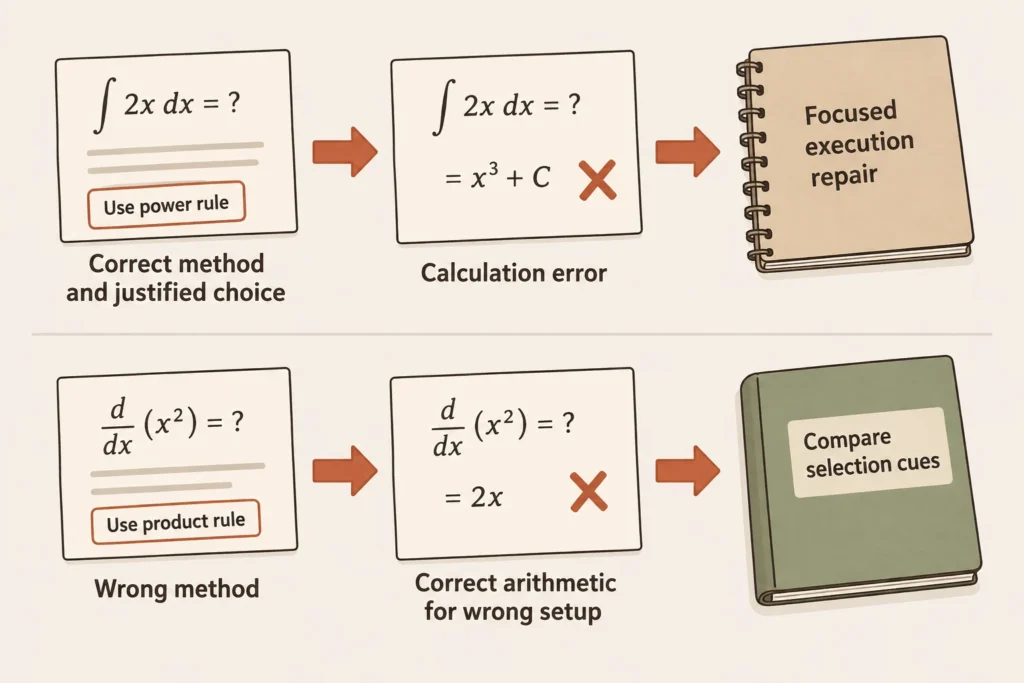
| Wrong method; the work becomes correct when the method is named | Distinguish confusable problem types | Choose and justify methods on fresh, unlabeled questions |
| Correct relationship identified; formula or required conditions unavailable | Retrieve the specific method and its conditions | Recover them without notes, then solve a fresh problem |
| Correct method and setup; calculation or procedural steps fail | Focused execution practice | Locate the faulty step, repair it, then return to mixed questions |
Note: This is intended as a troubleshooting guide, not a standardized test. Calling a function will prime recall as well as eliminating choice pressure, and one correct cued problem doesn’t mean much. Repeat until you see the same phenomenon with similar problems. Errors can reflect multiple gaps; repair the earliest unfounded choice, then examine what fails.
Mix methods when choosing is the bottleneck
Whenever you remember and are able to perform the appropriate techniques when called upon, begin practicing mixing those styles you learned. You don’t have to have it down chapter-perfect the first time through. If you find that a specific technique is consistently unavailable or undependable to you despite being able to identify it, continue drilling that specifically. Randomly practicing moves you do not know or cannot identify makes it difficult to recognize if your issue is selecting the right thing or knowing what to do.
Create a practice set with questions aligned to the course from types of problems you actually mix up. Omit section titles, strategy names, and a logical order of problem types. Include real information: units, graphs, given assumptions, and any formulas allowed on test day. Record the strategy and then the information that tells you why you can use that strategy before you solve. For the pair above, “the terms have a constant ratio across successive terms” is a reason; “it looks geometric” is not. Corrections should comment on both the selection and the work.
It’s important to note that this deliberate interleaving isn’t just mixing algebra and history. The important thing is to vary practice so students experience different retrieval or spacing requirements. Practice that encourages discrimination is one theory for why interleaving works, but classroom schedules can vary spacing and retrieval requirements as well. A classroom mathematics study providing randomized support for mixed practice does not prove all initial blocked practice must vanish, nor that mixing creates more learning minutes.[1][3]
The evidence is dependent on the task. Meta-analysis revealed small pooled benefits for mathematics tasks, mixed results for expository text, and a benefit for blocking in word-based learning studies. The strongest evidence in classroom settings that we’ve seen is for seventh-grade math. Not every college-level assessment. Recommend mixing if your course regularly requires students to choose among methods they’ve learned, rather than conceiving of mixing as an across-the-board improvement.[1][2]
Check improvement on fresh questions
Keep a set of unseen, blank questions of similar format and level of difficulty. Take these questions after some time with the allowed materials for the exam. Write down your defendable choice separately from the answer. You may know the answer to repeated questions; knowing the answer and being unable to defend a choice is not evidence of closing the gap between the two.
Improved decisions with similar final-answer accuracy suggest leftover retrieval or implementation errors. Persistent incorrect selections should be met with analyses of what cues differentiated techniques rather than further drilling of a single technique. When your mixed practice is already quite robust but testing performance is still lacking, consider if practice aligns with the testing conditions of timing, scoring, and format; technique choice may not be your limiting factor.
Sources and references
- Journal of Educational Psychology; consulted published paper hosted by Addvance Maths: A Randomized Controlled Trial of Interleaved Mathematics Practice (2020-01)
- Psychological Bulletin; PubMed record: Similarity matters: A meta-analysis of interleaved learning and its moderators (2019-09-26)
- Educational Psychology Review: Spacing and Interleaving Effects Require Distinct Theoretical Bases: a Systematic Review Testing the Cognitive Load and Discriminative-Contrast Hypotheses (2021-03-26)
- OpenStax, Rice University: Chapter 13 Key Concepts, Algebra and Trigonometry