

A complete restart usually wastes time on material you already know while current assignments keep moving.
Start with the syllabus math
Use the grading policy rather than the large percentage displayed in your learning platform. A running grade may exclude ungraded work, and weighted categories behave differently from a simple points course. Write down the passing threshold, course weights or total points, completed scores, remaining assessments, and any rules about dropped scores, replacements, curves, or minimum exam averages.
Suppose passing requires 70%. The first exam is worth 20% and you scored 48%, giving you 9.6 course points. A completed lab component worth 10% has an 80% score, adding 8 points. You have earned 17.6 course points, with 70% of the course still available. You need another 52.4 points, so your required average on the remaining work is 52.4 divided by 70, or about 74.9%. That is demanding, but mathematically possible.
Now change one policy detail. If the syllabus also requires a 70% average across exams, and exams together make up 70% of the course, you need 49 course points from exams. After earning 9.6 on the first one, you need 39.4 of the remaining 50 exam points, an average of 78.8% on the remaining exams. Strong lab work cannot erase that requirement. If your calculation demands more than 100%, verify it with the instructor and check whether a listed replacement or dropped-score rule applies; without such a policy, the course may no longer be mathematically recoverable.
I once copied a running percentage onto a sticky note, then noticed every blank future item had disappeared from the calculation. The percentage looked precise and answered the wrong question. Writing the weights first is less elegant, but considerably more useful.
Where did the points go?
Review the returned exam, rubric, answer key, and comments. Label lost points by the reason the answer failed. One mistake proves little; repeated patterns and large point losses deserve attention.
| Point-loss pattern | What the exam shows | Useful repair |
|---|---|---|
| Knowledge | You could not recall a needed fact, definition, formula, or concept. | Attempt short closed-note retrieval, then correct it from course material. |
| Application or method | You knew the concept but chose the wrong method or could not use it in a changed problem. | Practice altered examples and explain why each method applies. |
| Interpretation | You missed a qualifier, direction, command verb, or required part. | Paraphrase prompts and mark constraints before answering. |
| Pacing | Later questions were blank or rushed despite being within reach. | Use timed mixed sets and set checkpoints for moving on. |
| Execution or test conditions | Correct reasoning was followed by transcription, arithmetic, navigation, or checking failures; unusual conditions may also be relevant. | Use a brief checking routine for repeated slips. Recreate realistic conditions before assuming stress, illness, or the environment caused the result. |
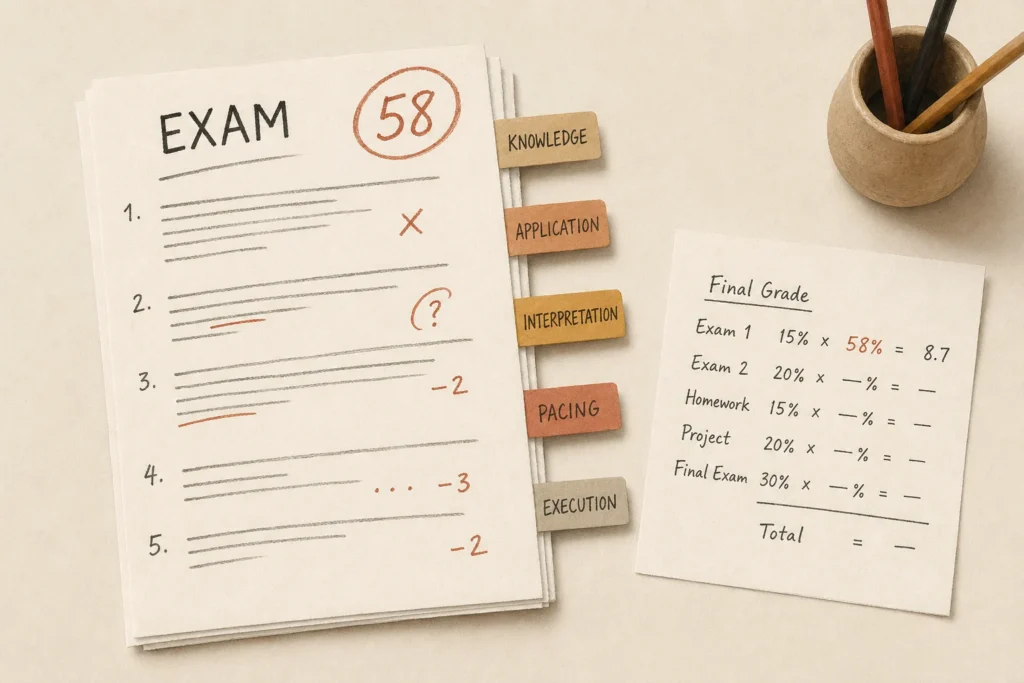
In the 48% example, suppose 22 points were lost on application questions, 14 disappeared in an unfinished final section, 8 came from missing knowledge, and 8 were scattered interpretation or execution errors. The first repair targets are application and pacing because they account for 36 points and are likely to appear again. That leads to a narrower plan: solve changed versions of the application questions and complete one timed set that includes a long final problem. Rereading every chapter gives equal attention to unequal losses.
This kind of structured post-exam reflection is often called an exam wrapper. It can organize your decisions, although research has not established that the reflection alone reliably raises grades. Its value here is choosing what to practice next.[6]
Begin corrections by attempting the question again before opening your notes, then compare your answer with the rubric, key, or instructor feedback. Controlled experiments have found benefits from retrieval over repeated study for delayed retention, and from feedback after an attempted answer. Those experiments used prose passages and general-knowledge questions, so they support the attempt-then-feedback sequence rather than promising a cure for every exam problem.[4][5]
Prepare for office hours
Bring the syllabus, returned exam, rubric or comments, your grade calculation, the point-loss labels, and one or two attempted corrections. Ask the instructor or teaching assistant to inspect something specific: “Did I choose the wrong method here, or apply the right method incorrectly?” “What was missing from this response?” “Which assigned problems are closest to the next exam’s expected level?” You can also confirm how the course grade is calculated and whether your recovery estimate matches the policy.
Avoid leading with a vague request to help you improve or an assumption that points should be returned. If you find a specific scoring discrepancy, follow the course’s regrade policy. Otherwise, use the meeting to check your diagnosis and obtain better practice targets.
Keep the current course moving
Protect the next required assignment and current lecture work before adding exam repair. For the hypothetical student with a problem set due Friday, the coming week might include the problem set as planned, a 35-minute session to redo two application errors and create one altered version, a 25-minute timed set later in the week, and a 15-minute retry after feedback. Each block has an output; none is labeled simply “review exam.”
At the end of the week, record what changed: how many methods you selected correctly, whether you reached the final question, and which errors remained. If office hours reveals that an apparent application problem was really a prompt-interpretation problem, relabel it and change the next practice block. The first diagnosis is allowed to be wrong; the next plan should use the better evidence.
Sources and references
- University of Hawaiʻi: How are grades calculated in Gradebook Classic?
- Carnegie Mellon University Student Academic Success Center: I don't know how to best prepare for and take exams.
- Cornell University Learning Strategies Center: What To Do When You Get Your Graded Test (or Essay) Back
- Psychological Science / PubMed: Test-enhanced learning: taking memory tests improves long-term retention (2006-03)
- Journal of Experimental Psychology: Learning, Memory, and Cognition / PubMed: Correcting a metacognitive error: feedback increases retention of low-confidence correct responses (2008-07)
- Psychology Learning & Teaching: Do Exam Wrappers Increase Metacognition and Performance? A Single Course Intervention (2017)