

The tempting response to several missed classes is to open the oldest recording at minute zero and reconstruct the absence in sequence, but the course keeps moving, so the assignment due Friday becomes another piece of overdue work while you’re still watching what happened last Tuesday. I once caught myself numbering a folder of lecture files without checking what was due, and the useful realization was almost embarrassingly simple: a crowded downloads folder isn’t a to-do list, and the number of files tells you nothing about their priority.
You are rejoining a course, not rescheduling one study block
One missed personal study session can often move to another day. Several missed classes may also involve attendance rules, announcements, graded activities, group obligations, and explanations that upcoming work assumes you heard, so use a different decision rule: recover the requirements attached to the nearest class, assessment, or course policy, leaving lower-priority detail until it blocks something important.
Build a 48-hour recovery map before opening recordings
I get frustrated when a reassuring hour of content review hides a grade or participation problem that still needs action, so map that problem, the knowledge required soon, and whatever can wait.
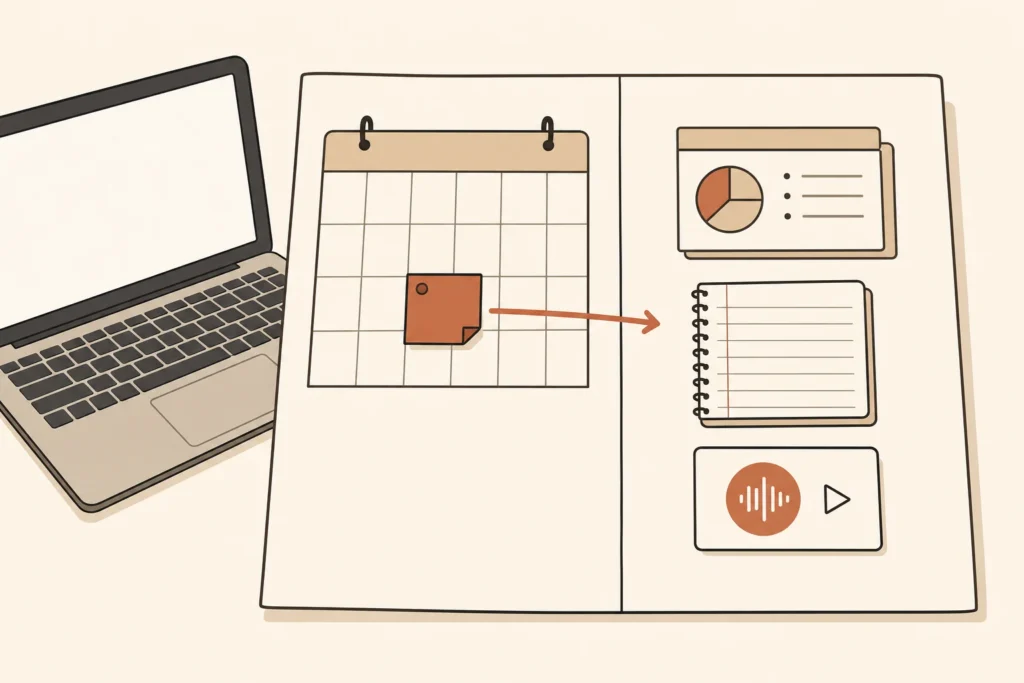
- Recover the official facts. Check the syllabus, course calendar, LMS announcements, gradebook, and assignment pages for each affected course. Record only the missed class dates, due or makeup work, attendance or participation consequences, and the next assessed task.
- Sort each item into one of four layers. Administrative recovery covers forms, messages, attendance, and makeup arrangements. Assessed work includes anything graded or required. Core concepts are the ideas or skills needed for upcoming work. Lower-priority details are examples, readings, or explanations that can wait without blocking the course.
- Send a message only when a policy, missed assessment, extension, accommodation, or non-replaceable activity needs a decision. Name the course and missed date, state what you have already checked, identify the unresolved issue, and ask for the smallest decision you need. For example: “I reviewed the LMS announcement and slides from October 8. I’m unclear whether the in-class exercise must be made up before Friday’s assignment. Is there a replacement task?”
If you have approved absence accommodations, use your institution’s established communication process when you are able. A prolonged absence or difficulty communicating across several courses may also require coordination through the relevant accessibility or student-support channel.
Rebuild the smallest usable version of each urgent lesson
A missed lesson is caught up enough when you can name its main topic or skill, identify any assessment-linked rule or task, follow one representative example or process, and list the questions that still block you. That is a more useful finish line than “watched the recording,” which describes consumption rather than capability.
| Source | Use it for | Do not expect it to do |
|---|---|---|
| LMS and syllabus | Official dates, rules, tasks, and posted materials | Recreate class explanation or discussion |
| Recording or slides | Instructional sequence, demonstrations, and examples | Decide what is urgent without checking current work |
| Peer notes | Class emphasis, examples, and unposted context | Confirm a binding deadline or grade rule |
| Reading or textbook | Repair a specific concept or prerequisite | Reveal what the instructor emphasized |
| Instructor or TA | Resolve one consequential ambiguity | Recreate several classes by email |
Official materials establish dates and requirements, and one additional source should close the remaining gap: a recording for explanation or sequence, peer notes for class emphasis and examples, or a reading for a specific concept. Recording marathons particularly annoy me because they look complete while postponing the moment when you discover whether anything became usable, and copied peer notes create the same illusion, so verify every deadline, grading rule, and requirement against official course materials.

End catch-up work with proof that it supports the next task
Close the materials and produce something from memory by explaining the concept, solving one representative problem, outlining the argument, or rehearsing the course-specific skill, and if the needed move still breaks down, repair that narrow link rather than restarting the entire lesson.
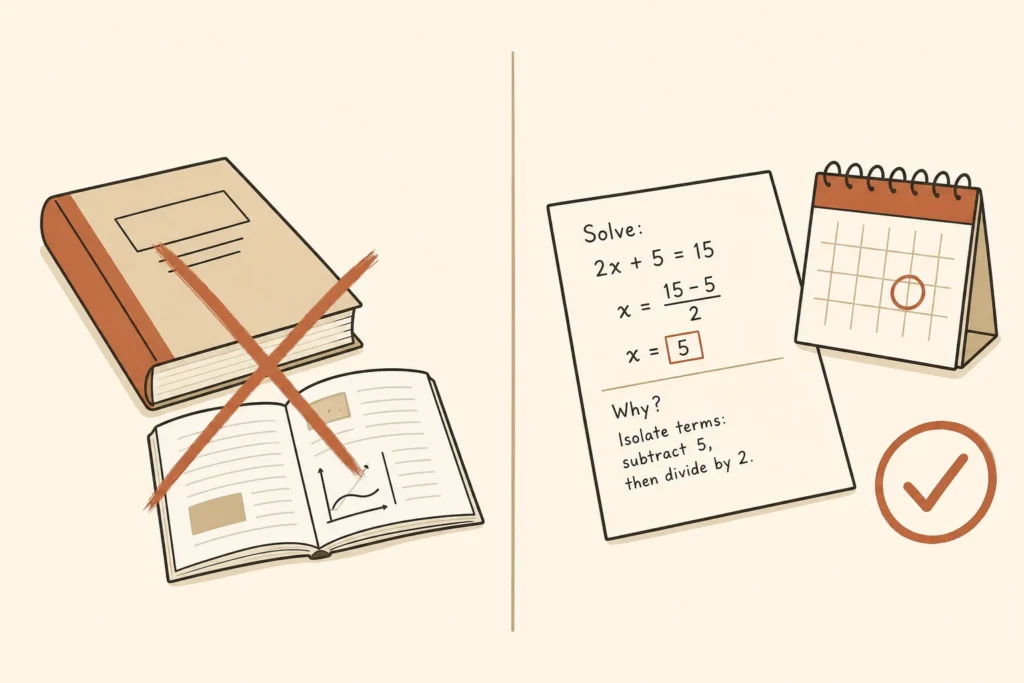
One brief revisit on a separate day matters if the course will build on or assess the material again. Retrieval plus another attempt gives you better evidence than rereading alone, but the output should match the subject: problems for quantitative courses, explanation and comparison for conceptual courses, and course-specific rehearsal for performance or practical skills.
Do not let the current week become the next backlog
Current work gets protected space each day: reserve time for anything due soon or needed for the next class, and add only one finite catch-up output. An old concept required for tomorrow’s work counts as current preparation, but “finish all missed lectures” has no usable stopping point and does not belong on a daily plan.
- Identify the three steps in the missed method, then redo one example without notes.
- Read the announcement, submit the required form, and write down two unresolved questions.
- Watch the recording segment tied to Friday’s problem set, then attempt problems 1 through 3.
I find this stop rule satisfying: when you can complete the next required task and rejoin current instruction, move leftover detail to a later-review list. A plan that fills every available evening with old material is not recovery, it simply moves the absence forward.
Some missed work needs action before it needs studying
Your finish line for the next 48 hours is not an erased past. Come back with an accurate map, one protected current commitment, and one repaired bridge into the work ahead.
Sources and references
- Cornell University: Cornell Student Disability Services, Temporary Disabilities
- University of Massachusetts Amherst Disability Services: Disability-Related Absences FAQ
- University of Illinois Urbana-Champaign Student Success: Attendance Matters
- Cornell University Center for Teaching Innovation: Canvas
- Psychological Science in the Public Interest via PubMed: Improving Students' Learning With Effective Learning Techniques: Promising Directions From Cognitive and Educational Psychology (2013-01-01)