
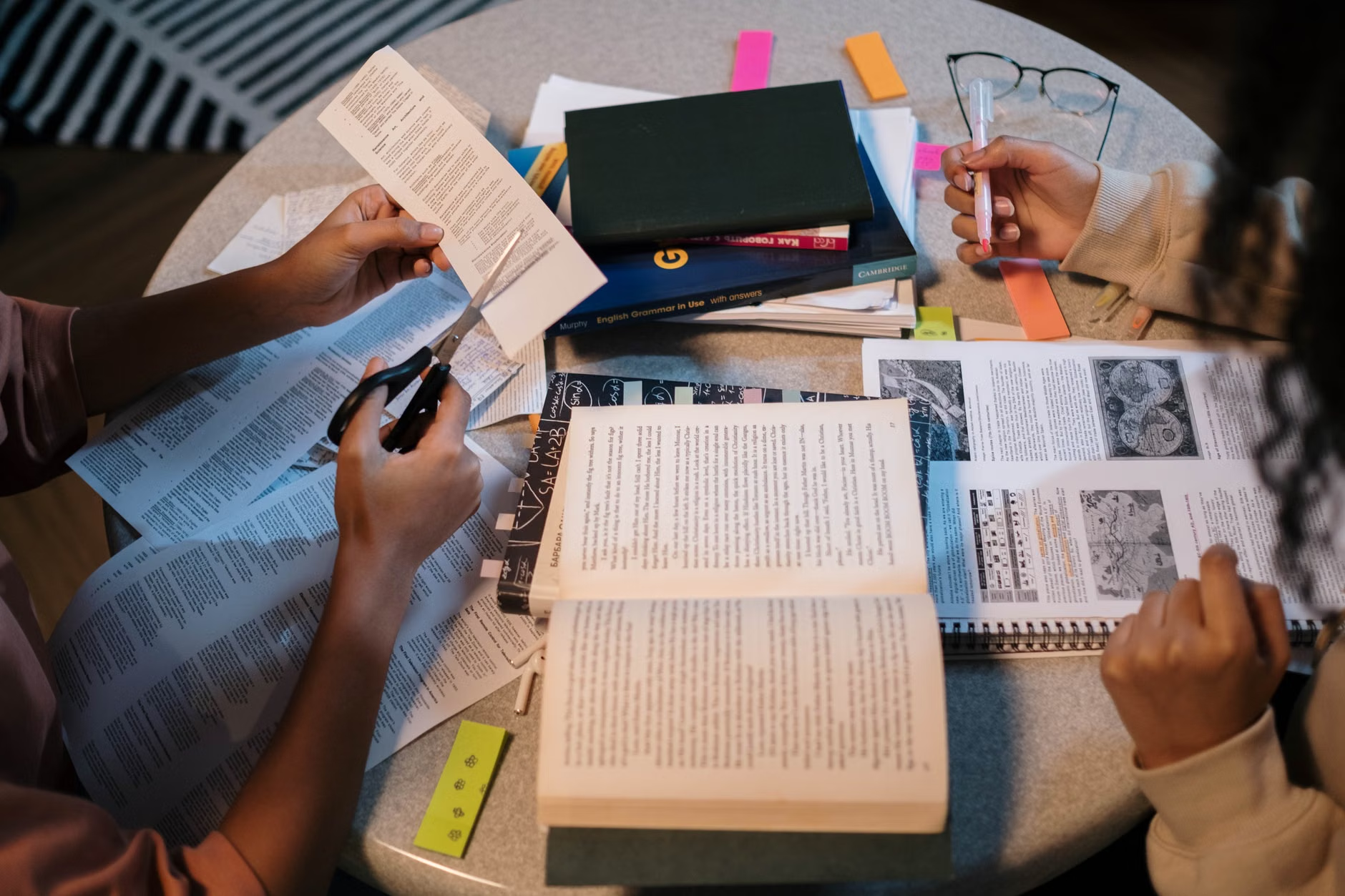
A thoroughly highlighted chapter can feel reassuring right until you close it and realize you can’t explain what mattered. The problem isn’t that you cared too much or read too slowly, it’s that marking sentences became a substitute for deciding what the reading needed to produce.
Highlighting works reasonably well as a locator, but it’s unreliable as the main learning activity unless those marks lead to recall, explanation, evidence, or analysis. I dislike the usual response to this problem, which is simply to “skim more,” because that replaces one vague instruction with another and does nothing about the fear that you’ll miss the important sentence.
Decide what the reading must produce before you begin
Complete this sentence before opening the text: “By the end, I need to be able to…” Your answer determines whether you preview the structure, read selected explanations closely, collect evidence, or slow down over a bounded passage.
| Purpose | How to read | Useful exit product |
|---|---|---|
| Orientation | Preview headings, introduction, conclusion, figures, and summaries | Two or three anchors about topic, structure, and relevance |
| Comprehension | Read the necessary explanations closely and pause between chunks | A brief explanation from memory plus two or three questions |
| Evidence | Search for relevant claims, results, examples, or quotations | Claim, precise evidence, location, and why it matters |
| Close analysis | Reread a limited passage for wording, structure, assumptions, or omissions | Interpretation supported by specific textual details |
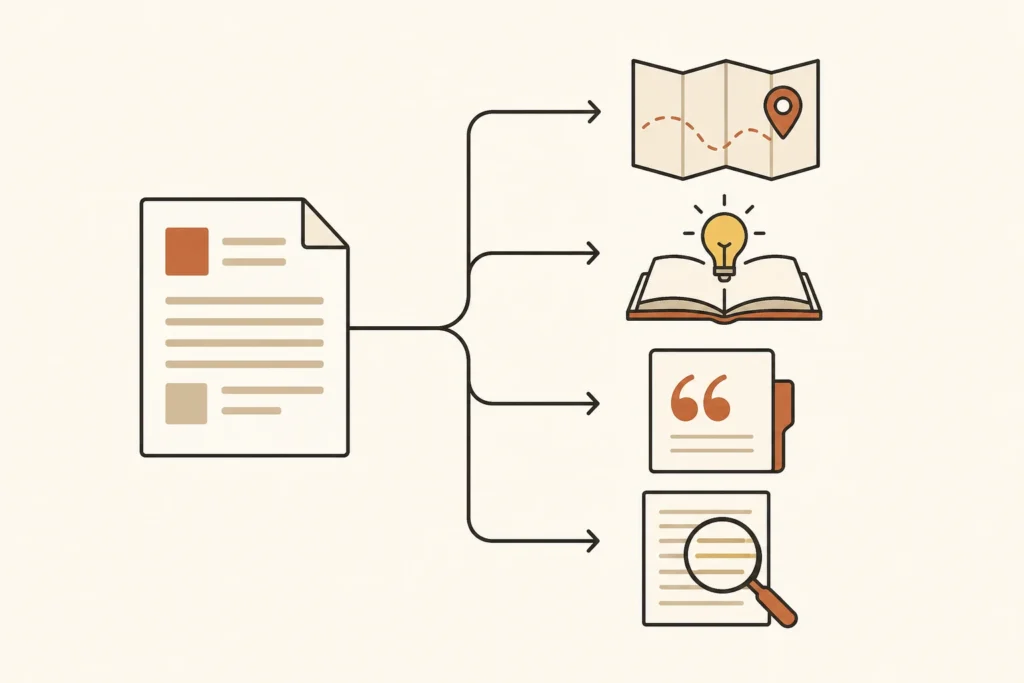
An instructor’s question overrides your default purpose: a prompt about how an author defines justice on pages 40 to 46 requires close reading there, not equal attention across the chapter.
Annotate only what has a job later
Before you highlight, give the passage a short job label such as “claim,” “why,” “evidence,” “question,” or “confusing.” Mark the smallest amount needed to find the idea again, and if you can’t explain what you’ll do with a mark later, leave the sentence alone.
I once caught myself highlighting three consecutive paragraphs because each sentence seemed to clarify the one before it. The result was a yellow rectangle with no useful entry point, so I kept one sentence, wrote “why the policy failed” beside it, and turned the rest into a question I could answer without looking.
After a section, close the text and write one to three questions it should now help you answer, perhaps about the stages in a process or why the author rejects an earlier explanation. That gives you something useful to retrieve later and exposes what you can’t yet explain.
Use a different route for each kind of reading
For a textbook, build questions around concepts and processes
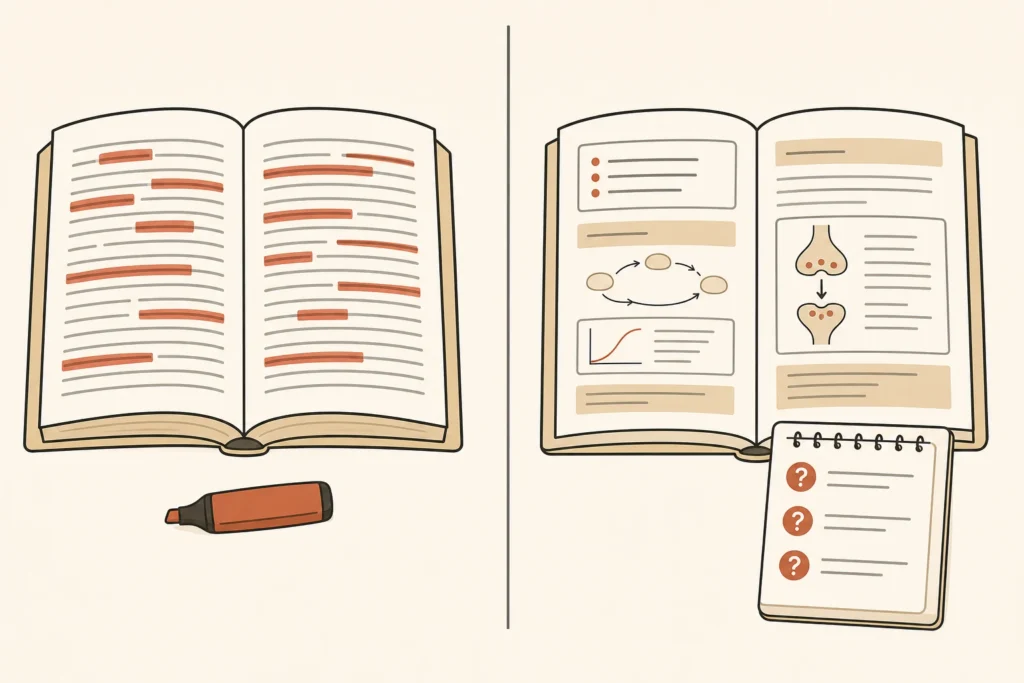
Start with the learning objectives, headings, diagrams, worked examples, and section summaries, then read closely where you need the explanation connecting those pieces and build questions about how a process works, how two mechanisms differ, or what happens if one stage fails. I like this route because it gives the chapter a shape before the details start competing for attention, and you can stop once you can answer the central questions and name any remaining gap.
For a scholarly article, follow the argument and the evidence
Use the title, abstract, introduction, conclusion or discussion, and figures to locate the research question, main claim, and relevant evidence, but change the order when the assignment demands it, giving methods close attention when you’re evaluating study design and spending more time on the argument, limitations, and results when you’re comparing conclusions. I’m not a fan of treating every article section as an equal obligation, because a cleaner record is the claim, the supporting result or passage, its location, and one sentence about why it matters.
For a primary source, treat wording and perspective as evidence
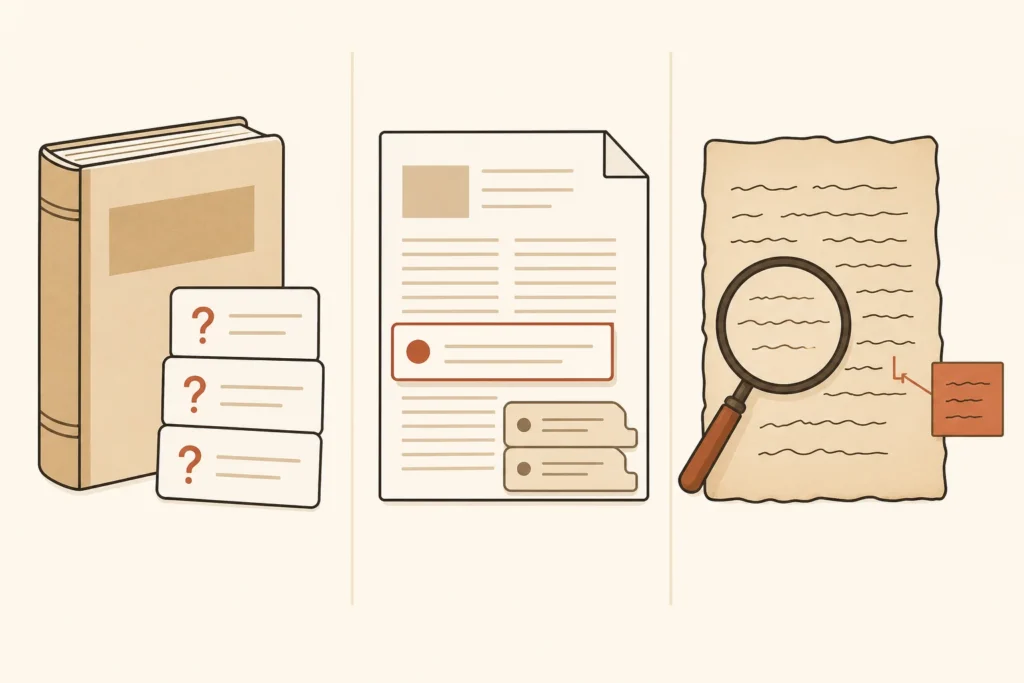
A letter, speech, legal opinion, or historical image isn’t merely a container of facts, so note who created it, for whom, for what apparent purpose, and in what context, then mark revealing language, assumptions, contradictions, or omissions. I find one well-supported observation much more satisfying than a page of underlining, especially when the note connects an exact phrase to an interpretation you could defend in class.
Use a time boundary without abandoning comprehension
Set the available block before starting, but make the boundary about output rather than pages. In a 45-minute block, for example, you might reserve the final 10 minutes to close the text, answer your questions, and identify one gap instead of highlighting until the clock runs out.
- Name the purpose and minimum exit product, such as three retrieval questions or one claim with two pieces of evidence.
- Use the first pass to complete that product, moving quickly through low-relevance sections and slowing down where the task requires explanation or analysis.
- Close the text and try to answer, explain, or reconstruct what you collected.
- Return only to the exact blockage, then update the answer or note instead of rereading from page one.
When you can’t complete the exit product, name the blockage: unfamiliar vocabulary, missing background knowledge, an unclear process, or two competing interpretations. I find that narrower diagnosis much less frustrating because it tells you what to reread, while “I didn’t understand the chapter” sends you back through everything and often produces the same confusion in brighter colors.
Read more closely when a passage is assigned for analysis, repeatedly emphasized in class, tied directly to an assessment, or something you plan to quote. Otherwise, let the stopping rule be simple: finish with a small set of ideas you can retrieve or use, not proof that every sentence received equal attention.
Sources and references
- Association for Psychological Science / PubMed: Improving Students’ Learning With Effective Learning Techniques: Promising Directions From Cognitive and Educational Psychology (2013)
- Science / PubMed: Retrieval Practice Produces More Learning than Elaborative Studying with Concept Mapping (2011-02-11)
- Institute of Education Sciences, What Works Clearinghouse: Organizing Instruction and Study to Improve Student Learning (2007-09)
- University of Toronto OISE Academic Skills Hub: How to Read Academic Articles
- George Mason University Libraries: Reading a Scholarly Article
- Library of Congress: Getting Started with Primary Sources